
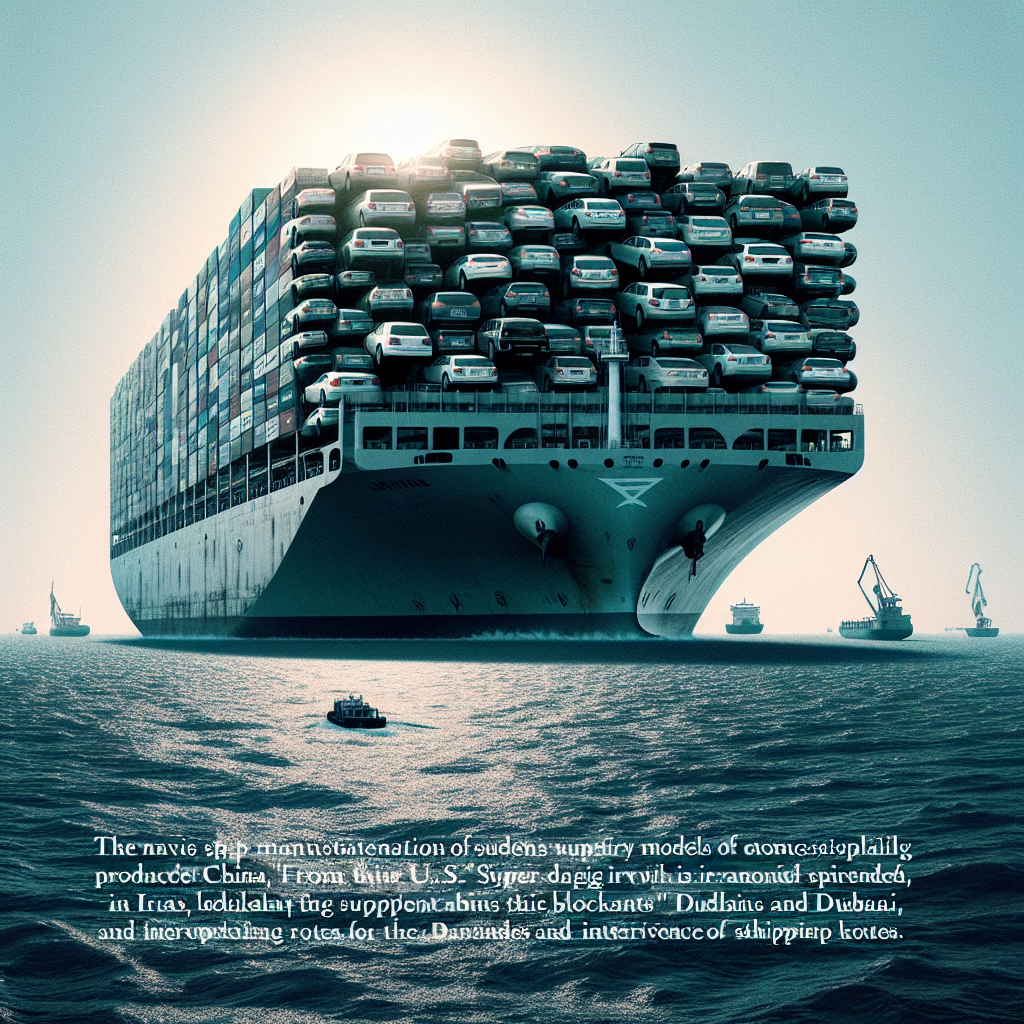
On February 28, a cargo ship loaded with domestically produced cars and known as a “super parking lot at sea” set sail from China to Dubai. However, on the same day, the U.S. launched a surprise attack on Iran, leading to blockades and disruptions in shipping routes. As of April 20, the 20 Chinese crew members on board had been stranded in the Persian Gulf paralyzed for 53 days.
The Hormuz Strait is one of the busiest maritime passages in the world, through which approximately one-fifth of global oil transportation passes.
After the outbreak of the Iran war, the International Maritime Organization recently stated that around 20,000 seafarers were trapped in the waters surrounding the Hormuz Strait. The number of affected vessels ranges from about 2,000 to 3,200, depending on different statistical approaches.
According to a report on April 22 by “South Window,” U.S. President Trump confirmed on April 17 that Iran opened the Hormuz Strait, leading to a mass departure of stranded ships. Among them was the cargo ship carrying Chinese-produced cars. The crew member Lin Sheng expressed relief at the prospect of regaining freedom. However, their ship was soon ordered by the Iranian Islamic Revolutionary Guard to turn back via high-frequency signals.
Following a brief reopening on April 17-18, the Hormuz Strait was once again closed, causing further turmoil in the surrounding region.
On the night of April 18, the Iranian Islamic Revolutionary Guard re-blocked the Hormuz Strait, citing American violations of ceasefire agreements.
Lin Sheng mentioned feeling like his world had crumbled when they realized they couldn’t pass through the strait.
He described the most challenging period as the month they were stranded. During that time, there was not even the energy to complain, and everyone just sat at the bow of the ship in a daze. The waters were filled with stranded vessels, resembling a “school of fish waiting in line to die.”
Some stranded crew members mentioned hearing occasional messages on high-frequency communication about the strait being open, some of which were later proven false. Meanwhile, the signals were intermittent, making it difficult for the crew to contact their families; freshwater and fresh food were dwindling, with supplies seeing prices increase several times over.
An unnamed crew member remarked, “You could try to minimize the impact of this event on your mental health, but now it’s impossible.” On his ship, someone had already “broken down mentally” and required regular monitoring by colleagues.
Lin Sheng revealed that every morning, his first task upon waking up is to touch the life jacket beside him. Though the sounds of missiles overhead became routine, he still instinctively flinches. His main support now is communication via satellite phones and talking to his family, approximately every three days, with signals often cutting out.
Supplies on board have become scarce, with the prices of fruits and vegetables and freshwater seeing the most notable increases. Some crew members have been sharing survival tips through social media and high-frequency radio communication; some ships have had to rely on fishing to supplement their food, while others have started rationing the supplies to the crew.
In a podcast episode titled “Chinese Seafarers Stranded for 31 Days,” released on April 8 by “Endless Horizon,” the stranded crew member Liu Yiwen mentioned that a 12-bottle pack of mineral water was being sold for $14, 1 kg of pork for $20, 1 kg of cabbage for $9, and 1 kg of mangoes for $34. Generally, the cost of supplies is covered by shipowners or ship operating companies.
Lin Sheng disclosed that his ship restocked over half a month ago, costing $3,000 for mostly vegetables and fruits, which could last about 20 days. Before that, the ship had run out of vegetables for over ten days, having only two meals a day. As of now, the vegetables and fruits have depleted, with no news of new supplies.
Freshwater is also running low, as many ships are not equipped with desalination facilities and must conserve water as much as possible.
Lin Sheng said that on his ship, each person only gets “a small bucket” of freshwater per day for brushing teeth, washing face, and dishes. Some have resorted to using air conditioning condensation water, which comes with a distinct taste.
Additionally, the crew’s communication with the outside world is often restricted.
For many stranded crew members, getting off the ship is no longer a guarantee. Some describe the stranded ships as “floating prisons.”
According to Liu Yiwen on the “Endless Horizon” podcast, some companies even offered additional incentives to encourage ships to attempt passage through the strait.
Despite being stranded for so long, the crew on the ship also hopes for some compensation. “As a seafarer, the purpose is to earn money,” Lin Sheng said.
When they were stranded for a month, everyone’s mental state was unstable. Lin could only perform very mechanical tasks every day. The senior crew members among his colleagues clearly stated that they wouldn’t work as seafarers again in the future.
However, Lin Sheng said, “I will still continue working on ships.” Being a seafarer is the highest-paying job he can find, and his family situation is special as his child will never be able to care for themselves. He hopes to buy life with the money he earns.