
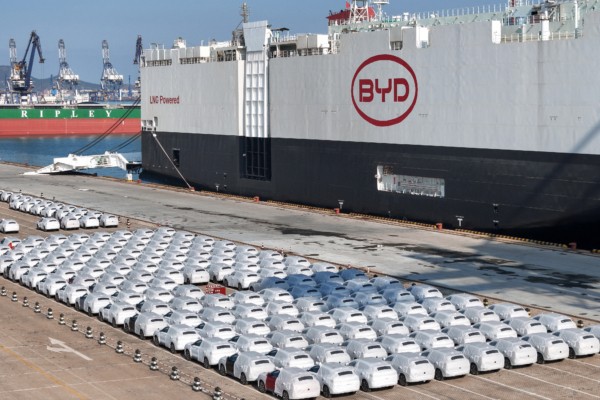
The price war in China’s new energy vehicle industry continues to escalate, with companies relying on low prices to grab market share, squeezing profit margins. Zheng Yongnian, the Dean of the School of Public Policy at the Chinese University of Hong Kong (Shenzhen), stated that in his judgment, internal competition is like collective suicide, with no one emerging as the winner.
Recently, it was revealed that Nezha Automobile’s parent company, “He Zhong New Energy,” has accumulated losses of 18.3 billion yuan over 3 years, and concerns have been raised about potential failure of state-funded investments in various regions.
During a recent interview with mainland media “Shangguan News,” Zheng Yongnian remarked that more than ten of the best car manufacturers in China may not have a combined profit as much as a single company. “Everyone holds the mindset that whoever can persevere until the end will be the winner. It’s just not exciting.”
When asked about the deeper reasons for “internal competition,” Zheng Yongnian mentioned that local governments in China “lack independent thinking, follow the crowd, rush to follow others without considering the conditions, and even if there are no conditions, they still charge ahead. Internal competition is collective suicide, with no one emerging as the winner.”
According to CCTV reports, the number of Chinese new energy vehicle brands once exceeded 300, partly due to blind investments made by some local governments. Companies like Highsee, Bitauto, and Borui, among others, have faced bankruptcy and restructuring, with these new energy enterprises receiving investments from local state-owned capital during the financing process.
The once prominent new energy vehicle “dark horses” listed on the charts now find themselves in bankruptcy predicaments, with their vacant factories and idle production lines not only marking the burst of a car manufacturing bubble but also trapping hundreds of millions of state capital invested in places like Yichun, Jiangxi, and Nanning, Guangxi in difficult to recover situations.
The collective price-cutting trend in China’s new energy vehicle sector has intensified since 2023. In that year, the leading domestic new energy vehicle company, BYD, announced price reductions, with new forces like Weixiaoli following suit.
In February 2024, BYD boldly declared “Electric (Cars) are cheaper than Gas (Cars),” and within two weeks, over ten flagship models saw the release of their glory versions, with the largest price reduction exceeding 30,000 yuan.
Within 12 hours of the release of the glory versions, companies like Nezha, Changan Qiyuan, Wuling, Beijing Hyundai, SAIC-GM, and others quickly joined in: Wuling’s Starlight PLUS dropped from the previous 105,800 yuan to 99,800 yuan; Changan Qiyuan’s A05 official guidance price was reduced from 89,900 yuan to 78,900 yuan; various flagship models under Nezha Automobile all saw price cuts, with the highest reduction reaching 22,000 yuan; Deep Blue Auto launched the SL03 and S7 glory versions, with a decrease of 10,000 yuan.
In April 2024, the release of Xiaomi SU7 sparked the “catfish effect,” leading brands like Xiaopeng, Wenjie, Jikai, Jiyue, and Haobo to either reduce prices or introduce limited-time benefits, while FAW Toyota, Chery, Geely, NIO, and other companies all introduced replacement subsidies.
According to data from the China Association of Automobile Manufacturers, in the first five months of 2024 alone, 136 models were reduced in price, exceeding 90% of the total price reductions for the entire year of 2023 and surpassing the total price reduction for the entire year of 2022.
After multiple rounds of price reductions, in August 2024, a BYD model announced a direct reduction of 50,000 yuan.
Some reflect on 2024 as the year of the most intense price competition in the new energy vehicle sector.
Many new energy vehicle companies are lamenting this internal competition. “The more we sell, the more we lose. Selling more means losing more” is the sentiment shared by many car companies.
In the first quarter of 2024, Guangzhou Automobile Group achieved a net profit attributable to the parent of 1.22 billion yuan, a 20.65% decrease compared to the previous year. At that time, Chairman of Guangzhou Automobile Group, Zeng Qinghong, expressed that “If this continues, with no money to be made, no benefits, companies cannot survive. No company can afford to lose hundreds of billions.”
Some draw comparisons to the motorcycle industry. Years ago, Chinese motorcycle enterprises in the Southeast Asian market engaged in a self-destructive margin-cutting internal competition, some companies sacrificing product quality and user experience. The result of this internal competition was that more expensive Japanese motorcycles emerged victorious, leading Chinese brands to be eliminated from the market.
Industry insiders widely anticipate that as market competition intensifies, the new energy vehicle industry in China may enter a phase of accelerated consolidation. In the foreseeable future, some weaker companies may exit the market.