
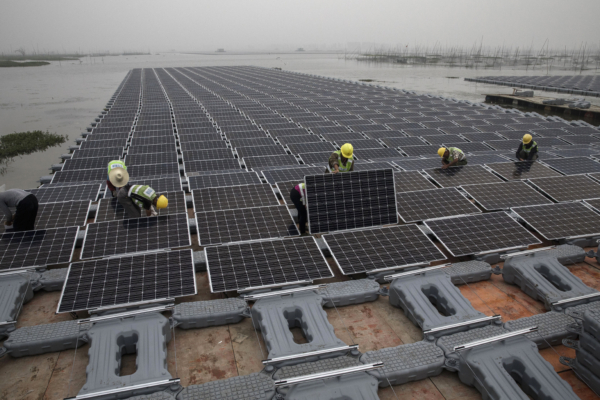
On April 20, the U.S. Secretary of the Interior testified publicly stating that Chinese solar products are flooding the American market, therefore, it is necessary to strengthen the review process to eliminate any potential national security threats from the Chinese Communist Party. In addition, China’s excess solar manufacturing capacity is driving down prices and impacting the U.S. domestic solar manufacturing industry.
Secretary of the Interior Doug Burgum testified before the House of Representatives appropriations panel on April 20 about the 2027 budget of the Interior Department, stating, “Many of these solar projects are almost entirely built with solar panels manufactured in China. Therefore, this is indeed a national security issue.”
When asked if solar energy poses a greater risk than other energy sectors, Burgum mentioned that, in consideration of national security, the U.S. has already imposed bans on most Huawei products.
Studies indicate that 85% of the U.S. grid uses Chinese equipment, such as inverters used to convert solar energy into grid-ready electricity, raising security concerns including remote control, hacker exploitation, and potential backdoor vulnerabilities.
In the global solar manufacturing industry, China controls over 80% of the supply chain, particularly in upstream materials like silicon wafers for solar panels and manufacturing equipment.
The United States was once a leading solar manufacturing nation. However, from 2010 to 2020, the U.S. solar manufacturing industry was nearly decimated by the price war of Chinese products – the Chinese government’s subsidies and low-cost financing established a massive solar industry, flooding the U.S. with low-priced solar products, leading to the closure of American companies like the California-based solar company Solyndra. In 2022, the U.S. government began subsidizing to rebuild the solar supply chain.
The Solar Energy Industries Association (SEIA) released its “Solar Market Insight Report” in March this year, indicating that the severe and long-term global solar supply overcapacity is mainly caused by China’s expansion of production capacity, which has now exceeded global installation demand.
“Since most solar panels of U.S. solar companies are procured overseas, the market has been quickly flooded with low-cost panels, threatening the U.S.’s efforts to expand the domestic solar supply chain. In 2024, imported modules exceeded 54 gigawatts, while installations were around 40 gigawatts, prompting calls for increased government intervention through tariffs, trade sanctions, and anti-subsidy investigations for regulation. In the short term, some companies have had to reduce production rates or postpone factory expansion plans.”
Reuters reported on April 15 that China is considering preliminary measures to restrict the export of solar manufacturing equipment to the U.S., but has not yet sought the opinions of Chinese manufacturers on potential restrictions.
China also dominates the global supply chain in rare earths. Rare earths are crucial for industries like electric vehicles, chips, and defense. The Chinese government has repeatedly restricted rare earth exports to exert pressure on the U.S., Europe, and other allies.
Unlike rare earths, China’s solar manufacturing industry has long been facing issues of excess capacity and production, leading related companies to deepen losses over the past two years. China finally began addressing the problem of excess capacity last year. From January to October this year, Chinese manufacturers reduced production of polysilicon by 29.6% and wafers by 6.7%, despite solar cell and finished module production increasing year-on-year.
SEIA’s “Solar Market Insight Report” states, “During the peak of the 2024 solar boom in China, new factories were announced almost weekly, leading to a 50% drop in module prices. In the first half of 2025, the four largest Chinese solar manufacturers, including Longi, JA Solar, JinkoSolar, and JA Solar, collectively reported losses of $1.54 billion.”