
Recently, there has been a suspected fund chain break in the Chinese plastic industry platform “Jinsubo”, involving over 2 billion yuan in payments and hundreds of enterprises. Customers from North China, East China and other regions have gathered in Shanghai for rights protection. Some interviewees revealed that the platform’s collapse may have been triggered by futures trading losses, with some victims suggesting it was due to mismanagement or even deliberate deception.
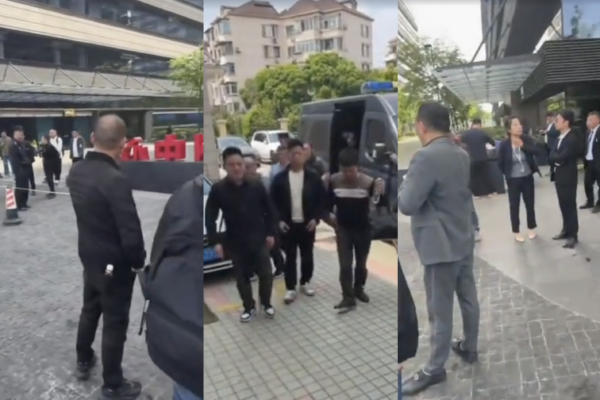
On Monday, April 20th, customers from Beijing, Hebei, Shandong, and other regions gathered at the Shanghai office of Jinsubo for rights protection, with reportedly hundreds of people present.
Lu Junjie, the owner of a non-woven fabric factory in Beijing, described the scene as relatively calm, “No one was crying or making a scene, we just want to know where the money has gone and when we can get it back.”
According to him, there were police and relevant department personnel on-site, and the person in charge of Jinsubo platform was reportedly taken away last Friday, with an investigation initiated, “The results may be announced in two months.”
However, despite the massive fund gap, most people are not optimistic about the future. Lu Junjie said, “The amount involved is too large, I feel it’s very difficult to fully resolve.” Most affected enterprises “only seek to recover the principal, not profits.”
Jinsubo’s official website introduces it as a platform that relies on big data to provide comprehensive B2F2B services to the plastic industry. The platform has a 30-year operating history, over 10,000 manufacturing enterprises, and more than 2,000 logistics drivers.
Once hailed as a “plastic B2B empire” with billions in transactions, Jinsubo has now plummeted from its peak to become one of the largest financial scandals in the history of China’s plastic industry. However, this major event has not appeared in the Chinese media.
Jinsubo had received an A-level tax credit rating from the Chinese tax system, making its business model initially attractive to many customers. Lu Junjie explained, “Jinsubo attracted customers with competitive prices, offering discounts of 50 to 80 yuan per ton, but using a pre-sale model where orders placed today would only be delivered after a month or even a month and a half, with full payment required.”
It was this “low price + full prepayment” model that led to an increase in procurement volume for many enterprises. Lu Junjie said, “We used to buy goods worth 2-3 million yuan (RMB) from them every month, it was quite normal.”
However, behind this business model was a premise: full prepayment and delayed delivery. As cooperation deepened, many companies increased their procurement volume, leading to a growing accumulation of funds with the platform.
Chen Meijuan, the head of a industrial and trade company in Zhejiang, had a similar experience. Her company, with only 7 employees, was affected by payments amounting to about 367,000 yuan.
Though not as large as multimillion-dollar transactions, for small factories like hers, it was still a heavy blow. She told the media, “For a small factory like ours, it’s like a natural disaster, equivalent to a year’s work going to waste.”
Around the Chinese New Year, many manufacturers stockpiled orders, sending a large sum of money into the Jinsubo platform. However, as the delivery deadlines approached, anomalies started to surface.
Lu Junjie told reporters, “When it was time for the deliveries to be made, they kept postponing. We felt something was wrong. Later, our salesperson informed customers to come to the company. Many people were waiting at the door, that’s when we knew they couldn’t deliver the goods.”
Chen Meijuan described how the platform later issued partial shipment commitment letters to some customers, but ultimately failed to deliver, saying, “They wrote commitment letters, but none of the customers received the goods, it was all about buying time.”
Why did Jinsubo collapse? There are various speculations, but interviewees all mentioned the same point: futures trading losses.
Lu Junjie shared the platform’s explanation, “They said, they were involved in futures trading, made losses; and speculated on the market, sold us goods but didn’t restock.” He said the platform took customer prepayments and invested them in futures, using the profits to buy materials for shipping. However, once the market turned, they were unable to restock.
Chen Meijuan had a similar assessment. She said, customers paid based on a 7,000 yuan per ton price, but raw material prices subsequently rose. “There are claims that the company may have lost money by investing customer funds in futures trading, while also having to buy materials at a higher price, leading to losses in two areas which they couldn’t sustain.”
Some victims expressed more doubts, “We paid in full, how could they incur such losses, it’s definitely their own problem.” In the eyes of some victims, this seemed more like mismanagement or even deliberate deception.
From the known scale, the Jinsubo scandal involved a massive amount of money.
Lu Junjie estimated that in North China alone, “Around 1 billion yuan, 70,000 tons of goods are ‘trapped’, involving around 150 enterprises”, with “70% being trading companies and 30% being manufacturers.”
Chen Meijuan stated that the number of registered protesters had reached about 500, with the overall amount possibly exceeding over twenty billion yuan.
The size of individual amounts involved was also staggering. Lu Junjie said, “Some people had transactions worth 50-60 million in one deal, even 280 trucks of goods, almost 80 million. And three companies together have sent over 200 million in payments.”
The impact of the missing payments from Jinsubo has not only affected the directly affected enterprises.
Lu Junjie said, “This money is not just ours, but also the customer’s deposits. Once we can’t recover the payments, the pressure on the financial chain will quickly spread downstream, and our financial chain will break.”
He mentioned that his factory is currently in a semi-production halt state, “We’re not making money, we’re actually losing money.” Regarding maintaining low production levels at the factory, he explained, “One machine costs over ten thousand in electricity per day, shutting down and restarting also costs a lot, so we have to keep working.”
Meanwhile, the increase in raw material prices has further exacerbated costs. Lu Junjie said, “Raw materials used to cost around 5,500 yuan per ton, now it’s around 8,500 yuan.” With orders not coming in, they can only break even or even lose money on shipments.
Chen Meijuan’s company has also come to a standstill. She admitted that this year, foreign trade orders had already decreased due to the China-US trade war, “Now with this from Jinsubo, we’re losing even more”, fearing that some companies may go out of business.
Tax risks have added to the existing troubles. Since many transactions involved paying inclusive taxes to public accounts, with goods not delivered and no invoices, companies are facing unexplainable financial difficulties.
Lu Junjie also mentioned issues in foreign trade business. His company had 11 containers bound for the Middle East, but due to the Iran war situation, the cargo ships had to return midway, resulting in significant losses, “It costs 1,000 yuan per container per day, that’s 220,000 in 20 days, plus repackaging, sending to other countries, total loss is 800,000.”
Faced with all these challenges, many Jinsubo victims have shifted their demands from “delivery of goods” to “accountability”. Chen Meijuan said, “Even if the money is gone, we need to hold the platform accountable.”
Some of Jinsubo’s partners include Sinopec, PetroChina, Sinochem, Xiamen C&D Inc., Yima Group, and China Shenhua. Financial institutions involved include China Construction Bank, Industrial Bank, Ping An Bank, among others.
The collapse of the Jinsubo platform is not an isolated incident. In recent years, a series of financial scandals have occurred across various industries in China, reflecting deeper economic challenges.
In the real estate sector, giants such as Evergrande and Country Garden have faced collapses, triggering systemic liquidity crises. In April 2025, the centralized trust company, Aviation Trust, was put under custody, involving unpaid amounts of hundreds of billions, with many trust companies mired in bad debts from real estate financing projects of Evergrande, Sunac, and more.
In the field of gold financial management, Shenzhen Jinya Fu Holdings Group, a top 500 Chinese company, was reported in December 2025 with its headquarters deserted, leaving numerous gold investors empty-handed.
The banking system is also under pressure, with a wave of mergers and closures among small and medium-sized banks since 2024. In the earlier P2P lending crisis wave, millions of investors lost all their money overnight after the platforms collapsed.
In the case of the Jinsubo incident, perhaps one sentence from Chen Meijuan captures the common plight of many victims: “Now it’s like calling to the heavens with no response, calling to the earth with no echo.”