
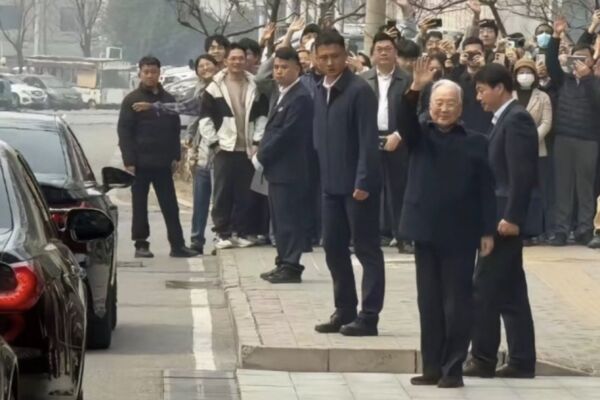
Former Chinese Premier Wen Jiabao recently inspected the Institute of Geography of the Chinese Academy of Sciences, a visit that was suppressed domestically but surfaced on overseas social media platforms with photos initially and later with videos. Wen Jiabao’s appearance in Beijing sparked discussions overseas. Why does his every move often attract significant attention abroad?
On March 27th, photos of Wen Jiabao appearing in public in Beijing began circulating widely overseas, and by the 29th, videos from the scene emerged. While visibly aged with sparse, silver hair, Wen Jiabao still appeared spirited as he waved and greeted the crowd shouting “Hello, Premier.” Since Xi Jinping came to power, retired senior officials have been strictly forbidden from “recklessly criticizing the central government.” Retired former Standing Committee members face strict restrictions when they go out, requiring approval from the Director of the Central Office, Cai Qi. In recent years, it has been rare to see retired central leaders publicly appearing after retirement. Wen Jiabao’s public appearance this time is considered extremely unusual.
Independent commentator Cai Shenkun said on X that Wen Jiabao’s public appearance could also be seen as dispelling rumors. He mentioned that recently, someone continuously sent him emails, alleging that the entire family of Wen Jiabao was under house arrest. They hoped he would repost an urgent appeal letter of over ten thousand words on X platform, mainly claiming that Wen Jiabao publicly opposed Xi Jinping’s unification of Taiwan by force and was subsequently put under house arrest by Xi Jinping in retaliation. However, he believed that based on Wen Jiabao’s past experiences and political wisdom, it was unlikely to have come to such a situation. Information he gathered from some friends in Beijing did not support these claims.
After Wen Jiabao’s appearance, an anonymous source sent an article to The Epoch Times mailbox stating, “We previously exposed Xi Jinping’s attempt to unify Taiwan by force through the U.S. attacking Iran and subsequently house arresting the entire family of Wen Jiabao. This has forced Xi Jinping to have the Central Office arrange for Wen Jiabao’s appearance, indicating that the exposure is effective and has influenced China’s current situation.”
The article also mentioned that since the Tiananmen tragedy in 1989, Wen Jiabao has been the only high-ranking Chinese Communist Party leader who still insists on reforming the political system, hopes to vindicate the events of June 4th, and prevent China from undergoing another Cultural Revolution.
Epoch Times could not verify the authenticity of this exposure.
Scholar Wu Zuolai, currently in the U.S., posted: “The old man was forced to show up due to rumors circulating. He basked in the spring sunshine. Not only Wen Jiabao but also other former Standing Committee members are under house arrest; they need to apply to Cai Qi when they go out and report back before proceeding. The explanation given was for security reasons, requiring the highest level of protection, with green lights wherever they go. Back then, a former Standing Committee member who came to our library to look up information had two levels of security escort.”
An article by André published on the Chinese service of Radio France Internationale pointed out that Wen Jiabao’s public appearance had drawn attention due to the current political atmosphere, with internal party purges and military crackdowns. Figures like Zhang Yuxia falling from grace immediately upon mention and Political Bureau member Ma Xingrui disappearing when mentioned. His (Wen Jiabao’s) sudden appearance inevitably leads people to interpret what signal is being sent.
Renowned commentator Tang Jingyuan, in analysis for New Tang Dynasty Television, believed that Xi Jinping had recently appeared in the Xiong’an New Area to solidify his presence. Wen Jiabao’s high-profile inspection of the Institute of Geography at the Chinese Academy of Sciences this time was not only to dispel rumors of being “under house arrest” but also carried a sense of rivalry with Xi Jinping.
He noted that Wen Jiabao’s outing first released photos and then videos. Moreover, as he emerged from the research institute, he waved to the crowd gathered on both sides, seemingly pre-arranged with clear promotional undertones. Under Xi’s regime, it would be unlikely for an old-timer like Wen Jiabao to make such a public appearance, suggesting that “Xi, as the leader of the Party, simply cannot control Wen Jiabao.”
Netizens observed that Wen Jiabao’s travel this time also had a military vehicle with “VA plates” from the Central Military Commission Joint Staff Department as an escort.
Tang Jingyuan analyzed that with Zhang Yuxia’s recent incident, the Chinese Communist Party is experiencing a split between two central factions, one led by Xi and the other led by Wen Jiabao, including central figures like Liu Yuan. He believed that the defense provided to Wen Jiabao was from the military system, individuals from the Central Military Commission Joint Staff Department, rather than the Central Guard Bureau.
Current affairs commentator Li Linyi expressed that the real reason for Wen Jiabao’s sudden appearance at this time is still uncertain. His appearance has been blocked within the country, but videos and photos have leaked overseas, indicating political manipulation behind the scenes. His appearance stirring up overseas discussions might be due not only to possible unusual power struggles but also because he is considered a remaining conscience among the Party’s elderly figures and a potential influencer in China’s reform, especially after the arrest of Central Military Commission Vice Chairman Zhang Yuxia.
Before bidding farewell to the premiership in 2012, Wen Jiabao stated at a press conference that without political system reform, the historical tragedy of the Cultural Revolution could potentially reoccur. Some observers have compared this statement to the current rule under Xi Jinping and deemed it a “precise prediction.”
Of course, during the Hu-Wen era, the political situation was not entirely transparent. However, many observers pointed out that compared to today, there was relatively looser control over speech, and there was a more active civil society, with the emergence of many rights-defending lawyers standing up for the oppressed or those facing injustice. Until Xi Jinping’s tenure, the 2015 mass arrests of 709 rights-defending lawyers brought all of this to an end.
During his participation in the United Nations General Assembly session in New York in 2010, video footage of Wen Jiabao’s interview with CNN has recently resurfaced. In the video, Wen Jiabao discussed internet censorship issues, while defending the authorities, he acknowledged that freedom of speech is indispensable for any country. Wen also slightly hinted, stating: “I believe the people’s pursuit and need for democracy and freedom are unstoppable. I hope you will gradually see China’s ongoing progress.”
Li Linyi stated that with Xi Jinping continuing to strengthen dictatorial control, Wen Jiabao’s situation is not easy, and he may not necessarily intend to play a role. The outside world should not overly hope. The changes in China may have other arrangements beyond human predictions.