
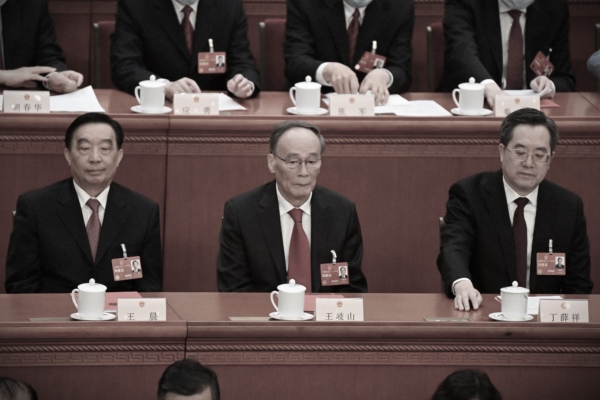
The Deputy Director of the Party Committee of the China Banking and Insurance Regulatory Commission, Zhou Liang, was officially announced to have been investigated and removed from office yesterday. Zhou Liang, who had long served as Secretary to Wang Qishan of the Central Commission for Discipline Inspection, has attracted attention due to his close ties to Wang Qishan. Analysts suggest that Xi Jinping targeting Zhou Liang may put Wang Qishan at risk. There are also reports indicating that Wang Qishan sees Zhou Liang as a son and had appealed to Xi Jinping on two occasions, but Zhou Liang was ultimately arrested, indicating Xi Jinping’s fear of Wang Qishan’s influence.
The Chinese Communist Party officially announced the investigation into Zhou Liang yesterday. Zhou Liang, 55, had been Wang Qishan’s secretary since 1997, accompanying him to various positions including in Guangdong Province, the State Council’s Reform Office, Hainan Province, Beijing, the State Council, and the Central Commission for Discipline Inspection. In 2013, he became Deputy Secretary-General of the Central Commission for Discipline Inspection; in April 2015, he was appointed Deputy Minister of the Organization Department of the Central Commission for Discipline Inspection, and in September promoted to Minister of the Organization Department of the Central Commission for Discipline Inspection, becoming the personnel chief during Wang Qishan’s tenure.
From November 2017, Zhou Liang successively held positions such as Vice Chairman of the China Banking Regulatory Commission, Vice Chairman of the China Insurance Regulatory Commission, Secretary of the Party Committee of the All-China Financial Trade Union, and concurrently Vice Chairman, before becoming Deputy Director of the National Financial Administration in May 2023.
Wang Qishan served as Secretary of the Central Commission for Discipline Inspection during Xi Jinping’s first term, but at the 19th National Congress of the Chinese Communist Party in 2017, there were strong indications that Wang Qishan would not continue as a Standing Committee member or Secretary of the Central Commission for Discipline Inspection. In March 2018, Wang Qishan transitioned to the position of Vice President of the country and officially retired in March 2023.
Several of Wang Qishan’s former associates have been removed from office, including Dong Hong, Vice Group Leader of the Central Inspection Team, who was sentenced to death with a reprieve for bribery in 2022, and Tian Huiyu, former President of China Merchants Bank and Wang Qishan’s secretary during his tenure at the Construction Bank, who was also sentenced to death with a reprieve. On October 10, 2024, Fan Yifei, former Deputy Governor of the People’s Bank of China, was also sentenced to death with a reprieve. Fan Yifei was the finance manager during Wang Qishan’s tenure as President of the Construction Bank.
Su Ziyun, Director of the Strategic and Resource Institute at the Taiwan Institute for National Defense and Security Studies, told Epoch Times that Zhou Liang is another victim of the power struggle within the Crown Prince Party (Second Generation Reds).
“The Crown Prince Party is divided into three factions: the extreme left, represented by Xi Jinping; the commercial faction, indifferent to politics; and the so-called democratic faction. Xi Jinping is cracking down on the Second Generation Reds in the military, and Zhang Yuxia is a representative. Zhang Yuxia may not be a true democrat, but he advocates for intra-party democracy and collective leadership, thus offending Xi Jinping,” he said.
Su Ziyun believes that Zhou Liang, as a member of the commercial faction around Wang Qishan, was targeted by Xi Jinping under the guise of corruption, but it is actually part of the power struggle within the Crown Prince Party. “By targeting the pawns first, there may be risks for Wang Qishan subsequently, similar to the approach taken with Zhang Yuxia. However, Xi Jinping holds absolute power, which also sets the stage for extreme backlash.”
China expert Wang He stated that Wang Qishan’s influence has been eroded over the years. The recent focus of the authorities has been on the financial sector and state-owned enterprises, but “the factions within the Crown Prince Party are deeply entwined, making it difficult for Xi Jinping to completely control them, especially with formidable figures like the Jiang family, the Zhu Rongji family, and the Li Peng family. The crackdown targets only peripheral factions.”
The investigation into Zhou Liang has stirred discussions overseas on social media platforms:
Independent commentator Cai Shunkun, with connections within the Chinese system, stated that Wang Qishan considers Zhou Liang as a son, and Zhou Liang’s abilities are highly esteemed by Wang Qishan.
He revealed that Wang Qishan had appealed to Xi Jinping on two occasions and promised to no longer interfere in political matters, hoping for leniency from Xi Jinping. Xi Jinping had agreed to Wang Qishan’s pleas face to face. The issue arose during the Chinese New Year this year when Wang Qishan sent someone to meet Zhou Liang, which violated a major taboo of Xi Jinping. As a result, Xi Jinping demanded that Wang Qishan sever all ties with his former associates and prohibited further contact.
Cai Shunkun emphasized that following the arrest of Zhang Yuxia by Xi Jinping, who had offended almost all Second Generation Reds, military heirs, and elderly officials, Xi Jinping is wary of the remaining few high-level connections that pose a threat to him, primarily guarding against Wang Qishan and Zeng Qinghong. With Zhou Liang’s arrest, Xi Jinping has shown no mercy towards Wang Qishan. This highlights Xi Jinping’s deep fear of Wang Qishan, indicating a trend where Wang Qishan too could meet a fate similar to Zhou Yongkang.
As early as November 20, 2023, Cai Shunkun had written on the same platform, stating that when Wang Qishan took over as Secretary of the Central Commission for Discipline Inspection in 2012, he completely followed Xi Jinping’s orders, but would inevitably be ruthlessly abandoned.
He disclosed that on July 16, 2016, Wang Qishan confided to more than twenty close associates, “This is likely our last gathering, and we may not have such an opportunity in the future. I am also getting old and no longer have the ability to shield everyone from the rain. Each of us will have to fend for ourselves.” This dinner foretold Wang Qishan’s lonely fate in his later years.
It is worth noting that on the same day Zhou Liang, Deputy Director of the National Financial Administration, was officially removed, Ba Shusong, the former Managing Director of the Hong Kong Stock Exchange who had close ties to Wang Qishan, went missing.
On the evening of March 24, Tencent Finance reported that Ba Shusong, former Managing Director and Chief China Economist of the Hong Kong Stock Exchange, had gone missing recently. Some sources claim that Ba Shusong has been under investigation. The Hong Kong Stock Exchange confirmed that Ba Shusong left the company at the end of 2025 and had previously served as a non-executive consultant at the Hong Kong Stock Exchange.
Ba Shusong, 56, is currently a professor at the HSBC Business School of Peking University and the Executive Director of the HSBC Financial Research Institute. He had previously served as the main lecturer for the Political Bureau of the Chinese Communist Party, Deputy Minister of the Economic Department of the Hong Kong Liaison Office, Director of the Development Strategy Committee of the China Securities Association, Deputy General Manager of the Hangzhou branch of the Bank of China, and Assistant General Manager of Bank of China Hong Kong.
Cai Shunkun indicated that Ba Shusong’s removal and the cleansing of financial officials are closely related. Ba Shusong was highly valued by Wang Qishan and had handled large sums of money on his behalf.