
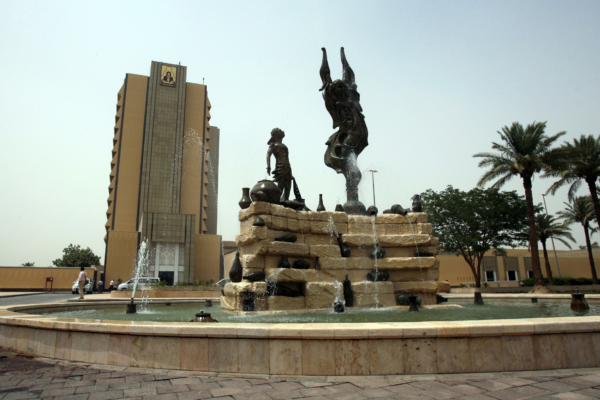
On Monday evening, a drone attacked the Al-Rasheed Hotel in the “Green Zone” of the Iraqi capital, Baghdad. At the time of the incident, flames and thick smoke billowed from the upper floors of the hotel, fortunately with no reports of civilian casualties.
This attack is one of the most symbolically significant attacks suffered by the Iraqi capital since the outbreak of the US-Iran conflict over two weeks ago, as the Green Zone houses important facilities such as Iraqi government offices and the US Embassy.
The Iraqi Interior Ministry later confirmed that a drone attacked the perimeter fence of the Al-Rasheed Hotel. The ministry strongly condemned any attempt to attack diplomatic missions within and outside the country.
No organization has taken responsibility for the attack so far, and Iraqi authorities have not confirmed the origin or model of the drone used. The Iraqi Joint Operations Command confirmed multiple attacks within the country on Monday but did not specifically mention the attack on the hotel in its initial statement.
In addition, a video released by CNN showed the US military intercepting a projectile near the US Embassy compound in Baghdad, approximately 600 meters away from the air defense system. On March 14, the helicopter pad in the US Embassy area was also targeted by missile attacks, thankfully with no casualties reported.
This attack occurred amidst a series of incidents in the vicinity, including attacks on Baghdad International Airport and facilities related to US military presence, resulting in at least five injuries.
Analysts suggest that based on the tactics used and the increasingly frequent pattern of attacks since late February, this attack may be related to groups like Kataib Hezbollah, a pro-Iranian terrorist armed group, or its affiliated factions.
In fact, this attack utilized low-cost “suicide drones,” mirroring the recent attacks on US facilities in Iraq.
Earlier this month, US military bases near Baghdad Airport and other diplomatic facilities were targeted by drones as well. It is widely believed that these are retaliatory actions against the US-led coalition’s strikes on the Hashd al-Shaabi forces.
Regarding the attack on the Al-Rasheed Hotel, the US State Department has not yet issued a specific comment but has issued warnings about potential threats the US may face in Iraq. Earlier, the US Embassy in Baghdad warned of potential attacks on hotels frequented by foreigners by pro-Iranian terrorist organizations, urging American citizens to evacuate Iraq promptly.
Built in 1982, the Al-Rasheed Hotel is located in the heavily guarded Green Zone of Baghdad. For decades, it has been the primary accommodation for international diplomats, foreign journalists, and military personnel in the Iraqi capital.
The hotel is named after the eighth-century caliph Harun al-Rashid and was originally constructed by the Indian Oberoi Group. At that time, Iraq was leveraging its abundant oil wealth to drive modernization in Baghdad.
During the Gulf War in 1991, many international media outlets broadcasted live coalition air raid scenes from the high floors of the hotel, catapulting its fame. Since then, in numerous conflicts in Iraq, the hotel has remained a focal point for foreign media operations.
In October 2003, during the tenure of Deputy Secretary of Defense Paul Wolfowitz, the hotel was hit by a fierce rocket attack, resulting in the death of a US Army officer and several injuries.
After years of turmoil, the hotel underwent extensive renovations, becoming once again the preferred destination for visiting dignitaries, aid workers, and business travelers. Due to its location on the border of the Green Zone, the hotel has become a strategic meeting point between the Iraqi government, foreign officials, and coalition forces.