
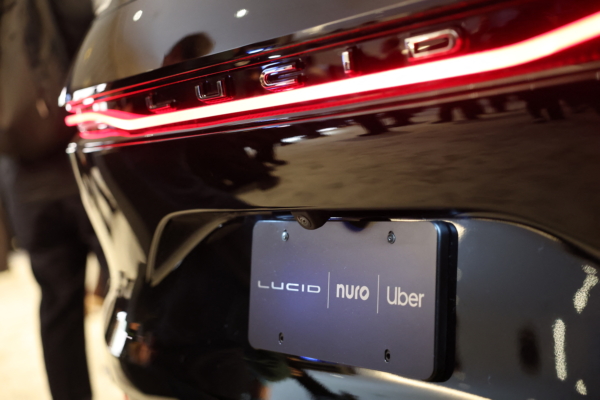
On Thursday, March 12, the US autonomous driving startup Nuro announced that it has officially begun testing autonomous driving technology in the Japanese capital, Tokyo, and has deployed a small number of test vehicles on the road. This marks the company’s first foray outside the US after partnering with Uber and Lucid Group, establishing a presence overseas.
Based in Mountain View, California, Nuro is backed by major companies such as Nvidia and Toyota, with the aim of competing in the emerging market of commercial autonomous vehicles against players like Waymo under Alphabet, Google’s parent company, and Zoox under Amazon.
Nuro announced the deployment of “a few vehicles” for testing in Tokyo and set up a local office for data collection. Prior to this, Waymo had collaborated with Japanese taxi operators for testing, and there were other small-scale pilot programs in Tokyo and its surrounding areas. Now, Nuro is joining the competition in the field of self-driving technology.
Andrew Chapin, Nuro’s COO, stated in an interview that “many Japanese original equipment manufacturers (OEMs) could potentially become our customers in the future.” However, he declined to disclose the names of potential partners or confirm if Nuro is currently in talks with local Japanese manufacturers.
Chapin also expressed confidence that Nuro’s system, designed with real-time adaptability and responsiveness, can handle the challenges posed by Tokyo’s narrow and crowded streets where vehicles often drive on the left. Despite the complexities, he emphasized that Nuro’s system is well-equipped to adapt.
In this diverse and intriguing market, Chapin noted that testing the self-driving system is a good “stress test” for the technology. He reiterated that achieving Level 4 autonomous driving (vehicles capable of fully autonomous driving under specific conditions) is the company’s ultimate goal.
Uber previously approached Nuro and electric car manufacturer Lucid to provide autonomous ride-hailing services in the San Francisco Bay Area. The plan was to build a fleet of 100,000 self-driving cars, with 20,000 vehicles supplied by Lucid and Nuro for autonomous taxi services starting gradually in 2027, powered by chips from Nvidia.
On the other hand, Nuro’s competitor Waymo has been conducting tests on public roads in Japan since April 2025 and has partnered with Toyota. Toyota has also inked a deal with the Japanese telecommunications giant NTT to jointly invest 500 billion yen (about $32 billion) in AI and autonomous driving technology development.
Meanwhile, the traditional Japanese automaker Nissan has partnered with the UK AI startup Wayve Technologies to prepare for the launch of the latest generation of driver assistance systems, albeit at Level 2.
According to the definition provided by the Society of Automotive Engineers (SAE), autonomous driving is classified into levels ranging from 0 to 5.
Level 0 involves only warnings and assistance systems (automatic braking, blind-spot warning, lane departure warning, etc.); Level 1 includes single-function assistance like steering, braking, or acceleration assistance and can maintain lane keeping or adaptive cruise control (ACC); Level 2 comprises multiple functions simultaneously such as ACC and lane-keeping, with the driver still required to monitor the vehicle throughout.
Level 3 is conditional automation (system can fully take over under specific conditions, with the driver not required to monitor but must be prepared to take over at any time); Level 4 is high automation (fully autonomous driving in specific areas/conditions without the need for pedals or steering wheel); Level 5 is full automation (no human intervention required under any conditions).
(Adapted from Bloomberg)