
The latest report indicates that Russia’s military casualties on the battlefield far exceed the official numbers released by the government. The number of Russian soldiers killed or injured could be as high as 1.2 million. The nearly four-year-long war has heavily depleted Russia’s strength, and it may have even lost its status as a “great power.”
According to a report released by the Center for Strategic and International Studies (CSIS) based in the United States at the end of January, since Russia’s invasion of Ukraine in February 2022, the number of Russian military casualties could be as high as 1.2 million (including killed, wounded, and missing), with the number of fatalities possibly reaching up to 325,000. The report states that since World War II, no major power has suffered such a high number of casualties or deaths in a war.
The report estimates that the Russian military casualties are significantly higher than those of Ukraine, with a ratio of approximately 2.5:1 or 2:1. Ukrainian military losses from February 2022 to the end of 2025 are estimated to be between 500,000 and 600,000, with fatalities ranging from 100,000 to 140,000.
The report suggests that the large number of Russian military casualties is due to Russia fighting a war of attrition, gradually weakening the enemy by destroying their military forces (including resources and personnel), resulting in high casualties, massive resource expenditure, and limited frontline advances.
Analysts believe that Russia’s high casualties are a result of ineffective coordination among different branches of the military, poor tactics and training, corruption, low morale, and Ukraine’s successful implementation of a defensive war strategy favoring them in the conflict.
Since the start of the war, the total casualties in Russia and Ukraine are estimated to be as high as 1.8 million, with projections that it could reach 2 million by the spring of 2026.
The Kremlin does not endorse the military casualty figures provided by the Center for Strategic and International Studies, stating that only data from the Ministry of Defense is reliable but without providing any relevant numbers.
Independent investigations conducted by Russian media outlet Mediazona and the BBC Russian service reveal that at least 168,000 Russian soldiers have been killed in action, based on verifiable names. Additionally, estimates based on Russia’s population registry suggest a death toll of 219,000.
Mediazona also disclosed that starting from the end of December 2025, Russian courts began deleting lawsuit records related to missing or deceased soldiers. These records have vanished from the websites of courts in 50 regions of Russia, including cases brought by military units and civilian lawsuits.
Russia’s government may be attempting to hide the true scale of soldier casualties to prevent families from seeking rights and to maintain social stability.
The report from the Center for Strategic and International Studies points out that the significant casualties do not necessarily mean that Russia has a definitive advantage on the battlefield, as the Russian military’s advance is extremely slow.
For instance, during the offensive on the key town of Pokrovsk in Donetsk Oblast from late February 2024 to early January 2026, the Russian army advanced less than 50 kilometers, with an average daily progress of only about 70 meters. This speed is even slower than some of the most brutal offensive battles of the previous century, including the notorious Somme Offensive in World War I.
In the northern Kharkiv Oblast, Russia’s advance has also been sluggish. From mid-November 2024 to early January 2026, the Russian army only advanced about 9.5 kilometers, averaging about 23 meters per day.
The report highlights that aside from the slow advance, Russia’s territorial gains over the past two years have been relatively limited. Since the invasion in 2022, Russia has occupied approximately 75,000 square kilometers of Ukrainian territory, around 12% of Ukraine, and controls about 120,000 square kilometers, roughly 20% of Ukraine, including Crimea and parts of Donbas captured before 2022.
Despite these territorial gains and overall progress on the battlefield, particularly in the last two years, Moscow has fallen short of its military conquest goals in Ukraine.
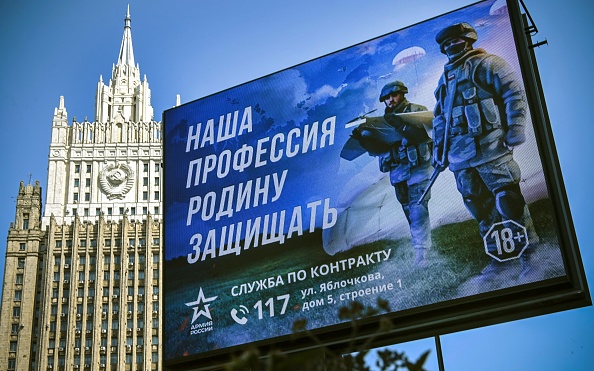
Due to significant personnel losses on the battlefield, Russia is intensifying recruitment efforts. However, relying solely on high bonuses to attract recruits may not be sustainable.
Russia’s monthly recruitment target is around 35,000 people, but according to Oleksandr Syrsky, the Chief Commander of the Ukrainian Armed Forces, as many as 90% of new recruits were deployed to replace casualties on the battlefield in 2025.
Russia claims to have recruited nearly 423,000 people last year and has set a similar target for 2026.
Recruitment in Russia heavily relies on providing substantial incentives to attract individuals, with bonuses amounting to several times the country’s average wage.
In the largest oil-producing region of Khanty-Mansiysk, new recruits can receive a total bonus of 4.1 million rubles (approximately USD 53,000). Across 28 other regions in the country, the bonuses, plus additional money, total up to 2.5 million rubles.
This is particularly attractive to residents in the poorest regions of Russia, prompting many individuals to enroll in wealthier areas due to higher compensation. Last month, independent Russian news site Bell revealed that males from regions like Buryatia and Tuva in Siberia had a 25 times higher likelihood of dying in combat in Ukraine than males from Moscow.
The bonus amounts decreased in 2025 but sharply rose in recent weeks, indicating the governors’ efforts to meet recruitment targets.
Janis Kluge, a Russia expert at the German Institute for International and Security Affairs, stated last year’s expenditures on recruitment bonuses in various regions amounted to at least 500 billion rubles, around 0.5% of Russia’s GDP. These bonuses are sourced from federal, regional, municipal budgets, and some businesses.
Kluge mentioned that if Russia continues to prioritize military expenditures, it can still meet recruitment targets at the current rate.
He noted, “This is a massive sum for recruiting soldiers, but within the context of military spending being 8% to 10% of GDP, it’s just a small part of the cost of war. They can double that figure and find even more people.”
Michael Kofman, a senior researcher at the Carnegie Endowment for International Peace, remarked that the recruitment trends suggest that “Russia will struggle to maintain offensive pressure.”
Ukrainian President Zelenskyy revealed in early February that Russia’s monthly casualties (serious injuries) amount to 30,000 to 35,000.
Zelenskyy stated that frontline losses will ultimately pose more challenges for Russia to sustain recruitment numbers. He expressed, “If this situation continues, they will lose 100,000 to 120,000 frontline troops within a few months, and filling this gap will be very difficult.”
Data from the Ukrainian analytical agency Frontelligence Insight indicates that Russia’s desertion rate reached its peak in the nearly four-year war.
The war’s prolonged duration has significantly eroded Russia’s strength. The report from the Center for Strategic and International Studies suggests that despite Russia still possessing nuclear weapons and a massive military, it falls short of being considered a great power across nearly all indicators, including military, economic, and technological aspects.
The report reveals that Russia’s economy is displaying signs of strain, with dim prospects for long-term productivity.
For instance, in 2025, Russia’s manufacturing sector experienced seven consecutive months of contraction, with production levels decreasing for ten months. Additionally, consumer demand weakened, inflation soared, the labor market faced tension, and with global oil prices dropping, delayed oil revenue, fiscal austerity, and expanding budget deficits. Economic growth slowed to 0.6% in 2025.
Russia also faces capital challenges, limited foreign investment, and borrowing difficulties in the international market. To fund the war, the Kremlin borrows domestically and raises taxes. Around half of the budget is allocated to the armed forces, military-industrial complex, domestic security, and debt servicing. While the war sustains employment and industrial activity, it generates scarce long-term assets or productivity enhancements.
Severe labor shortages have increased the burden on the civilian economy. Tank factories operate overtime, while automotive manufacturers reduce shifts.
Russia grapples with significant demographic challenges, including population decline, aging, low birth rates, high mortality rates (especially among working-age males), and a substantial exodus of highly skilled workers emigrating abroad.
Russia continues to lag behind in critical areas such as artificial intelligence and other key technologies. No Russian enterprise is among the top 100 global technology companies in terms of market value.
According to the report from the Center for Strategic and International Studies, Russia’s nominal GDP is closer to that of Canada or Italy. Even after purchasing power parity adjustments, Russia’s GDP amounts to only one-fifth of the United States’ and one-fourth of China’s.
Russia may also face significant challenges with the reintegration of tens of thousands of returning soldiers, including many violent criminals and individuals who have experienced traumatic combat. Some veterans have increasingly resorted to violent crimes, including murder, against civilians.