
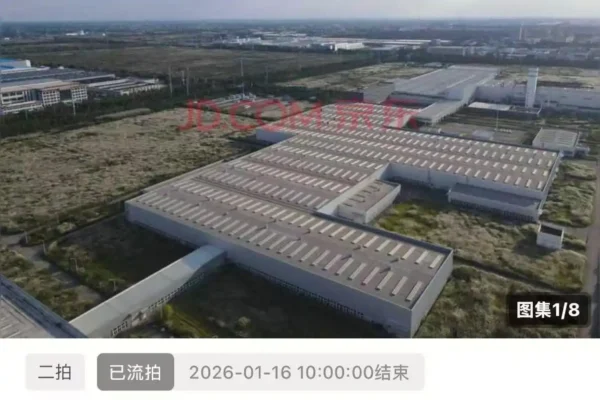
On January 16, information released by the JD Asset Trading Platform revealed that the real estate and factory equipment, facilities, spare parts, and other assets located at 1 Tongda Road, Changshu City, Jiangsu Province, went unsold in a second auction due to lack of bidders. The auction attracted significant attention following public allegations made by Yao Zhenhua, the Chairman of Baoneng Group.
The starting price of this auction was approximately 859 million yuan, with a required deposit of 170 million yuan, and the assessed value of the assets was around 1.535 billion yuan. The subject of the auction was the location of Changshu Guanzhi Automobile Co., Ltd. and the factory, with the land designated for industrial use, currently under seal and with mortgages. The total documented building area was 183,148.04 square meters, land area of 716,473 square meters, and the real estate was completed in 2014.
According to a report by The Paper, the auctioneer disclosed that the aforementioned assets were valued at around 1.535 billion yuan. Based on this valuation, these assets underwent two price adjustments: the first auction was held on December 31, 2025, with a starting price of 1.05 billion yuan, which went unsold and led to a second auction on January 15, 2026.
Information from Tianyancha revealed that the plaintiff in the case was China Import and Export Bank, with the dispute revolving around a financial loan contract with the execution object amounting to approximately 270 million yuan. However, in the final enforcement ruling, the applicant changed to Suzhou Assets Management Co., Ltd. (referred to as “Suzhou Assets”), whose controlling shareholder is Suzhou Asset Investment Management Group Co., Ltd.
On January 14, Yao Zhenhua released a video alleging that the relevant authorities in Changshu City were suspected of illegal operations during the auction of Guanzhi Automobile assets, jeopardizing the legitimate rights and interests of the shareholders with a massive investment of 26 billion yuan and related creditors with 13.9 billion yuan in debt. Despite such a significant “price difference,” no one ultimately made a bid.
In his report, Yao Zhenhua questioned the legality of the court’s execution procedures. Information disclosed on the official website of Baoneng Group indicated that prior to Yao Zhenhua’s public allegations, the Baoneng Group attempted to prevent the auction through bankruptcy reorganization.
Tianyancha’s risk information revealed that on December 22, 2025, Guanzhi Automobile Co., Ltd. added a bankruptcy review case, with the applicant being Shenzhen Xinben Supply Chain Co., Ltd., and the handling court being the Intermediate People’s Court of Suzhou City, Jiangsu Province. Due to long-standing arrears, Shenzhen Xinben chose to sue their former business partner, entering the formal bankruptcy reorganization process through a bankruptcy review application.
The entanglement between Baoneng Group and Guanzhi Automobile began in 2017.
Data shows that Guanzhi Automobile was established in December 2007, initially named Chery Quantum Auto Co., Ltd., a joint venture between Chery Automobile and an Israeli group. In 2010, the project selected Changshu Economic and Technological Development Zone in Jiangsu as the production base; in 2011, the factory project officially started construction; and in 2013, Guanzhi Automobile’s first model, the Guanzhi 3 sedan, was launched.
Between 2013 and 2016, due to poor management of the joint venture company, Guanzhi Automobile’s sales remained low, accumulating losses exceeding 6 billion yuan. Both founders, Chery and Quantum, began seeking new buyers. In 2017, Baoneng Group acquired a majority of Guanzhi Automobile’s equity for a high-value equity consideration of 13.3 billion yuan, becoming the controlling shareholder.
At that time, Yao Zhenhua claimed to invest hundreds of billions of yuan to create the “Chinese version of Tesla.” However, in 2020, Baoneng Group faced a liquidity crisis, leading Guanzhi Automobile to lose financial support, essentially entering a production halt phase, with Guanzhi Automobile’s sales steadily declining from 2019 to 2021, almost reaching zero.