
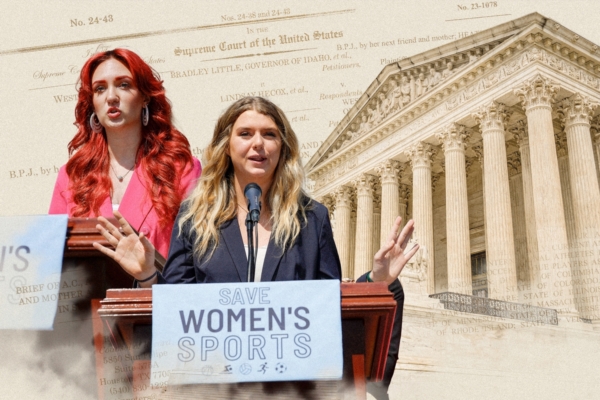
Selina Soule, a high school track champion from Connecticut, has multiple state titles and school records under her belt. However, when transgender male athletes began competing against her, Soule said her hopes of winning races became bleak.
“No matter how much time I put into training, how much extra effort I give, it’s all in vain. I simply can’t win races,” Soule, a 2020 graduate of Glastonbury High School, told The Epoch Times.
Currently, there is a nationwide debate in the United States regarding male participation in female sports, and Soule’s perspective is widely shared.
Several states in the US have implemented laws prohibiting males from participating in female sports. The Supreme Court is set to hear cases challenging these laws on January 13 to determine whether a ruling should be made on this issue.
The Supreme Court will hear two cases where self-identified transgender male students claim that West Virginia and Idaho’s bans on their participation in women’s sports constitute illegal discrimination.
These cases – Little v. Hecox and West Virginia v. B.P.J. – are expected to rule on whether state laws violate the Constitution and federal civil rights laws.
According to judges’ decisions, these lawsuits could make it easier for states nationwide to maintain gender segregation in sports, a system considered crucial by some female athletes.
The organization “Movement Advancement Project” states that currently 27 states in the US have enacted similar bans to those under review by the Supreme Court. Some states’ bans have been obstructed by federal courts.
States like Idaho and West Virginia have faced obstruction. The federal appeal courts ruled that these states engaged in illegal discrimination based on gender and transgender identity.
However, female athletes argue that their interests are not being respected when male athletes compete against them.
A recent study by the organization “Concerned Women for America” showed that since the mid-1980s, female athletes have lost more than 1,900 gold medals due to male participation in women’s competitions.
102 female athletes submitted a friend-of-the-court brief, stating that female athletes across the nation face the risk of permanently losing equal opportunities and safety in sports.
Former high school volleyball player Macy Petty told The Epoch Times, “Males have infiltrated female sports. We’ve reached a point where female athletes stepping onto the field wonder if they actually have the privilege of competing only with other females.”
Petty, who graduated from Northwestern High School in South Carolina in 2020, participated in numerous competitions nationwide. In 2018, she had already competed in hundreds of matches across the country.
During a recruitment event for talented female athletes with scholarships, she was shocked to find a male teammate on the volleyball court.
“I felt only confusion at that moment,” Petty said to The Epoch Times.
Kristen Waggoner, president of the Alliance Defending Freedom, and many others agree with Petty’s critical view of male participation in women’s sports.
Waggoner stated at a press conference on January 8 that while “all children need care and respect,” the rights of young women cannot be overlooked. Waggoner, a former high school volleyball player, leads the organization helping Idaho and West Virginia defend their laws in court.
The justices are expected to focus on two legal provisions: the Equal Protection Clause in the Constitution and Title IX of the Civil Rights Act. The former generally guarantees equality before the law, while the latter prohibits gender-based discrimination at federally funded educational institutions.
A friend-of-the-court brief submitted by sports officials and coaches of female athletes noted, “This is significant.” They caution that declaring these laws unconstitutional “not only strips away the rights and protections specifically secured for women in school sports but does so to expand those rights and protections to males.”
They argue that allowing males to compete is “blindly adhering to the rhetoric of so-called equality.” Some coaches believe that “allowing transgender females to participate in women’s sports under applicable rules poses no safety threat and does not give transgender females an unfair advantage.”
What sets the West Virginia case apart is that it not only requests the justices to rule on the Equal Protection Clause but also on Title IX. Given the history of Title IX and how the Supreme Court has handled similar laws in the past, legal experts believe this case could strengthen female athletes’ stance against male participation.
In 2024, the U.S. Court of Appeals for the Fourth Circuit ruled that the state law in question treated the plaintiff, known as BPJ when he sued West Virginia at the young age of 11, inappropriately based on gender and thus violated Title IX.
However, some argue that Congress’s legislative intent when passing Title IX was different. A friend-of-the-court brief submitted by nearly 50 members of Congress pointed out that the 1975 enactment of Title IX aimed to prevent discrimination against females and initially adopted a binary view of sex.
“This is about safety, as well as the safety of locker rooms and changing rooms, and the exposure of bodies within sports. So gender matters; how one identifies their gender does not.” Randall Wenger, chief counsel at the Independence Law Center, told The Epoch Times. “If you are looking to protect athletes’ competitive opportunities, you have to separate based on gender.”
Scholars studying Title IX have pointed out that the language of Title IX is contradictory, constituting a “blunt ban that excludes all transgender girls from women’s sports teams.” Justices are focused on the issue of transgender athletes joining sports teams, but their arguments could extend to locker room and restroom segregation issues.
In 2022, swimmer Kylee Alons, who was studying at North Carolina State University at the time, expressed growing anxiety as she feared that Lia Thomas, a male athlete competing against women, might eliminate some of her female teammates.
“It wasn’t until the first day of competition, walking into the locker room, that I realized, ‘Oh, I’ve never thought about having to change in a locker room with men before,'” Alons told The Epoch Times.
“I think that you only really understand how uncomfortable that feels until you’re put in that situation, how violating that feels.”
Both sides of the debate have referenced the Supreme Court’s decision in the 2020 case Bostock v. Clayton County, which could impact the justices’ decision-making.
In a majority opinion, Justice Neil Gorsuch stated that “discrimination based on sexual orientation or transgender status necessarily entails discrimination based on sex.”
However, Bostock v. Clayton County focused on another civil rights law – Title VII – Justice Gorsuch explicitly stated that his decision did not involve restroom disputes.
How the justices interpret the issue of equality may depend on their view of physiologic differences and the impact of hormone-altering drugs on those differences.
Both the Fourth Circuit and Ninth Circuit courts found the bans in various states to be too broad since they covered males who had not undergone puberty-related physiological changes.
The Fourth Circuit explicitly stated that the anonymous male, BPJ, who brought suit against the West Virginia law, had not reached the so-called “Tanner 2 stage,” a medical term signaling the onset of puberty. “Thus, BPJ never experienced the elevation of internal testosterone levels,” the court wrote.
However, BPJ’s teammate, identified as AC in court documents, told a different story. AC said at the beginning of the school year, she and BPJ were evenly matched in sports, even though she was two years older.
By the end of that year, BPJ had far surpassed her in performance, had grown taller, and despite taking puberty blockers, his voice had become “deeper and more resonant.” A year later, BPJ became one of the school’s top athletes in shot put and discus.
AC previously withdrew from jiu-jitsu competitions because she did not want to compete against boys anymore, resulting in a significant drop in her ranking. She felt incredibly frustrated as she was ineligible for elite competitions.
During her high school years, track athlete Soule was forced to compete against two young males from her home state of Connecticut. She revealed to The Epoch Times that competing with them on weekends was “emotionally draining and frustrating.”
“Every time I competed against them, I had no chance, even though I had broken school records five times,” she said.
The court records of these two cases are filled with arguments submitted by both sides, including statements from sports scientists and doctors supporting the bans on male participation in female sports.
On the other hand, a group of pediatricians pointed out significant differences that occur during puberty. One court brief stated, “Males must undergo endogenous puberty to experience the significant athletic advantages that manifest in adolescence and adulthood.”
Defending Education’s vice president Sarah Parshall Perry told The Epoch Times, “We found – and more and more studies show – that these differences between girls born female and boys born male begin to manifest at age 10 or 11 when physiological boys’ testosterone levels surge 20 times.”
The organization “Do No Harm” and sports physiologists noted that these differences even exist before puberty. Kurt Miceli, medical director of “Do No Harm,” told The Epoch Times that puberty blockers and hormone therapy may not negate these differences.
“Current evidence suggests that puberty blockers and estrogen only mildly blunt the physical advantages a person gains during growth, meaning some strength advantages still exist even after years of hormone intervention,” he said.