
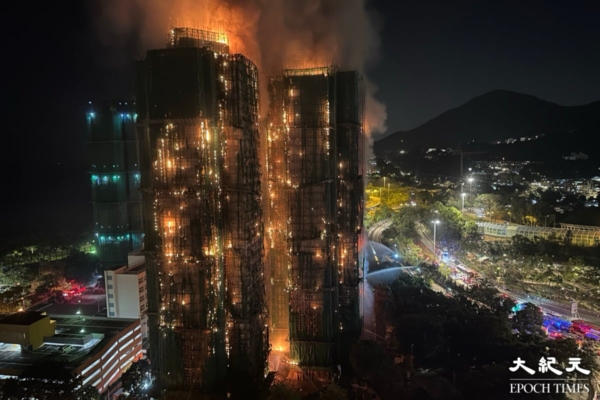
On November 26th, a massive fire broke out at the Hong Fo Yuen in Tai Po, New Territories, Hong Kong, resulting in a five-alarm blaze. As of the time of reporting, the fire has tragically claimed the lives of at least 146 people, with 79 others sustaining injuries and over 200 individuals still missing. Both local and overseas Hong Kong residents are calling for the Hong Kong government to establish an “independent investigation committee.” However, the government not only failed to initiate any independent inquiry but also arrested the initiator of the petition seeking an investigation into the fire on charges of “inciting rebellion.”
The fire at Hong Fo Yuen has revealed more underlying issues. Observers believe that the entire incident highlights the collapse of Hong Kong’s overall system, wherein avoidable tragedies unfold due to the government’s neglect of public complaints. Blaming the government’s evasion of responsibility, the middle class in Hong Kong and even moderate pro-establishment figures are beginning to raise their voices.
According to Agence France-Presse, out of the 8 buildings at Hong Fo Yuen, 7 were completely engulfed in flames, affecting nearly 2000 households. This marks the most severe residential fire incident in Hong Kong’s history, with the confirmed death toll climbing to 146 individuals. Over the weekend, thousands of citizens, accompanied by their families, visited Hong Fo Yuen to mourn the victims, with the mourning procession extending for hundreds of meters.
Regarding the deadliest fire in at least 63 years in Hong Kong, the government’s latest investigation announced on November 28th revealed that the fire originated from the lower-level protective nets, with polystyrene boards blocking the building’s windows leading to rapid fire spread, subsequently affecting other structures. The bamboo scaffolding caught fire, and the burning bamboo pieces falling ignited other protective nets, causing the fire to spiral out of control.
Chief Executive of Hong Kong, Carrie Lam, stated to the media that the government will conduct a comprehensive inspection of all bamboo scaffolding across the city, considering whether to switch to metal scaffolding.
However, the government’s attempt to blame the bamboo shelters has been widely questioned, as bamboo scaffolding is a century-old construction method in Hong Kong. Civil engineering structural expert residing in the United States, Zhu Xueye, expressed to the Epoch Times that from a housing structure perspective, the simultaneous burning of several buildings indicates that the materials used for the shelters indeed lacked fireproof properties.
Zhu further explained that fire prevention in high-rise buildings is crucial – once a fire breaks out in tall buildings, the strong winds at height make it challenging to contain the fire beyond a certain level. Thus, fire-resistant materials are necessary for firefighters to have sufficient time to extinguish the flames. Without such materials, a gust of wind could quickly spread the fire to the rooftop, making rescue efforts nearly impossible.
Back in 2024, during the maintenance work at Hong Fo Yuen, whistleblowers lodged complaints with the Hong Kong Labour Department, stating that the protective nets used in the maintenance work were not fire-retardant as required. However, these complaints were dismissed by the Labour Department on the grounds that there were no welding operations being carried out and deemed the fire risk relatively low, resulting in no halt to the maintenance work.
Harry Poon, a construction expert and chairman of the 中科监察 (China Science and Technology Monitoring) group, revealed in an interview with the online political program “Zhen Talk” hosted by Liang Zhen that he had written at least 80 letters since May last year to various departments, including the Hong Kong Housing Department, Labour Department, Buildings Department, and the Housing Bureau’s Independent Review Committee, warning the renovation contractors of buildings like Hong Fo Yuen about potentially using flammable nets, but his warnings were disregarded.
Reportedly, the construction company involved, “Hong Yip Construction Engineering Co.,Ltd” has a history of multiple fines related to construction or scaffolding disputes. Online users also disclosed that the maintenance project by Hong Yip was charged at an exorbitant fee of 330 million Hong Kong dollars, surpassing the competing bids at the time by 150 million Hong Kong dollars.
Liang Zhen expressed to the Epoch Times that the current shortage of new buildings in Hong Kong has turned “large-scale maintenance” into a huge business with significant interests involved. With the exorbitant fee of 330 million Hong Kong dollars for the maintenance of the eight buildings, it raises suspicions as to why such a dubious and the most expensive company was entrusted with the project, implicating possible irregularities.
In response to the catastrophic fire, the Hong Kong Buildings Department ordered the temporary suspension of 30 private building projects on November 29th, of which 28 were undertaken by Hong Yip Construction.
Under Hong Kong law, private buildings aged 30 years or older must undergo a “Compulsory Inspection Scheme” known as “large-scale maintenance” upon receiving notice from the Buildings Department.
According to reports from the local media, “Business Hong Kong Association” Councilor and pro-Beijing lawmaker Wong Bit Kiu, was a consultant to the Hong Fo Yuen’s Owners’ Corporation during the 330 million Hong Kong dollars renovation project and contractor selection process. When residents raised safety concerns about the project, she posted on social media expressing the importance of completing the renovation smoothly while working together for the stability of the complex.
Following the fatal fire at Hong Fo Yuen, she faced intense criticism from the public. Wong Bit Kiu responded on Saturday (28th), stating that she was unaware of the latest progress of the renovation project and that “the district councilor for that area is not under my jurisdiction.”
Concerning the lack of an independent investigation initiated by the government and the arrest of those petitioning for an inquiry, Liang Zhen, a resident of Hong Kong, questioned why the government failed to delve deeper into the matter. She believes that there are vested interests at play behind the scenes, with Hong Yip Construction Company closely linked to the “Business Hong Kong Association,” the largest pro-Beijing political party in Hong Kong.
She elaborated that aside from political parties, the Chinese Communist Party (CCP) has various organizations in Hong Kong, including some satellite organizations such as these owner-established corporations, all of which have significant interests involved.
Huang Guocai, a Hong Kong artist residing in Taiwan, stated to the Epoch Times that the incident has laid bare the collapse of the overall system in Hong Kong. People find themselves in a situation where their complaints fall on deaf ears under the co-governance by China. The system has completely disintegrated, with online reports going unanswered.
Huang noted that when the fourth estate existed in Hong Kong, people could turn to the media to voice their complaints and expose issues. However, now, most media outlets in Hong Kong are under the control of the Chinese Communist Party.
Former Director of the Hong Kong Observatory Lam Chiu-ying raised questions on his Facebook, saying, “The flammable netting and polystyrene foam are obvious material culprits, so why are bamboo, which is relatively non-flammable, being targeted?” He emphasized that the responsibility in disaster cases should rest more on addressing the issues referring to “people” and “system,” rather than shifting the blame to bamboo constructs.
Former editor-in-chief of the South China Morning Post and current associate professor at the Hong Kong Baptist University School of Journalism, Wang Siu Wai, expressed to foreign media, “The bigger issue here is: Faced with this tragic fire, should senior officials be held fully accountable?”
Former Financial Secretary of Hong Kong John Tsang Chun-wah mentioned on Sunday (30th) on social media that it would be premature to “sentence bamboo scaffolding to death” and that it would be impractical to ban its usage, suggesting an investigation into human factors such as smoking, use of non-compliant materials, and proposing improvements and regulatory methods. He also questioned whether the general public could afford replacing bamboo scaffolding entirely with metal ones during extensive renovations.
In response, senior current affairs commentator Sang Pam stated that many moderate voices in Hong Kong are now speaking out. John Tsang’s remarks on Facebook about not rushing to blame bamboo indicate a differing stance from individuals like Patrick Nip and Carrie Lam. The emergence of these moderate middle-class individuals signifies a significant shift in public sentiment.
Regarding the fire incident, Liang Zhen mentioned, “In reality, every Hong Kong citizen knows the truth – bamboo scaffolding is not the cause of the disaster. Many public figures, including Wong Chau Sang and Nina (commonly known celebrities), have come forward to help. She believes that deep down, everyone in Hong Kong must be thinking that this is where they live, where residents of any political stance are equally at risk, and everyone could be victims.”
After the 43-hour blaze that devastated Hong Fo Yuen, leaving thousands homeless, numerous citizens donated supplies and volunteered to assist in relief efforts. However, incidents of conflicts between volunteers and the “Care Team” established by the Hong Kong government have been reported. The Chinese state-run newspaper, Wen Wei Po, on the 29th, claimed that the police suspected the presence of “black violence” and “yellow people” infiltrating the relief activities.
“Black violence” and “yellow people” were terminologies used by pro-Beijing media during the 2019 Hong Kong anti-extradition movement to describe protesters.
As reported by the independent media, Hong Kong citizens Minerva Chan and others initiated a petition on the Change.org platform on the 28th, seeking to investigate the Hong Fo Yuen fire. The petition outline included four major demands: continuous support for affected residents, ensuring proper resettlement; forming an independent investigation committee to scrutinize potential vested interests; reassessing the engineering regulatory system for genuine rectifications; and thoroughly holding the authorities accountable for any negligence. By the evening of the 29th, over ten thousand people had signed the petition.
However, one of the initiators of the petition, 24-year-old university student Miles Kwan, was arrested by the Hong Kong police on the 29th on charges of inciting rebellion, and the petition website was removed.
In a statement issued by the National Security Bureau in Hong Kong on the 29th, it was claimed that during the disaster, “anti-China Hong Kong rioters” were inciting hatred towards the government, and there will be no leniency in cracking down on any behavior of “using disaster to riot.”
Liang Zhen criticized the Hong Kong government for resorting to violence to maintain stability, a typical approach by the Chinese Communist Party. She mentioned a similar incident following the 2022 fire in Urumqi, where a White Paper Revolution unfolded in Shanghai. The gravity of the situation in Hong Kong surpasses the Urumqi incident, further illuminating the absurdity. Therefore, the CCP fears the emergence of a White Paper Revolution in Hong Kong – this is their most feared scenario.
Furthermore, she stated that at present, the public no longer trusts the government, and the Hong Kong government’s credibility has been shattered.
Sang Pam, the Chairman of the Taiwan Hong Kong Association, concurred stating that in Hong Kong, public opinion has not been entirely suppressed and is continuing to grow stronger. Not only are pro-democracy activists but also certain localists and even some mild pro-establishment figures beginning to have concerns, questioning why the government is evading responsibility.
He added that globally, petitions will be initiated to support the 24-year-old young man in Hong Kong with his four essential demands. This sentiment will resonate worldwide, with Hong Kong people requesting accountability through commemorative activities, prayer meetings, “Lennon Walls” (walls covered with anti-extradition messages), and discussions on accountability.