
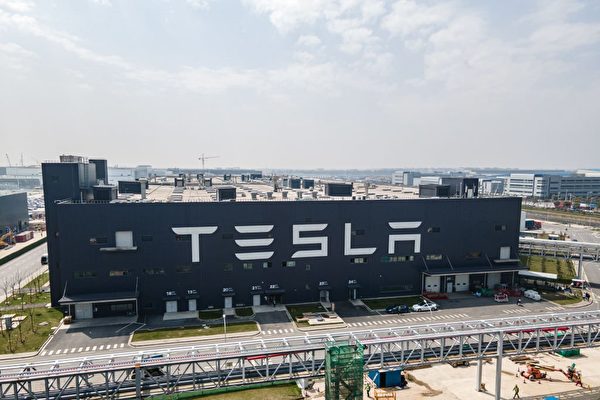
In recent years, the American electric vehicle leader Tesla has suffered heavy blows in the Chinese market, with not only declining sales and shrinking market share, but also facing strong competition from local Chinese enterprises. Industry experts point out that Tesla’s plight is not an isolated case, but another example of foreign companies falling into the trap of the Chinese Communist Party’s “lure and kill” strategy.
In 2019, Tesla CEO Elon Musk attended the groundbreaking ceremony of its first overseas super factory in Shanghai, where the Chinese government rolled out the red carpet for him and the media enthusiastically praised him for “igniting the Chinese electric vehicle industry.” Musk also hailed China as a symbol of the “future,” leading to a surge in investment sentiment. However, just six years later, the situation took a turn for the worse.
A report by The Wall Street Journal on July 6 pointed out that Tesla’s position in China has significantly deteriorated. Chinese consumers who once enthusiastically supported Tesla have now turned to cheaper and more versatile domestic brands such as BYD and Xiaomi.
In early 2025, BYD sold over 480,000 electric vehicles in just two months, a surge of over 75% compared to the same period last year, while Tesla only sold slightly over 60,000 vehicles in the same period, a 14% decrease from the previous year.
In 2021, Tesla’s market share in the Chinese electric vehicle market was about 11%, but by May 2025, it had plummeted to just 4%, while BYD’s market share soared to 29%.
American financial commentator and former Bloomberg columnist Noah Smith wrote last year, exposing the Chinese Communist Party’s long-standing “lure and kill” strategy against foreign businesses, first attracting foreign capital with a huge market and preferential policies, then stealing technology through means such as technology transfer, joint ventures, and corporate espionage, ultimately squeezing foreign enterprises out of the market.
In 2018, Tesla established a wholly-owned super factory in Shanghai, enjoying allocated land for free and tax incentives. The Shanghai factory once contributed half of Tesla’s global production capacity and accounted for nearly 40% of its battery supply chain, serving as a critical component of its global strategy.
However, in this partnership, Chinese enterprises have rapidly grown by using Tesla’s technology transfer and imitating its business model, especially through subsidies and allowing environmental degradation, leading to the rapid expansion of the Chinese electric vehicle industry and ultimately competing with and even replacing Tesla in the market.
Veteran political and economic commentator Wu Jialong pointed out in an interview with the media that Musk probably did not realize the existence of this model. After Tesla’s technology leaked, Chinese companies established their own supply chain and brand, gradually replacing Tesla in the Chinese market and even competing with Tesla on a global scale.
He emphasized that due to declining income and employment, the Chinese domestic market has faced weakened consumer demand, leading to oversupply pressure and forcing Chinese electric vehicles to be exported at low prices to global markets, triggering cut-throat price competition. Even Tesla’s expansion of its Mexican factory has not helped it escape the fierce competition in the global market against Chinese car manufacturers.
Professional Li Mengju, a former factory manager of a Taiwanese sauna factory, also shared his insights in an interview, citing previous experiences where mainland Chinese employees learned techniques and subsequently established their own factories, undercutting prices by up to 50%, causing customers to switch their orders.
Li further illustrated how Taiwanese brands faced challenges in China, with incidents like one of the major distributors, TP-Link, imitating and eventually creating their own brand after covertly selling imitated products of D-Link in the market, resulting in legal disputes that ultimately led to the decline of D-Link’s presence in China.
The situation faced by Tesla brings to mind the historical parallels with American companies Motorola and Apple. Motorola invested heavily in China to help establish the telecommunications infrastructure and nurture companies like Huawei, only to be overwhelmed by policy restrictions and local competitors and eventually disintegrating in 2011.
Apple has encountered a similar fate. Through partnerships with Taiwanese factories like Foxconn, Apple built a complex global supply chain but inadvertently facilitated the rise of Chinese brands like Huawei, Xiaomi, and Oppo. Now, the Chinese government is expanding domestic subsidies that favor local phone brands, overtly sidelining Apple’s high-end products.
Li Mengju bluntly stated that Musk entered China, lured by cheap labor and the vast market potential, without realizing that by 2020, several Chinese electric vehicle brands had rapidly emerged, indicating that technology leakage had already occurred.
He pointed out: “Musk does not understand that the logic of operating in a capitalist society is different from that of a planned economy. He underestimated the ideology of the Chinese Communist Party and their indifference towards traditional values like ‘reputation’.”
He emphasized: “This is not just an issue of individual businessmen but a systemic strategic behavior of the (Chinese Communist) regime.”
Li Mengju, who was imprisoned by the Chinese authorities in 2019 after photographing armed police in Hong Kong and later sentenced to one year and ten months on charges of espionage, strongly urged Taiwanese businesses to withdraw from China, warning that if even Musk was mistreated in Shanghai, what more could be expected for others?
From Motorola to Apple and now Tesla, the “lure and kill” model employed by China on foreign enterprises continues to repeat itself. Companies are welcomed into the market, encouraged to share technology and supply chains, only to be replaced and even expelled from the market afterwards.
Li Mengju said that the “lure and kill” strategy of the Chinese regime has become a cornerstone of its economic development, especially after 2019, with increased risks for personal safety for Taiwanese doing business in mainland China, as evidenced by legislation like the “22 Punishment of ‘Taiwan Independence'” measures. Under Xi Jinping’s leadership, the business environment has deteriorated further in mainland China.