
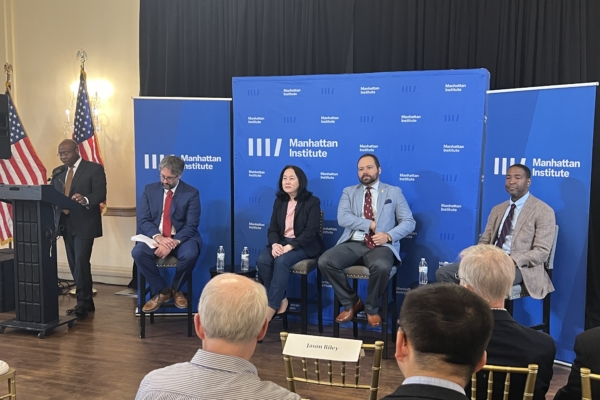
The United States Supreme Court ruled in 2023 that considering racial factors in college admissions violates the Fourteenth Amendment of the Constitution, prohibiting the use of racial preferences in university admissions. Following this landmark ruling, many universities stated they would comply with the decision, but some institutions redesigned their admissions policies to retain considerations based on race. On June 11, the conservative think tank Manhattan Institute held a forum titled “Temporary Trend or Turning Point? The Road to a Future of Race-Free Equality”.
The forum discussed whether some universities’ “flexible” inclusion of racial factors in admissions aligns with the spirit of the Harvard case ruling. It also explored the arguments suggesting that implementing admissions policies based on socio-economic status (SES) as an alternative to “racial equality actions” could bring about challenges.
The discussions were divided into two groups: “Group One: The Ideal of Race-Free and Campus Responses” and “Group Two: Class and Racial Preferences and the K-12 Frontline”. They delved into the origins, current status, and persistence of affirmative action, the backlash against Diversity, Equity, and Inclusion (DEI) initiatives, and the path to achieving genuine equality in education and other fields.
In the first group discussion, Ilya Shapiro, Director of Constitutional Studies at the Manhattan Institute, explained the legal implications of the Harvard admissions discrimination case ruling: universities cannot use race as an admissions factor but may consider individual experiences (such as overcoming adversity) as long as these are not “proxies” for race. He noted significant variations in how different universities have implemented the ruling, with some schools (like Harvard and Yale) showing minimal changes in racial composition while others use “flexibility” as an alternative variable. The ruling put an end to the practice of using diversity as a guise for racial balancing, but the extent of enforcement depends on oversight by the courts and administrative bodies.
Wai Wah Chin, adjunct researcher at the Manhattan Institute and founding president of the New York Coalition of Asian American Leaders, stated that President Kennedy originally established affirmative action to combat racial discrimination and not to use race as a selection criterion. However, she argued that the policy has since “degenerated” into a tool for “judging people based on race”. She believed that racial quotas are fundamentally the wrong approach, merely masking the issue without addressing the root causes of disparities in education resources.
Chin stated that the mission of universities is to pursue knowledge and skills, focusing on advancing individuals with exceptional abilities rather than seeking to achieve a balance of skin color, gender, or race in admissions. She advocated for a return to an admissions system based on “merit and character”, emphasizing that true diversity should stem from a variety of perspectives and thoughts rather than superficial characteristics like skin color or background.
Philosophy Associate Professor at Colorado State University, Andre Archie, viewed the current era as a “turning point” towards a society free of racial bias.
In the second group discussion, liberal Richard Kahlenberg, Director of the Economic Equity Project at the Progressive Policy Institute, supported replacing race-based affirmative action with class-based preferences, arguing that this approach aligns more with principles of fairness and enjoys broader public support. He highlighted that the public strongly opposes racial preferences but widely supports policies that assist economically disadvantaged students.
Maimon Schwarzschild, a law professor at the University of San Diego, expressed skepticism about class-based preferences as a replacement for race-based preferences, warning that while it may seem more appealing than racial bias on the surface, it carries potentially greater risks. He cautioned that any biased system, whether based on race or class, is susceptible to becoming bureaucratic and expanding, akin to how racial bias has “engulfed” higher education.
Schwarzschild pointed out that class-based biases may require an ideological framework to justify their legitimacy, similar to how diversity, equality, and inclusion efforts under racial biases and critical race theory could incite class conflicts reminiscent of those in 20th-century Europe, leading to societal divisions. Additionally, defining class is challenging, as solely relying on family income or wealth may not adequately measure it, potentially leading to bureaucratic manipulation of standards. He noted that many economically disadvantaged individuals are immigrants or children of immigrants, and if class-based biases result in providing them with “unequal opportunities”, it could exacerbate local voters’ animosity towards immigrants, even legal ones, further fueling anti-immigrant sentiments.
He argued that class-based biases may pose greater dangers than racial biases due to their larger scale, ambiguous definitions, susceptibility to abuse, and deviation from academic merit principles.