
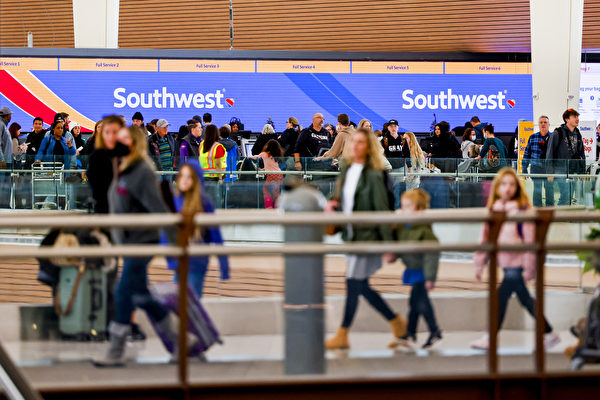
Southwest Airlines announced a major change on Tuesday, March 11th, that will begin charging for checked baggage, overturning the unique operational strategy the airline has had for decades.
This change symbolizes a significant transformation for Southwest Airlines. In the past, the company was known for its “two free checked bags” policy and insistence on open seating. However, in order to increase revenue, Southwest Airlines has started adjusting various operational policies in recent years, including introducing Basic Economy, abandoning the open seating system, and implementing stricter restrictions on ticket refunds and changes.
Starting on May 28th, all passengers except for those purchasing the highest tier Business Select tickets will need to pay for checked baggage. Business Select passengers will still be able to check two bags for free, and A-List Preferred members will also enjoy the same benefit. A-List members and Southwest Airlines credit card holders can check one bag for free.
As for specific fees, Southwest Airlines has not yet announced the standards. Taking Delta Air Lines, American Airlines, and United Airlines as references, checked baggage fees from these competitors typically start at $35 per bag.
Southwest Airlines was once known for its simple and transparent fare structure, free baggage, and open seating model, standing out in the market. However, with increasing industry competition, this airline, which used to challenge traditional carriers, now has to accept market realities and gradually move closer to traditional airline operational models.
After investment firm Elliott Investment Management acquired a stake in Southwest Airlines last year, the company faced growing revenue pressure and the need for improved financial returns. Despite the management’s long-standing insistence on the free baggage policy, the board expressed skepticism and demanded a reassessment of the financial strategy.
According to internal data analysis at Southwest Airlines, implementing baggage fees could generate an additional $1.5 billion in annual revenue but may result in a loss of $1.8 billion in market share. However, facing the widespread implementation of baggage fees by competitors, the company ultimately chose to concede.
In addition to baggage fees, Southwest Airlines also plans to introduce Basic Economy, similar to counterparts’ fare types, offering lower prices but with more restrictions: no refunds, no flight changes, no free changes in flight dates, and no same-day standby.
Furthermore, unused ticket points will only be valid for six months, while other ticket points will have a validity period of 12 months (previously, Southwest Airlines ticket points were valid indefinitely).
Additionally, Southwest Airlines announced last year that it would gradually phase out open seating and transition to an assigned seating system, as well as planning to introduce extra legroom seats to attract more premium customers.
Amid industry dynamics, Southwest Airlines, with its “employees first” approach, is undergoing a crucial transformation. In February 2024, Southwest Airlines announced laying off 1,750 corporate employees for the first time in the company’s history.
CEO Bob Jordan has stated, “You can’t stay unchanged, but we will still adhere to the core values of the company.”
(Reference sources: CNBC and The Wall Street Journal)