
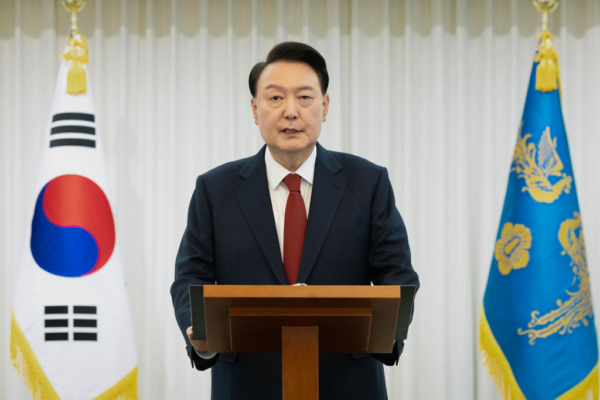
According to a report on Monday (December 30th), South Korean investigators have applied to the court for an arrest warrant against President Yoon Suk-yeol, marking the first time a sitting president in South Korea faces such action. Earlier this month, he was suspended from office for briefly implementing martial law.
Authorities in South Korea are investigating whether his actions on that day amounted to treason. The Corruption Investigation Office for High-ranking Officials confirmed to the Associated Press that they have requested an arrest warrant from the Seoul Western District Court and plan to question Yoon Suk-yeol on charges of abuse of power and plotting treason.
Treason is one of the few charges in South Korea that the president does not have immunity against. As part of the investigation, police had attempted to raid the presidential office but were unsuccessful. The Seoul court will decide whether to issue the arrest warrant based on the request.
Yoon Suk-yeol’s lawyer, Yoon Kab-keun, has called the arrest request “unfair” and stated that the anti-corruption agency does not have the authority to do so.
“The declaration of martial law was within the president’s authority,” the lawyer told reporters. He has submitted written opinions on the arrest warrant request to the Seoul Western District Court along with his attorney appointment letter.
On the night of December 3rd, Yoon Suk-yeol announced a state of emergency citing “conspiracy of anti-state forces to overthrow the government,” accusing the opposition controlling the parliament of paralyzing the government through anti-state activities related to North Korea. Despite deploying military and police to block the parliament, opposition lawmakers managed to break through and carry out a vote, leading to the lifting of martial law after a 6-hour ordeal.
However, Yoon Suk-yeol was impeached by the parliament for the decision to impose martial law briefly, resulting in the suspension of presidential powers.
The imposition of martial law has left a scar on the Korean people. Despite South Korea now being widely seen as a beacon of democracy and peace in Asia, prior to winning the democracy struggle in the 1980s, the country endured decades of military dictatorship, with martial law imposed 16 times.
Reuters reported that the Constitutional Court has begun hearings to determine whether to reinstate Yoon Suk-yeol to the presidency or permanently remove him from office. The court has 180 days to make a decision. According to the Associated Press, if he is ultimately removed from office, South Korea will hold elections within 60 days.
Last Friday (December 27th), the court held the first preparatory hearing where Yoon Suk-yeol’s lawyer requested a delay in the proceedings for better preparation, but the request was denied. The court stated that it would proceed swiftly, with the next hearing scheduled for January 3rd.