
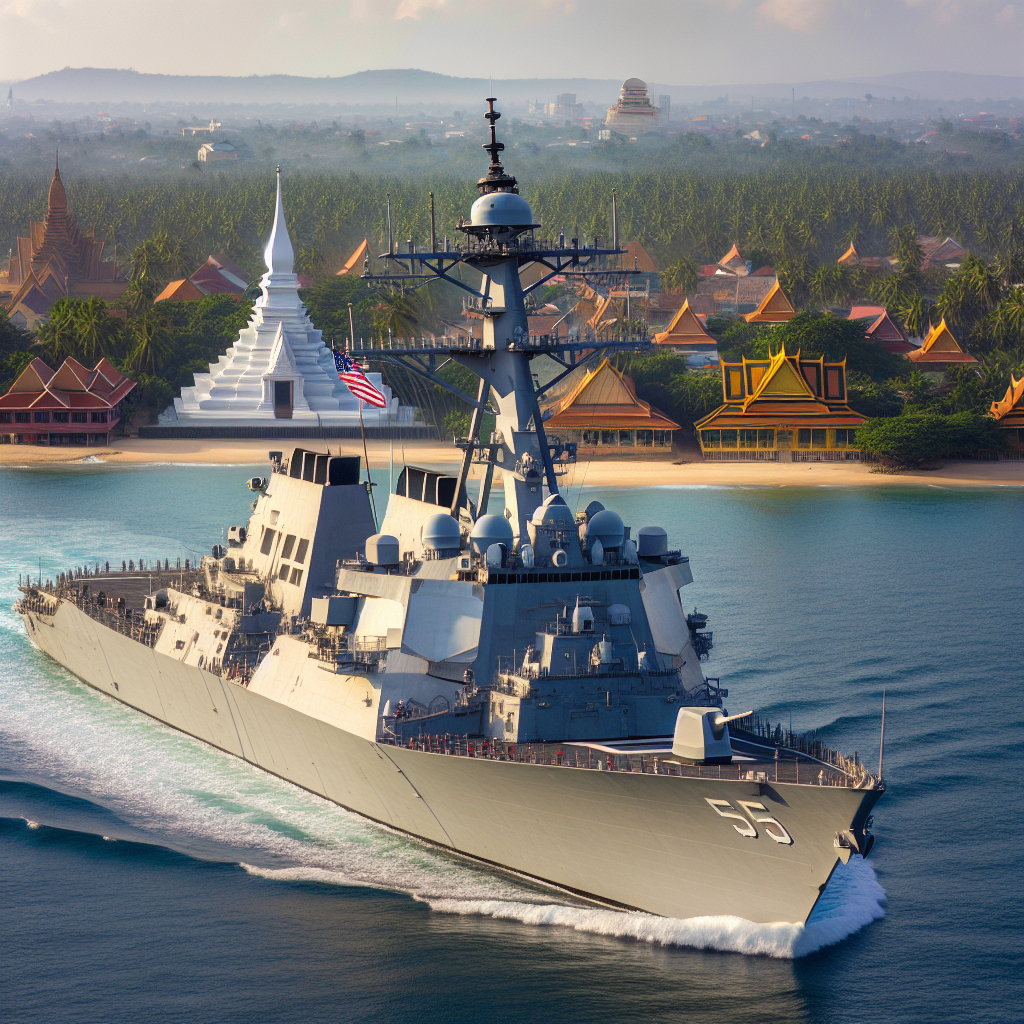
The USS Savannah destroyer of the United States Navy departed from Cambodia last Friday, after a five-day stopover. This marked the first visit of a U.S. warship to the Southeast Asian country in eight years. Analysts suggest that despite Cambodia’s close partnership with China, the visit of the U.S. warship indicates Cambodia’s efforts to enhance its relationship with the United States.
The USS Savannah arrived at the port of Sihanoukville in Cambodia on Monday, just about 30 kilometers away from the Yunlong Naval Base, which was rebuilt with funding from China. The base has raised concerns among U.S. analysts as it is seen as a potential permanent base for the Chinese military.
The Cambodian Ministry of Defense stated that the five-day visit of the U.S. warship aimed to “strengthen and expand friendship” and “promote bilateral cooperation.”
In June 2024, the U.S. Secretary of Defense Lloyd Austin met with Cambodian Prime Minister Hun Manet and Defense Minister Tea Banh, and both sides agreed to strengthen bilateral defense relations.
Recent years have seen tensions in Cambodia-U.S. relations due to Cambodia’s anti-democratic reforms, human rights violations, and increasing presence of China in the country, particularly concerning the Yunlong Naval Base issue, which led the U.S. to impose sanctions on two senior Cambodian military officials in 2021 for benefiting from the Chinese base construction.
However, analysts believe that the port visit of the U.S. warship and official commitments indicate Cambodia’s desire to dispel the perception of being a vassal state of Beijing.
Abdul Rahman Jacob, a researcher at the Lowy Institute in Australia, stated, “I think the Cambodians are trying to show that they are not picking sides between China and the U.S.”
Jacob mentioned that Cambodia’s move to welcome U.S. defense forces back to its coast demonstrates its professed neutrality principle to other countries in the Asian region.
Seun Sam, a policy analyst at the Royal Academy of Cambodia, told Voice of America that the international focus on Cambodia’s relationship with China overshadows its good relations with the United States and other countries as proven by the warship’s visit.
For a small country aiming to “enhance military capabilities,” cooperating with China in defense infrastructure development is considered normal, said Sam.
Nonetheless, a single port visit may not be enough to allay U.S. concerns about China’s military influence in Cambodia, indicating possible fluctuations in the U.S.-Cambodia relations.
Sam noted that while the warship stopover is a “good start,” it may not lead to a full restoration of ties between Cambodia and the U.S. as the U.S. will continue to criticize Cambodia for allowing China to establish military bases within its borders.
At the time the USS Savannah was at Sihanoukville port, two Type 056A corvettes of China, the “ABA” and “Tianmen”, had been stationed at the Yunlong Naval Base for nearly 12 months.
Cambodian officials previously stated that these Chinese ships were there to conduct training activities with the Cambodian Navy.
Sun Kim, Assistant Dean and Lecturer of the College of Social Sciences and International Relations at the University of Cambodia, pointed out the strategic importance of the Yunlong Base for China due to its proximity to potential conflict areas and vital sea lanes in the South China Sea.
Kim also mentioned that the Yunlong Base is crucial for China’s oil and gas transportation, facilitating China’s fuel transportation from Africa and the Middle East. Moreover, in case of conflicts in the South China Sea or the Taiwan Strait, the Yunlong Base could become even more significant.
“If China needs to deploy its navy, Yunlong could be one of the bases deployed by China,” stated Kim.
Despite this, according to Cambodian law, foreign troops are not allowed to permanently station in the country or conduct military operations through Cambodian bases. Cambodia denies Chinese control over the Yunlong Base.
Last Friday, Cambodian former Prime Minister and current President of the Senate, Hun Sen, announced on his Facebook page that Japan would be granted access to the Yunlong Naval Base, inviting Japanese warships to dock.
This announcement was made during the visit of Japanese National Security Advisor Katsuo Akiba to Cambodia. Hun Sen’s post included a video of his meeting with Katsuo Akiba, praising Japan as a recognized regional partner.
(Source: Voice of America)