
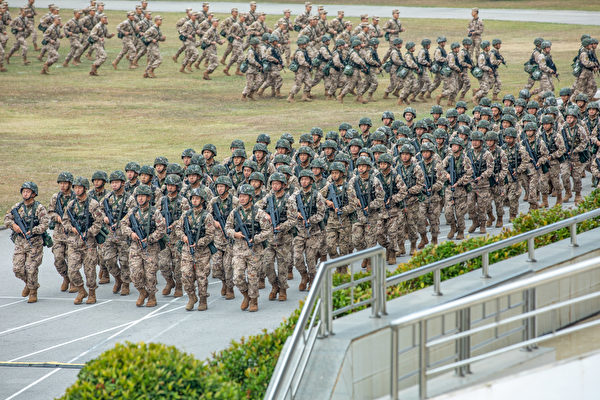
Ukraine’s counterattack entering Russian territory aims to draw Russian forces back for defense. Moscow is reluctant to abandon its current overall offensive but struggling to gather enough elite troops to resist Ukraine’s counterattack, finding itself in a dilemma. There are suspicions from the international community that the Chinese Communist Party (CCP) might send troops to support Russia, perhaps motivated by the dynamics within the Zhongnanhai, but it also faces significant challenges.
The CCP hopes for the conflict between Russia and Ukraine to continue indefinitely, serving as a distraction for the White House and exerting pressure on NATO countries. By prolonging the conflict, the CCP can diminish the pressure of isolation it faces. If a ceasefire occurs between Russia and Ukraine, the United States and its Western allies might then focus their efforts against the CCP.
Even though Ukraine has occupied some Russian territory, it pales in comparison to the land Russia has taken in Ukraine, giving Ukraine leverage in negotiations. With most of Russia’s elite forces deployed on the front lines and a lack of combat-ready troops in the rear, it is challenging for Moscow to repel Ukraine’s counterattack in the short term. If Moscow is forced to negotiate, the calculations within the Zhongnanhai become more complicated. Directly sending troops to assist Russia to sustain Moscow’s long-term operations might be an option.
Seventy-four years ago, despite internal opposition, Mao Zedong blindy ordered troops to Korea even while Lin Biao feigned illness. Today, the CCP might face similar blind decision-making.
In 1962, Mao launched a war against India but later unilaterally announced unconditional withdrawal after victory. The failure of the Great Leap Forward eroded Mao’s authority, prompting him to use a limited war to divert internal conflicts and bolster his prestige. The 1979 Sino-Vietnamese War was also a political maneuver by Deng Xiaoping to consolidate military power.
The current CCP leader has served as the Chairman of the Military Commission for 12 years without actual military experience, resulting in chaos within the military ranks and a lack of trust among leaders. The Zhongnanhai now faces unprecedented internal pressures, with central authority weakened, rampant rumors, and the possibility of the CCP leader emulating Mao and Deng by deliberately engaging in a limited war to shift focus and consolidate power, potentially implementing military control to tighten grip over society.
The war between Russia and Ukraine has lasted over 900 days, with Beijing covertly supporting the Russian forces in a proxy war. While maintaining a facade of neutrality, Beijing fears facing significant sanctions from the U.S. and European countries. Should the CCP intervene militarily, they would open themselves to retaliatory sanctions, straining the capacity of the Zhongnanhai.
Moscow relies on Beijing for support, giving the Zhongnanhai some leverage over the Kremlin. If the CCP decides to directly engage in the conflict, Beijing will be tied to Moscow, uncertain of who holds the upper hand; both parties engaging in the war would weaken each other. Progressing from backing a proxy war to direct military involvement, the CCP would face heightened challenges.
Seventy-four years ago, the CCP participated in the Korean War under the guise of “Resisting U.S. Aggression and Aid Korea.” If they were to send troops to aid Russia today, whom would they claim to resist? As the U.S. and NATO forces are not directly involved, declaring “Resist Ukraine and Aid Russia” would position the CCP as openly engaging in an aggressive war, implicating them as war criminals.
Another slogan the CCP used in the Korean War was “Protecting the Home and Defending the Country,” but they always fought as a volunteer army, undermining the logic of “protection.” Sending troops to aid Russia would place them far from the homeland, making it challenging to claim they are protecting the country.
In the past, the CCP supported North Korea’s war and later directly entered the battlefield, diverting forces prepared to attack Taiwan to the Korean Peninsula. The U.S. Seventh Fleet immediately assisted in defending Taiwan, thwarting the CCP’s invasion plan. Should the CCP send troops to aid Russia, their invasion plan for Taiwan could face failure again, potentially inviting coordinated strikes from the U.S. and its allies. The vast strategic risks would strain the Zhongnanhai’s capacity.
Currently, there are two battlefronts in the Russia-Ukraine war: one in Ukraine where Russian forces are mainly on the offensive and the other in the Kursk region of Russia where Ukrainian forces are attacking, putting Russian forces on the defensive.
If the CCP were to mobilize troops, they would most likely station them in the Kursk region of Russia. As Russia is hesitant to mobilize frontline troops back for defense, they might rely on the CCP to defeat the Ukrainian forces. The Zhongnanhai could potentially claim to be assisting Russia in repelling Ukraine’s invasion, skirting the label of directly engaging in Russia’s aggression against Ukraine.
To effectively aid Russia, the CCP would need to deploy heavily armored units, including tanks, armored vehicles, artillery, and rocket launchers, prepared for a significant offensive against Ukrainian forces. Merely fortifying defenses with trenches would offer scant aid to the Russian forces. Without the quick expulsion of Ukrainian troops, the conflict would prolong, pushing Moscow towards negotiation. Thus, if the CCP intervenes, they must provide sufficient troops and equipment to repel the Ukrainian forces.
If Ukraine deploys 10,000 troops in the Kursk region, the CCP would need to commit at least three times that number to mount a large-scale counterattack. The CCP has 13 group armies, with three in the Eastern, Northern, and Central theater commands, and two each in the Southern and Western theater commands.
The three group armies in the Eastern theater command may not be reassigned, while pulling one from the Southern theater command risks compromising defense in other areas. The three group armies in the Northern theater command, with one based in the Shandong Peninsula, if redeployed, would weaken coastal defenses in the Shandong Peninsula, Yellow Sea, and southern Bohai Sea. The second group army is stationed in the Liaodong Peninsula, and reassigning it would jeopardize defenses in the Liaodong Peninsula and the northern Bohai Sea coast. The third group army is deployed in Heilongjiang and Jilin, overseeing both the Sino-Russian and Sino-North Korean borders; any reassignment would expose vulnerabilities on both fronts.
The three group armies in the Central theater command are mainly situated around Beijing and largely immobile. The 83rd group army, possibly the most accessible reserve unit, stationed in Henan and Shaanxi, may be mobilized; however, the 83rd group army has two brigades stationed in Weinan, Shaanxi, poised to support the potential relocation of the central government to Shaanxi during wartime, potentially impacting the wartime capital plan if reassigned.
The Western theater command comprises the Xinjiang and Tibet military regions and two group armies. The Xinjiang military region’s main task is local surveillance and border defense, while the Tibet military region undertakes similar responsibilities. Considering past conflicts along the Sino-Indian border, the forces in these regions are largely committed.
One group army in the Western theater command is stationed in Gansu, Ningxia, and Qinghai, tasked with supporting the Xinjiang military region and suppressing discontent among Uyghur populations. The other group army is stationed in Tibet, Sichuan, and Chongqing, tasked with supporting the Tibet military region and containing Tibetan dissent. Should these forces relocate, the Zhongnanhai could face internal disorder.
The CCP’s decision to mobilize troops would pose challenges regardless of the theater command from which they draw forces, complicating logistics and considering the available weapon systems. Emphasizing offensive operations, tanks are paramount, but CCP tanks lag behind in capability.
The CCP’s most numerous tank model is the Type 96 tank, dubbed a third-generation tank but still an advanced version of an older design. Recognizing its shortcomings in comparison to Russian T-72 tanks, the CCP has yet to initiate a replacement plan. The newest model, the Type 99 (A) tank, touted as a third-generation tank, though utilizing some Russian components, still falls short of the superiority of the T-90 tank, failing to match Western tank capabilities.
The Type 99 tank equips only certain group armies, including the 81st and 82nd group armies around Beijing, the 79th group army on the Liaodong Peninsula, and the 76th group army in Gansu and Ningxia. The likely reserve unit, the 83rd group army from the Central theater command, still utilizes the older Type 59 and Type 15 light tanks.
The CCP would likely field the Type 99 tank if they intervene, avoiding deploying the outdated Type 96 tank. However, even with the Type 99 tank, the CCP may struggle to achieve victory.
If the CCP decides to send troops, they would aim for a decisive victory, but would the CCP’s forces surpass the Russian military?
Current estimates suggest Russian forces in Ukraine have incurred around 450,000 casualties, with approximately 520,000 troops deployed within Ukrainian territory. If the CCP deploys only one group army to engage Ukrainian forces, failure in offensive operations may allow room for deception; however, sustained losses leading to a retreat would be difficult to explain.
After the Sino-Vietnamese War, the CCP’s military remained untested in combat. Corps corruption plagues the officer system, contributing to tactical weaknesses. Today, political commissars hold significant sway, potentially undermining the military’s effectiveness even further, with the CCP’s forces likely exposing flaws sooner than the Russian military.
Once the CCP’s limited fleet of Type 99 tanks is compromised, and armored vehicles prove ineffective, maintaining a large-scale offensive becomes challenging, inevitably devolving into a protracted conflict requiring defensive efforts.
If one group army falters or suffers heavy losses, would the CCP then deploy the second or third group army? The CCP’s military commission can mobilize its reserves but may struggle to equip them adequately, echoing the challenges faced by Russian forces. While Russia can refurbish a significant inventory of former Soviet tanks, the CCP lacks that infrastructure and cannot readily transfer current equipment to reserve units.
Drawing extensively on reserve forces, the CCP could risk exposing them to enemy fire, without significantly influencing the battle’s outcome. Eventually, much like the Korean War, the CCP might find themselves unable to progress beyond a certain point, reliant on negotiations. While the CCP boasted a stalemate against the U.S. in Korea, they might now face resistance from Ukraine, mirroring a comparable conflict outcome.
The CCP’s multi-rocket system derived from Russia lacks precision. The CCP’s artillery has transitioned to NATO 155mm standards but faces inexperience in actual combat deployment, with logistical challenges in ammunition supply. The CCP adheres to Russian artillery tactics of massed fire rather than precision strikes.
While the CCP boasts battalion-level firepower exceeding that of the U.S., the CCP recognizes the U.S.’s reliance on air superiority. Knowing the challenges in obtaining immediate air support, the CCP leans primarily on ground firepower, equipping armored vehicles with large-caliber guns to compensate for a lack of aerial cover. The reduced deployment of Russian helicopters and potential U.S.-made anti-aircraft systems further complicate the CCP’s preparedness.
Should the CCP mobilize its forces, it is evident they lack aerial protection, as the Russian Air Force would not heed the CCP’s commands. Should the CCP deploy its Air Force to Russian territory, the J-20 or J-16 aircraft in combat would face immediate vulnerabilities. Additionally, the CCP’s ability to counter Ukraine’s vast drone attacks remains uncertain.
Although the CCP may consider military intervention, they face numerous challenges. Does the Zhongnanhai truly dare to take the risk?
(Da Ji Yuan original)