
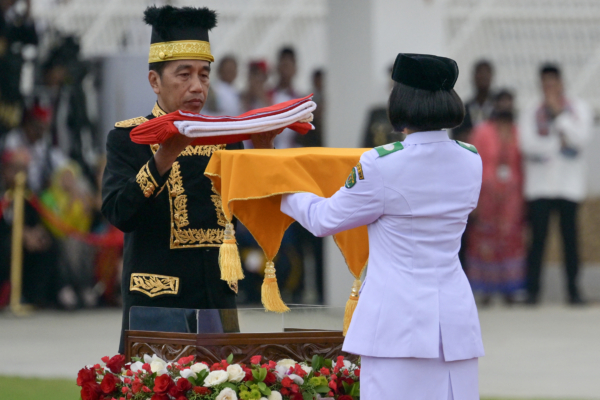
On Saturday, Indonesia celebrated its Independence Day anniversary in the planned new capital city of “Nusantara”. The event was scaled down as the future capital is still under construction.
Indonesian President Joko Widodo, also known as Jokowi, presided over the 79th Independence Day celebration at the new State Palace located at the Nusantara Center. In the background stood the dark and eagle-shaped Garuda Palace, named after the mythical Garuda bird in Indonesian mythology, serving as the new landmark of the capital.
Approximately 1,400 people attended the three-hour-long event, which included a grand flag-raising ceremony, a military parade, aerial performances, and cultural displays. Guests included government officials, political figures, business leaders, and 20,000 workers involved in the construction of the new capital.
Most attendees were dressed in traditional attire representing different provinces of Indonesia. Around the palace complex (administrative center), hundreds of local residents also watched the ceremony.
Nusantara is situated in a forest area on the eastern side of the island of Borneo, about 1,200 kilometers away from the current capital, Jakarta. The construction of the new capital is divided into five phases, with the initial focus being on the approximately 6,600-hectare “core area”, which serves as the administrative center. Officials claim it is “90% completed”. The completion of all projects is expected by 2045.
Due to delays in construction and a lack of private investments causing limited accommodations and food supply, the number of guests attending the Independence Day ceremony was significantly reduced from the initial 8,000 to 1,400. Nevertheless, Jokowi remains determined to continue with the event.
Jakarta still serves as the current capital of Indonesia. Vice President Ma’ruf Amin also held an Independence Day ceremony simultaneously at the Merdeka Palace in Jakarta, attended by foreign dignitaries and other guests.
In recent months, Jokowi has personally attended groundbreaking ceremonies for hotels and office buildings to boost confidence in the mega project. He also held the first cabinet meeting at the Garuda Palace.
Jokowi will complete two consecutive five-year presidential terms in October this year. His successor, current Defense Minister Prabowo Subianto, expressed during the cabinet meeting his belief that the preparations for the relocation are likely to be completed within the next three to five years.
He pledged to deploy more experts to expedite the project, stating, “We will finish it well because it is really needed.”
The plan to relocate the capital was proposed as early as 2019, with Jokowi highlighting the strategic location of Nusantara, situated at the center of Indonesia with lower risks of tsunamis, earthquakes, or volcanic eruptions. Jakarta will continue to serve as the country’s commercial and economic center.
The new capital is gradually evolving into a modern administrative center. Two new palaces overlook 16 six-story buildings, set to become government office locations, with a new central bank building under construction nearby.
Further away, 47 apartment buildings are being constructed to accommodate thousands of civil servants and their families, with some units expected to be occupied next month, becoming the first wave of residents in the new capital.
Jokowi envisions the city becoming a model for other regions in Indonesia. The capital is projected to use renewable energy for power generation and feature modern, low-carbon public transportation. The cityscape will incorporate parks, ponds, pedestrian pathways, and bike lanes. All government buildings, ministerial offices, and civil servant residences will have drinkable tap water, a first in Indonesia.
However, the area around Nusantara was originally the habitat of wildlife such as orangutans and proboscis monkeys. Some conservationists express concerns that development and human resettlement may disrupt the environment and threaten the ecology.