
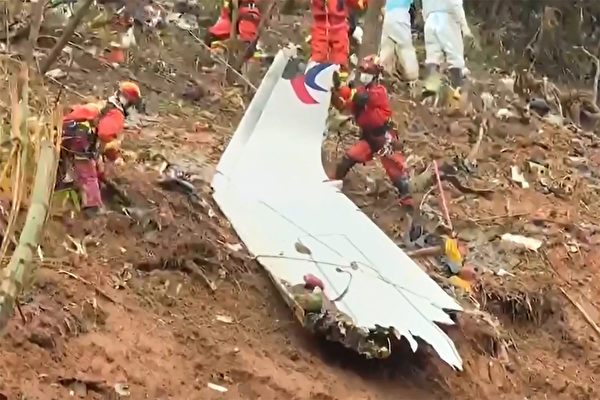
The National Transportation Safety Board (NTSB) of the United States has released crucial flight information of China Eastern Airlines flight 5735 before the crash. These details were kept hidden by the Chinese Communist Party for four years and were made public for the first time on Thursday (April 30).
The document, titled “Cockpit Voice and Flight Data Recorder,” was submitted by the NTSB to the Chinese authorities on July 1, 2022, spanning 261 pages. The document clearly indicates that both fuel switches of the engines were moved from the run position to the cut-off position when the aircraft was flying at 29,000 feet, which is identified as the key factor leading to the accident.
On March 21, 2022, China Eastern Airlines flight 5735 crashed in a mountainous area in Guangxi, resulting in the tragic death of all 132 people on board, making it one of the deadliest air disasters in China in nearly 30 years.
After four years since the accident, the Civil Aviation Administration of China (CAAC), which led the investigation, has yet to release the final report. Moreover, there has been a delay of two years in releasing the annual investigation update report, limiting the outside world’s visibility into the latest developments surrounding the cause of the accident.
After American netizens requested the NTSB to disclose the investigation information of MU5735 under the Freedom of Information Act (FOIA), the long-sealed document was finally made public. Epoch Times obtained a copy of the document.
According to NTSB regulations, the restrictions on sharing foreign investigation records it takes part in generally expire after two years, allowing the investigation country to issue the final report.
The American aircraft manufacturer Boeing, which produced the crashed plane, and the NTSB overseeing Boeing, were involved in the investigation of MU5735 at the request of the Chinese authorities.
The latest accident report from the CAAC regarding MU5735 was issued in March 2024, two years after receiving the American report. The report still omitted details, only mentioning that no faults or abnormalities were found on the aircraft or engines before takeoff from Kunming, with no issues related to weather or communication. It also stated that the flight crew held valid licenses, had sufficient rest, passed health checks on the day of the flight, and there were no dangerous goods onboard.
In May 2024, The Wall Street Journal reported that data from the flight data recorder pointed towards intentional manipulation leading to the crash of the plane. The CAAC refuted the claim, stating that the rumors of intentional crash misleading the public and interfering with the investigation work.
In May 2025, a piece of information surfaced on a Chinese social media platform titled “Government Information Public Request Response of the Civil Aviation Administration of China,” revealing that a Chinese netizen requested updates on the progress of the investigation into the crash of flight MU5735. The official response declined to disclose the information citing potential threats to national security and social stability.
In June of the same year, Liu Shaoyong, the then chairman of China Eastern Airlines, was under investigation for serious violations of laws and regulations and was expelled from the Communist Party in January 2026, leading to speculations linking it to the MU5735 air disaster.
Veteran aviation expert Gao Fei, after analyzing the latest NTSB report, told Epoch Times, “The report itself indicates that human factors caused the plane to crash, turning all the passengers on the plane into sacrificial lambs.”
“The NTSB report also proves one thing, and that is the concealment by the Chinese Communist Party. The CCP has received the report, is well aware of its contents, yet has not disclosed it,” he said. “It’s a cover-up to deceive the public.”
Gao Fei believes the authenticity of the leaked American report is very high.
According to data from the international aviation tracking website FlightRadar24, flight MU5735 started descending rapidly from a cruising altitude of 29,000 feet on the day of the accident, plummeting to 7,425 feet, meaning the plane was descending at a speed of 301 feet per second in just 1 minute and 12 seconds.
The plane briefly climbed 1,175 feet in 10 seconds, but then rapidly descended again, sending its last signal at 3,225 feet during the descent.
As per the latest NTSB report, when the aircraft was at 29,000 feet cruising altitude (23 seconds before the flight data recorder stopped recording), the N2 values of both engines quickly dropped below the critical level for generator shutdown. This was due to both fuel switches of the engines being moved from the run position to the cut-off position. Following the fuel switch change, the engine speeds decreased.
Three seconds later, the control column was pushed downward, and the control wheel had abnormal movements. Twenty seconds later, due to the power being cut off, the Flight Data Recorder (FDR) stopped working. At that time, the aircraft had descended to approximately 26,000 feet. The FDR failed to record the remaining descent process and the final moments of the accident.
Based on the NTSB investigation, the aircraft showed drastic changes in parameters such as control column force, pitch, and roll angles before the crash, indicating that after entering an uncontrolled or abnormal state, the control inputs were highly unusual.
The composition of the flight crew of flight MU5735 has been a point of discussion. Sun Shiying, the Chairman of China Eastern Yunnan Company, disclosed that the flight hours of the captain, the first officer, and the observer were 6,709 hours, 31,769 hours, and 556 hours, respectively.
Rumors later circulated online claiming that investigators had identified the most experienced but demoted first officer as the pilot who committed suicide in retaliation for the demotion.
Following the incident, the Chinese authorities stated that during the rapid descent of the aircraft, the pilot did not respond to repeated calls from air traffic controllers and nearby aircraft. Investigators reported no malfunctions found, and the operational behavior of the flight crew was under investigation.