
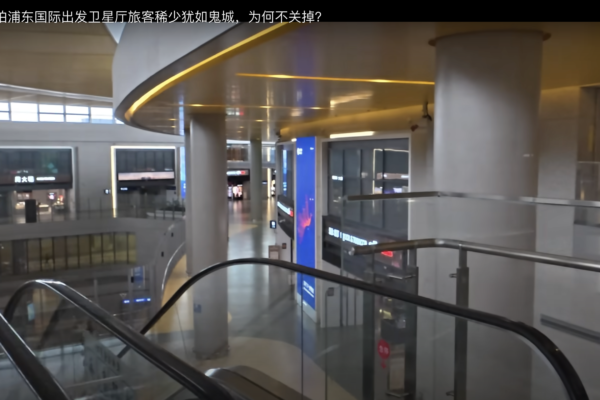
In recent times, the bustling international airport hubs of Beijing and Shanghai, once buzzing with activity, now appear desolate and empty, with duty-free shops shuttered. At the same time, the aviation industry is facing a myriad of challenges such as high debts, overcapacity, and a downgrade in consumer spending. Coupled with geopolitical tensions, major airlines have found themselves trapped in a vicious cycle of “the more they fly, the more they lose.”
Market turmoil has engulfed major airport stocks in China, once seen as economic barometers. According to financial media reports, the stock prices of listed airports in China have witnessed alarming declines. Beijing Capital Airport’s stock price has plummeted from a high of 14.1 Hong Kong dollars to the current 1.71 Hong Kong dollars, representing a nearly 90% drop. Similarly, Hainan Meilan Airport, once known as the “Hawaiian Gateway of China,” saw its stock price plunge from 51.95 Hong Kong dollars to 5.21 Hong Kong dollars, evaporating about 90% of its market value.
This collapse is not limited to individual companies but represents a collective breakdown of the entire industry. Stock prices of Shanghai Airport have fallen from 88.9 Chinese yuan to 27.19 yuan, while Baiyun Airport dropped from 23.69 yuan to 8.31 yuan.
Analysts attribute the significant decline in airport stocks to a drastic reduction in passenger flow through the terminals. Even China’s duty-free giant, China Duty Free Group (CDFG), has witnessed a staggering decline in its stock price from 180 Hong Kong dollars to 37.85 Hong Kong dollars.
Financial data further supports this crisis. Beijing Capital Airport, according to analysis by self-media focusing on civil aviation, has incurred massive losses for six consecutive years since 2020. Despite generating operating income of 5.632 billion Chinese yuan in 2025, a slight 2.54% increase year-on-year, the airport still suffered a net loss of approximately 630 million yuan.
Statistics show that Beijing Capital Airport has accumulated total losses of up to 11.4 billion Chinese yuan over the six-year period.
Recently, netizens at Beijing Daxing International Airport’s arrival hall expressed their astonishment at the lack of crowds during peak flight hours. One traveler remarked, “It’s noon, supposedly the peak flight time, but it seems like there’s only our flight. Are people not coming to Beijing anymore?”
Another traveler passing through Beijing Capital Airport’s T3 Terminal observed the once lively duty-free shops now closed off with some areas cordoned off for “renovations.” The traveler’s video footage revealed numerous closed shops, a sparse flow of people in the tobacco and alcohol section, and a small area left for cosmetics where international luxury brands like Boss, Bally, and CK had mostly closed their doors.
Shanghai paints a similarly grim picture. A traveler who frequents both Pudong and Hongqiao airports, Dai Yu, noted a stark contrast in the international section of Pudong Airport. She described it as deserted, with significantly fewer people compared to before, and many duty-free shops shut down.
According to securities analyst Ken Cao, one of the main reasons for the desolate airport scenes is the aversion of foreign tourists towards China. He cited visa application complexities and difficulties for foreigners in using local payment systems like WeChat and Alipay as logistical nightmares. Combined with policy confusion during the pandemic damaging the international image, many tourists have turned towards destinations like Japan or Thailand instead.
This shift has led to wide-body aircraft originally intended for international long-haul routes being redirected to the domestic market, intensifying competition in domestic routes.
For Chinese airlines, a “non-rational suicidal competition” or “skies internal war” continues to unfold.
The Chinese financial magazine, “Finance,” highlighted the dilemma faced by airline operators, termed as “booming but not prosperous.” In 2025, the average business class ticket price for domestic routes dropped by 2.9% after a significant decline in 2024 to 740 yuan.
To attract passengers, airlines have resorted to a “quantity over price” strategy. Though the passenger load factors of major Chinese carriers like Air China, China Eastern, and China Southern have increased to between 81% and 86%, the core profit indicator of “revenue per passenger kilometer” has seen a downward trend, with China Southern’s decreasing by as much as 4.17%.
Based on the latest financial reports, Air China recorded revenue of 171.485 billion yuan in 2025, yet still incurred a loss of nearly 1.8 billion yuan. This marked the sixth consecutive year of losses since 2020, accumulating a total loss of 72.723 billion yuan.
In 2025, China Eastern also reported losses amounting to 1.633 billion yuan. Among the three major carriers, only China Southern managed to marginally reverse losses, indicating that the industry’s financial pressures remain substantial.
Commenting on the situation, Ken Cao likened the wide-body aircraft, once considered as “money-making machines” before the pandemic, carrying affluent travelers to destinations like Paris and New York, to now catering mainly to domestic travelers due to Chinese consumers tightening their belts.
These large aircraft are now forced to compete fiercely with the domestic high-speed rail network. Cao described this as “the fuller the flights, the faster they lose,” with the entire market engaging in self-consumption.
Despite taking a series of supportive measures, the major airlines have struggled to escape the quagmire of losses since the pandemic. According to Bloomberg, between 2020 and 2025, the “Big Three Airlines” collectively incurred losses of about 209 billion yuan, with only China Southern managing to achieve profitability in one year.
The plight of the aviation industry reflects a microcosm of the shrinking consumption end of China’s macroeconomy. Data from the first quarter of 2026 shows that China’s total retail sales of consumer goods increased by only 2.4% compared to the previous year, with the Consumer Price Index (CPI) nudging up from 0.8% to 1.0%, primarily driven by rising fuel prices, indicating weak consumer demand in China.
Former Shanghai stock analyst Bu Qingsong highlighted that consumption is no longer just a numerical problem but a result of the combined effects of income expectations, job prospects, and social confidence.
This trend is also evident in the tourism market. According to reports by the Southern Metropolis Daily, during the recent “May Day” holidays, there has been a surge in domestic travel with tourists flocking to long-haul destinations such as Yunnan, Sichuan, Tibet, and even venturing to smaller airports in third-tier cities.
Data from travel platform “Qunar” showed that high-star hotels in smaller cities are more than 40% cheaper on average compared to those in first-tier cities, with some offering stays in five-star hotels for as low as 300 yuan.
The pain of contracting consumption has also extended to industry professionals. Pilots, once considered “aviation rock stars” with six-figure salaries, have seen substantial salary cuts, flight attendants facing slashed overtime pay, and ground personnel needing to bear training costs to retain their jobs.
However, in a bid to meet Beijing’s requirement for “stable employment,” many struggling airlines continue to recruit new staff, resulting in both senior and new employees enduring low-paying, dismal conditions.
Apart from internal challenges, external geopolitical risks have further burdened the industry. Bloomberg’s April report highlighted that the conflict in Iran has led to soaring fuel costs. Given the lack of fuel hedging operations among Chinese airlines, they remain extremely vulnerable to fuel price fluctuations.
Additionally, Nathan Gee, the Asia-Pacific transport and aviation research director at a US bank, revealed that by the end of December 2025, the net debt-to-equity ratios of the major airlines had exceeded 200%, indicating immense financial pressures.
According to Bloomberg, the Chinese government is reportedly considering implementing the largest financial relief measures for state-owned airlines since the pandemic. Options being discussed include government subsidies, tax incentives, low-interest loans backed by the state, and even potential mergers involving smaller airlines.
From 2016 to 2025, the “Big Three Airlines” – Air China, China Eastern, and China Southern – received over 120 billion yuan in government subsidies and grants.
However, the government subsidies have not only encouraged rapid industry expansion but have also led to severe overcapacity, resulting in airlines operating loss-making routes and intensifying domestic competition, leading to a vicious cycle of continuously squeezing ticket prices.