
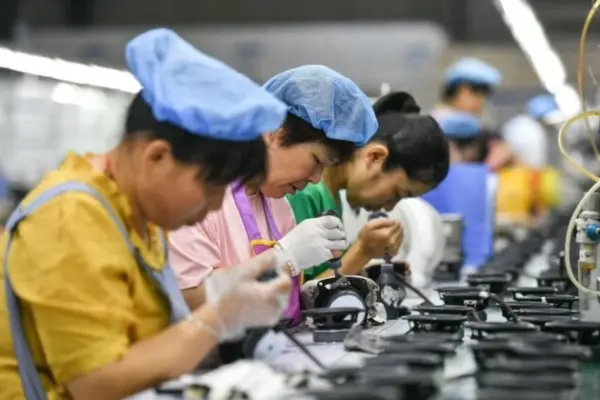
According to a recent survey by Reuters, the Purchasing Managers’ Index (PMI) of China’s manufacturing industry is expected to decrease from 50.4 in March to 50.1 in April, highlighting the increasingly evident impact of the Iran war on the Chinese economy. Some economists believe that China’s economy significantly slowed down in April, making it challenging to achieve the targeted 4.5% growth rate for the year.
The PMI is a monthly macroeconomic indicator that measures the economic conditions of the manufacturing and service sectors. It serves as an international leading economic indicator with 50% as the threshold – above 50% indicates economic expansion, while below 50% reflects economic contraction. It is compiled based on the views of purchasing managers on production, orders, inventory, and employment.
As global oil prices surged due to the Iran war, causing an increase in production costs, China’s manufacturing sector is facing repercussions. Despite China having substantial strategic oil reserves, its economy is not immune to external influences. The intricate web of global interdependencies means that a slowdown in key export markets immediately affects China. Southeast Asian countries, vital sales markets for China, are particularly vulnerable due to energy shortages. A decline in demand in these regions could ripple through the supply chain, ultimately impacting the Chinese economy.
Gero Kunath of the German Economic Institute (IW) warns that the longer the conflict lasts, the greater the pressure on the Chinese economy. Kunath predicts that if the conflict persists for several months or escalates further, the Chinese government may be forced to intervene to salvage its growth goals or abandon them altogether.
Alicia Garcia Elorza, Chief Economist for the Asia-Pacific region at Natixis, cautioned that the Chinese economy is noticeably slowing down, suggesting that achieving the growth target of 4.5% or higher for this year may be difficult.
The automotive and real estate markets have long been key indicators of China’s economic status. However, both sectors have continued to struggle in the first quarter of this year. Official data released in April by the China Association of Automobile Manufacturers shows a 20.3% year-on-year decrease in domestic sales of cars to 4.823 million units and a 23.8% drop in domestic sales of new energy vehicles to 2.006 million units.
The real estate market continued its downward trend in the first quarter. According to the data from the National Bureau of Statistics of China, property market investment in the first quarter decreased by 11.2% to 1.7719 trillion yuan, while sales of newly-built commercial properties dropped by 16.7% to 1.7262 trillion yuan.
Official data shows that economic growth in the first quarter was 5.3%, with most growth concentrated in the first two months. Signs of slowing growth were already evident in March, with retail sales increasing by only 1.7% year-on-year, reflecting subdued consumer confidence.
The impact of the Iran war on the Chinese economy is pronounced in terms of month-on-month growth rates. National Bureau of Statistics data indicates that the month-on-month growth rates for value-added industrial output, fixed asset investment, and total retail sales of consumer goods in March were 0.28, 0.52, and 0.14, respectively, compared to February’s rates of 0.83, 0.99, and 0.49.
Although China’s Producer Price Index (PPI) for industrial activities rose by 0.5% year-on-year in March 2026, ending 41 consecutive months of negative growth, this growth was mainly driven by the raw materials and energy sectors such as non-ferrous metal smelting and rolling processing, chemical raw materials and chemical product manufacturing, and coal mining and washing, rather than a widespread increase in prices of manufactured goods.
The report highlights that inflation driven by rising costs instead of strengthened demand poses a risk to economic growth. Analysts at ANZ Bank believe this trend is “not conducive to economic development”.