
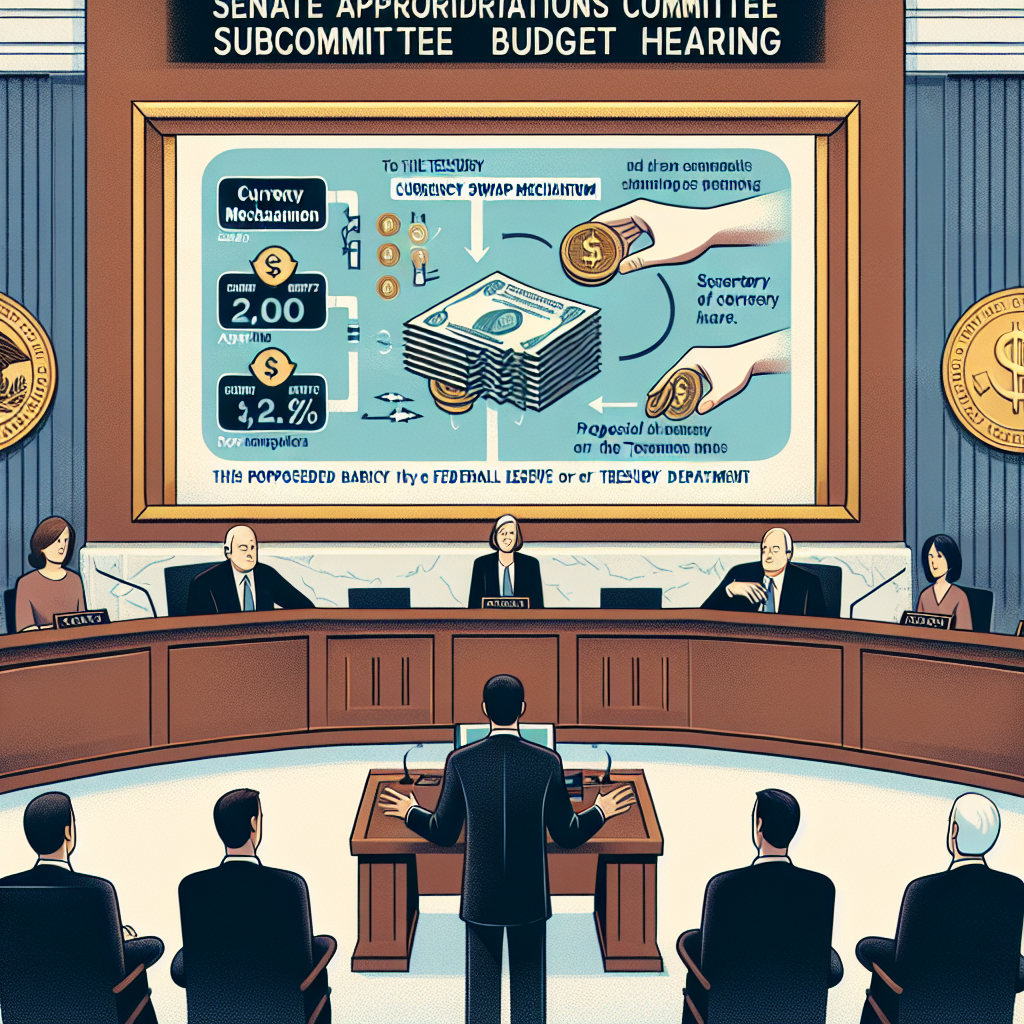
On April 22, during a budget hearing of the United States Senate Appropriations Committee subcommittee, Secretary of the Treasury Scott Bennett stated that the purpose of the currency swap mechanism provided by either the Federal Reserve or the Treasury Department is to maintain order in the U.S. dollar funding market and prevent disorderly selling of U.S. assets. He mentioned that this swap arrangement would benefit both the United Arab Emirates and the United States, with several countries in Asia and beyond expressing similar requests.
Bennett stated in a post on April 24 that for several years, he has been discussing the establishment of U.S. dollar currency swap agreements with many countries, including those in the Gulf region and Asian allies. By expanding permanent currency swap agreements, it would be a significant step towards establishing a new U.S. dollar funding center in the Gulf and Asia region.
Senior political and economic commentator Wu Jialong, speaking on NTDTV’s “News Decoded” program, emphasized that this move is not just a financial strategy but also involves geopolitics. He highlighted the implications of countering the influence of China across various regions, including in trade, finance, and geopolitics. Wu Jialong, a renowned Taiwanese macroeconomist, specializes in macroeconomic analysis, monetary policy, and geopolitical economics.
The U.S. dollar currency swap involves the U.S. providing dollars to foreign central banks at an agreed exchange rate while they pledge their domestic currency as collateral, with the agreement to exchange back at the same rate upon maturity. Wu Jialong illustrated using Argentina as an example. In October 2025, facing severe cash shortages, the Trump administration provided Argentina with $20 billion through a currency swap mechanism, stabilizing the peso’s exchange rate. Argentina has since repaid the funds. In a post on X on January 9, 2026, Secretary of the Treasury Scott Bennett wrote that stabilizing a strong U.S. ally and bringing tens of millions of dollars in profits to Americans is a “America First” perfect deal.
Wu Jialong explained that countries with dollar debt but insufficient USD to repay can mitigate the funding pressure by using the U.S. dollar swap agreement. This way, the U.S. aids these nations in managing financial crises by easing their fund constraints, providing them access to direct financing from the U.S. As a result, many countries facing USD debt pressures gain confidence in the dollar, reducing the reliance on the Chinese yuan.
For instance, if Saudi Arabia were to settle some energy transactions with China using the yuan and faced difficulties, who could assist them? However, with the currency swap agreement in place, the U.S. could step in when needed. Choosing to use the dollar more frequently would enhance confidence in the U.S. currency, safeguarding its status and undermining challenges related to de-dollarization and the internationalization of the yuan.
Wu Jialong pointed out that the primary issue in the U.S. economy is national debt, with interest payments exceeding $1 trillion, surpassing even the U.S. defense budget. The current national debt stands at $38 trillion, and during Trump’s second term, it could rise to $40 or $42 trillion, imposing massive interest costs even with low-interest rates.
Currently, the U.S. national debt is financed through various channels:
1. Governments of various countries, such as Japan, the largest holder of U.S. bonds now, and Gulf countries, replacing China, which previously held significant U.S. debt. The U.S. aims to absorb the surplus positions of Gulf countries back to support U.S. national debt. The Trump administration seeks to solidify these relationships to prevent financing difficulties for the Department of the Treasury if U.S. bonds do not sell well, resulting in higher interest rates.
2. Issuance of stablecoins. In July 2025, the U.S. passed the “Guiding and Establishing National Innovation for U.S. Stablecoins Act” to regulate payment-based stablecoins to develop the market for stablecoins linked to the dollar, boosting demand for U.S. national debt.
Moreover, the U.S. has started selling golden visas for $5 million each and considering using tariffs to raise funds.
Wu Jialong further explained that President Trump’s comprehensive strategy connects to debt management across all aspects, particularly targeting the establishment of currency swap agreements with Middle Eastern countries. These nations possess significant savings and surpluses, predominantly held in USD from oil revenues. The U.S. aims to guide these savings and surpluses into the bond market to support the national debt, intending to establish currency swap agreements with Middle Eastern countries to achieve this goal. To succeed, Wu Jialong stressed that building confidence in the dollar among Middle Eastern countries is crucial for them to reinvest in U.S. bonds, a feat achieved by Trump last year.
Unlike Middle Eastern countries, Wu Jialong noted that certain Asian and South American countries, especially those ensnared by the debt trap of China’s Belt and Road Initiative, face challenges due to forex shortages and may encounter financial crises. Through these currency swap agreements, the U.S. can assist them in managing financial liquidity issues, a strategy to win hearts and counter China’s influence in these regions.
In conclusion, Wu Jialong asserted that while tensions between the U.S. and China encompass trade issues, technology controls, and current energy security concerns, ultimately, it culminates in a monetary war and financial strategy. The establishment of a new U.S. dollar funding center in collaboration with Gulf and Asian allies serves as a critical tactic against China, not only in finance but also intertwining with geopolitics.