
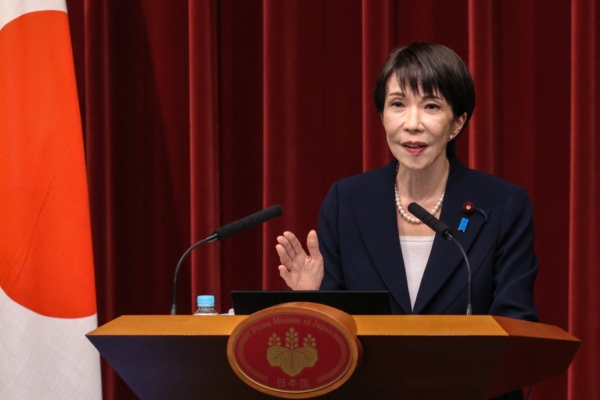
On Monday, April 27, Japanese Prime Minister Sanae Takamichi officially launched an expert committee to conduct a comprehensive review of the “security three documents.” Takamichi emphasized during the meeting that the international order post-Cold War has come to an end, and Japan is now at a crucial moment that “affects the fate of the nation,” requiring a thorough strengthening of the country’s deterrence and response capabilities.
“We are now in a completely different international situation from the past. The relatively stable international order after the Cold War has become a thing of the past,” stated Takamichi.
“In the Indo-Pacific region, we can see the strengthening of China (CCP), North Korea’s military power, and increased cooperation between China-Russia and Russia-North Korea,” Takamichi said. “In such circumstances, in order to steadfastly protect our country’s peace and independence, we must proactively strengthen our defense capabilities fundamentally.”
At the meeting, Takamichi advocated that Japan must draw lessons from the Russia-Ukraine conflict and Middle East tensions, integrating various capabilities such as diplomacy, defense, economy, technology, information, and talents to build a resilient Japanese “comprehensive national strength.”
She emphasized, “We must not let the international community become a place dominated by power, and the rule of law should continue to serve as the basis for Japan’s diplomacy,” reaffirming Japan’s commitment to promoting a “free and open Indo-Pacific region.”
The expert committee held this time is to prepare for the revision of the “security three documents” (also known as the security three files) by the end of this year. The “security three documents” include the “National Security Strategy,” “National Defense Strategy,” and “Defense Force Development Plan,” which are Japan’s highest-level national security policies established at the end of 2022, aiming to establish a “counterattack capability” (enemy base attack capability) and to increase defense spending to 2% of the country’s Gross Domestic Product (GDP) within 5 years.
Under Takamichi Sanae’s direction, the expert group will initiate the task of revising the “security three documents” this year. The committee consists of 15 members, including former Vice Minister of Foreign Affairs Kenichiro Sasaie serving as chairman, as well as individuals and scholars from the Ministry of Foreign Affairs and Ministry of Defense.
According to Japanese media reports, the Liberal Democratic Party and the Japan Innovation Party hope to consolidate opinions from various parties between May and June to form recommendations for the revision of the “security three documents.” Subsequently, the Japanese government plans to develop a revision framework draft in August, expected to be formally approved by the Cabinet around December.
Regarding the budget, the Japanese government has already achieved the goal of defense spending accounting for 2% of GDP ahead of schedule. However, with increased security pressures, the expert group will further discuss the possibility of additional increases.
Of note, senior US officials have expressed their expectation for Japan to raise its defense budget ratio to 3.5% of GDP.
One of the key focuses of this revision is how to address the “new forms of warfare” sparked by drones, artificial intelligence (AI), and quantum technology.
Experts will also discuss whether to revise the “non-nuclear principles.” Particularly, with China and North Korea expanding their nuclear capabilities in recent years, there is close attention on how Japan will handle various nuclear-related issues, such as whether to introduce nuclear-powered submarines.
As reported by Nikkei, differing opinions were voiced among the experts present at the meeting that day. One individual stated during the meeting, “It may be necessary to make the extended deterrence of the Japan-US alliance more effective, perhaps this is one of the topics to explore?”
While the Liberal Democratic Party maintains a cautious stance internally, the Japan Innovation Party advocates that “there should be no limits to the discussion.”