
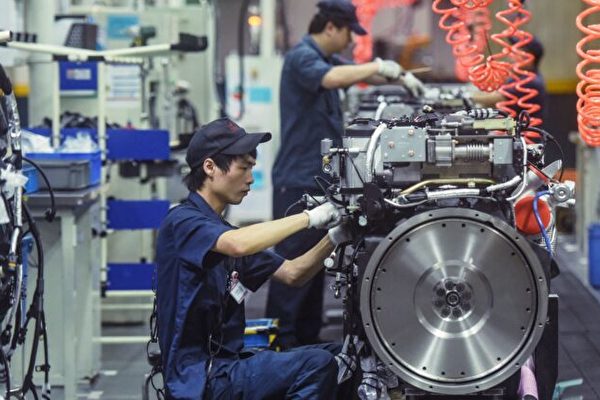
China’s economy continues to decline, and the city of Hangzhou in Zhejiang province is facing challenges in employment for young people and migrant workers. Recently, hundreds of job seekers gathered at the entrance of a factory in the Xiasha Industrial Zone, waiting in line for interviews to compete for limited positions. Dishonest middlemen deceive workers online, leading many young people from other provinces to fall into the trap of fraud.
Video footage from the scene shows a man recording the situation, saying, “Now people are crowded here, the factory needs few people but many come. They only choose 20 out of 300 people, many can’t even get in for the interview. Many out-of-town people from Guangdong and other places come to Hangzhou, thinking there are more opportunities here, but end up stranded.”
The Xiasha area in Hangzhou has long been a gathering place for manufacturing enterprises, including the industrial park established by Japanese company Panasonic and related production enterprises.
An Zhiqiang, engaged in electronic product trading in Hangzhou, said in an interview with a reporter from Dajiyuan that local private enterprises are downsizing and reducing staff. Even local residents struggle to find jobs, and it is even more challenging for people from other provinces. He mentioned, “After the spring, many factories here stopped operating due to lack of orders. Many machines were shut down, and several foreign enterprises also reduced their workforce. A Nordic factory making feed equipment here downsized from 80 employees to just 29, and more layoffs are expected.”
An Zhiqiang explained that with the economic downturn and reduced consumption, the demand for feed in livestock farming has decreased, resulting in slow sales of related equipment.
He added, “Nowadays, layoffs are happening across all sectors. Those still hiring are mostly large foreign-funded companies, such as the Japanese enterprises in Hangzhou, where there are many workers. They only recruit when someone retires, and young, hardworking individuals have a chance. Temporary workers are currently paid 13 yuan per hour, while the government’s standard is 25 yuan. In rural areas like Tonglu and Chun’an, the wage is 22 yuan per hour.”
By official standards, the minimum hourly wage in Hangzhou is 25 yuan, but job seekers have reported that some positions are offered below this level.
Dishonest middlemen deceive workers online, leading to numerous young women from other provinces falling into the trap of fraud. A worker from Yunnan shared on Douyin that he had been in Hangzhou, Zhejiang for a week, saying, “Some people online claim it’s easy to find work in foreign-funded factories in Hangzhou. After coming here, I realized it’s not true. Even a job paying 13 yuan per hour is hard to find. If I can’t find work, I’ll return to Yunnan.”
Another young woman lamented being deceived by dishonest middlemen online, saying, “I gave the middleman various fees, but he didn’t arrange any work for me.”
Wenzhou businessman Liu Mao, speaking under a pseudonym, stated during an interview that the current issue is not just a lack of opportunities in Hangzhou but the entire mainland is experiencing accelerated economic decline. He remarked, “Although Zhejiang’s GDP growth seems stable, the actual situation is severe underneath the facade of false data. Foreign enterprises in China are restricted by authorities. In the eyes of the Chinese Communist Party, foreign companies are seen as profiting from low costs and low human rights, while private enterprises face taxation and fines. With layers of exploitation, no enterprise can survive.”
Hangzhou Customs announced on April 20 that in the first quarter of 2026, the total value of Zhejiang’s goods trade imports and exports reached 1.38 trillion yuan, increasing by 7.1% compared to the previous year. Both imports and exports have maintained double-digit growth for four consecutive quarters. Exports reached 1.04 trillion yuan, a 6.8% increase, marking the first time it crossed the trillion-yuan threshold historically. Imports amounted to 347.31 billion yuan, up by 7.7%.
However, Zhang Mao revealed to reporters that there is a significant amount of padding in Zhejiang’s export trade figures: “According to data obtained through friends within the system, this year’s export value has decreased compared to the previous year; it did not increase by 7.1%. Friends tell me that the reported export data in various regions is severely falsified. Some places repeatedly report taxes, fabricate false taxes to cheat subsidies, and those in higher positions turn a blind eye. This country is beyond help.”
Currently, there is a worsening trend of “hollowing out” in the private economy on the mainland. Between 2024 and 2025, the profit margin of regulated industrial enterprises in Zhejiang continued to be under pressure. A textile industry insider in Zhejiang, Ms. Huang, told reporters that many family-owned foreign trade companies that once supported the local economy are closing down due to industrial chain shifts and reduced orders: “Now, profits have shrunk to less than 3%. Most garment factories are in deficit or have shut down.”
Ms. Huang added, “The situation in Zhejiang has changed. It is no longer a profitable place as before. Many enterprises are not just facing low profits but are beginning to collapse, running at a loss, or even closing down directly. Jiangsu and Zhejiang’s private enterprises have always been seen as a barometer of the economy. If even these private enterprises in Jiangsu and Zhejiang can’t hold on and start shutting down on a large scale, it indicates that the entire economy is in serious trouble.”