
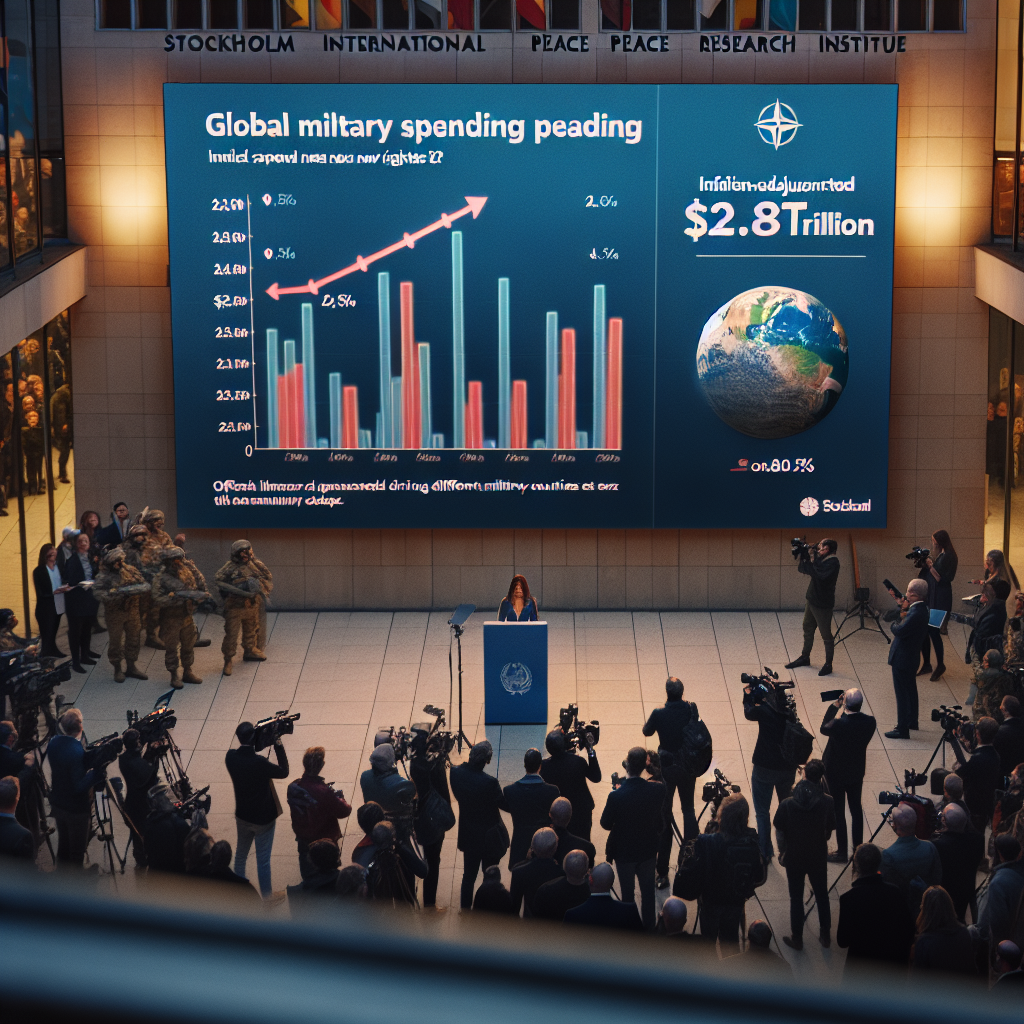
Stockholm International Peace Research Institute (SIPRI) released the latest data on Monday (April 27) showing that global military spending reached a new high of $2.89 trillion in 2025, driven by various countries’ military expansion efforts. After adjusting for inflation, the actual increase was 2.9%, accounting for 2.5% of global GDP, the highest level since 2009. The most notable increase in military spending was seen in Europe, with a 14% surge. In response to the escalating threat from the Chinese Communist Party, Taiwan’s defense spending also reached a new high since 1988.
According to Xiao Liang, a researcher at SIPRI specializing in military expenditure and arms production projects, “Global military spending rose again in 2025 as countries embarked on large-scale military construction in the face of another year of war, uncertainty, and geopolitical turmoil.”
He further pointed out, “Given the current crises and the long-term military spending goals set by many countries, this growth trend is likely to continue beyond 2026.”
As the world’s largest military spender, the United States had a military expenditure of $954 billion in 2025, a decrease of 7.5% from the previous year. Excluding the U.S., global military spending increased by 9.2% in 2025.
This decrease was primarily due to the Trump administration withholding approval for new military aid to Ukraine. However, experts believe that this decrease is temporary. Nan Tian, Director of the SIPRI Arms and Military Expenditure Program, indicated that “The decline in U.S. military spending in 2025 is likely to be a temporary phenomenon.”
He added that the defense budget approved by the U.S. Congress for 2026 has surpassed $1 trillion, and if President Trump’s latest budget proposal is approved, it could rise to $1.5 trillion by 2027.
Additionally, the United States has increased investment in nuclear weapons and conventional military capabilities to maintain its dominance in the Western Hemisphere and deter the Chinese Communist Party.
Overall, as the top three military spenders globally, the U.S., China, and Russia together accounted for $1.48 trillion in military expenditures, representing 51% of the total global spending.
Europe saw the most significant increase in military spending globally, with expenditures surging by 14% to reach $864 billion. Driven by increased NATO spending targets led by the U.S. and the pursuit of “European autonomy,” both Central and Western Europe experienced the most intense annual defense spending growth since the end of the Cold War.
According to SIPRI calculations, the 29 NATO member countries in Europe collectively spent $559 billion in 2025, with 22 countries spending at least 2.0% of GDP on defense.
Among them, Germany’s military spending increased by 24% to $114 billion, accounting for 2.3% of GDP and making it the fourth-largest military spender. This is the first time Germany’s military spending has exceeded the 2% threshold since 1990.
Spain’s military spending increased by 50% to $40.2 billion, exceeding 2.0% of GDP for the first time since 1994.
In Asia and Oceania, military spending increased by 8.1% to $681 billion, marking the largest increase since 2009.
China’s military expenditure continued to rise for the 31st consecutive year, growing by 7.4% to $336 billion. Japan’s spending reached $62.2 billion, accounting for 1.4% of GDP, the highest since 1958.
In response to military pressure from the Chinese Communist Party, Taiwan’s military spending also saw a significant increase of 14% to $18.2 billion, the largest annual growth since 1988.
India ranked as the fifth largest global military spender in 2025, with military spending increasing by 8.9% to $92.1 billion. Pakistan’s military expenditure increased by 11% to $11.9 billion.
As the war entered its fourth year, both Russia and Ukraine saw their military spending as a percentage of government expenditure reach historic highs. Russia’s military expenditure increased by 5.9% to $190 billion, accounting for 7.5% of GDP. Ukraine’s spending increased by 20% to $84.1 billion, with its military burden reaching 40% of GDP.
Military spending in the Middle East remained stable at around $218 billion. Israel’s military expenditure decreased by 4.9% to $48.3 billion as the conflict in Gaza subdued, but still 97% higher than in 2022.
Iran’s military spending increased nominally, but after deducting a high inflation rate of 42%, real spending decreased by 5.6% in 2025, to $7.4 billion. This marks the second consecutive year of decline in Iran’s military spending.
However, SIPRI researcher Zubaida Karim cautioned that Iran often uses “off-budget” oil revenues to finance missile and drone production, suggesting that official figures may underestimate its actual expenditures.