
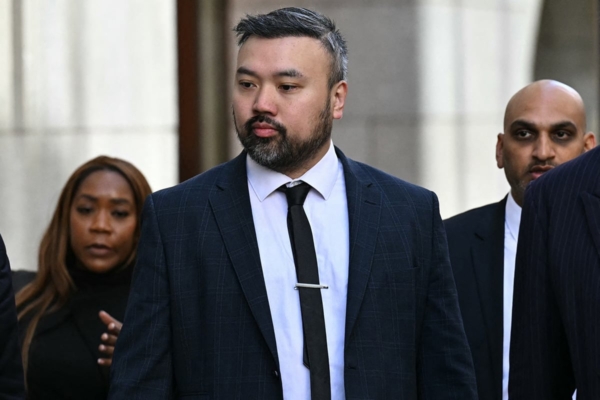
Hong Kong’s case of espionage at the London office of the Hong Kong Economic and Trade Office entered the stage of closing arguments for the prosecution on Wednesday (22nd) local time in the UK. The prosecution pointed out to the jury that the second defendant, Wei Zhiliang, has long been “treading on the edge of legality,” suspected of corruption and abusing power for personal gain. They also criticized his “fluent, confident, and shameless” lies in court and urged the jury to find both defendants guilty.
This case involves three charges, including “assisting foreign intelligence services” and “foreign interference” under the National Security Law of 2023, as well as the charge of “misconduct in public office” against Wei Zhiliang.
The prosecution cited testimony from Wei’s former supervisor, who claimed that Wei had admitted to attempting tax evasion and pointed out clear lies in Wei’s handling of a Ukrainian passport photo.
Wei Zhiliang allegedly sent the passport photo to the first defendant, Yuan Songbiao, but claimed in court that the photo was taken by an employee and involved a rental unit. However, fingerprint evidence presented by the prosecution refuted this claim, confirming that the hand holding the passport in the photo belonged to Wei himself. Additionally, the Ukrainian individual in question had a very short stay in the UK, making it impossible to visit the location Wei described to view the property.
The prosecution argued that Wei Zhiliang lied fluently, and the jury had every right not to believe “a single word” of his testimony.
Furthermore, Wei Zhiliang, as a border enforcement and immigration officer, was accused of repeatedly abusing the Ministry of Internal Affairs’ ATLAS system. The prosecution claimed that Wei accessed personal information of friends, anonymous witnesses, and demonstrators without authorization, even tracking a debtor named Kwong Man Kei for monetary gain. Such corrupt abuse of power was described as a blatant betrayal of public trust, significantly undermining confidence in government databases, especially for Hong Kong residents seeking asylum and expecting their information to be kept confidential.
Regarding the first defendant, Yuan Songbiao, the prosecution questioned the consistency of his statements after being arrested. Yuan initially claimed to only be responsible for administrative and pension advice, but later admitted involvement in the security work of the economic and trade office. The prosecution argued that Yuan Songbiao was not merely a passive recipient of information, but actively sought out the identities of specific dissenters from Wei Zhiliang.
The prosecution refuted the defendants’ claims about providing security services, emphasizing that security at the economic and trade office was handled by other companies, and the interactions between Wei and Yuan often revolved around protesters rather than official duties.
The prosecution characterized the collaboration between the two defendants and others as an attempt to intimidate the individual Kwong Man Kei into returning to Hong Kong, essentially a “Operation Fox Hunt” by the Chinese Communist Party to gather intelligence on democracy supporters and government dissenters.
In the final moments of the three-and-a-half-hour closing arguments, the prosecution urged the 12-member jury to speak for British society.
The prosecutor mentioned that figures like Joshua Wong, Nathan Law, and Alex Chow view the UK as a safe haven to express beliefs and escape oppression.
The core of this case, according to the prosecution, lies in whether the defendants’ actions undermined the protection and freedom provided by the state. Those who handle sensitive data at the border should uphold confidentiality, not exploit their authority for personal gain. The prosecution called on the jury to find Yuan Songbiao and Wei Zhiliang guilty to uphold democratic values.