
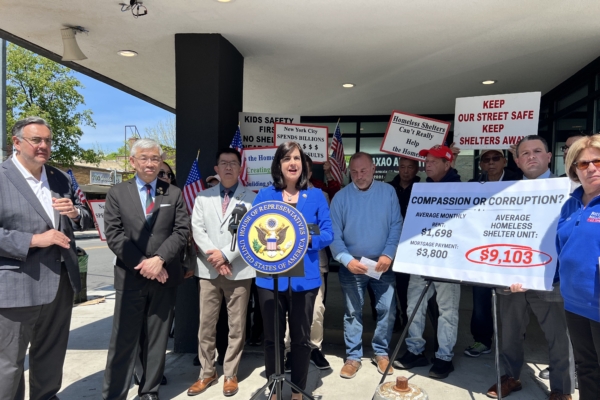
After a period of investigation and data collection, New York’s 11th Congressional District Representative Nicole Malliotakis held a press conference on Staten Island on the 24th along with state Assemblyman Yongjie Zheng, state Senator Steve Chan, and other elected officials and community representatives. They publicly questioned the lack of transparency and accountability in the contracts with New York City’s homeless population and formally called for the intervention of the U.S. Department of Justice.
Malliotakis pointed out that the shelter system in New York City has gradually evolved into a “high-profit business.” The city government has signed high-cost contracts with questionable operators, lacking competitive bidding, resulting in taxpayers paying far more for each shelter unit than the average housing cost. For example, at a shelter on Staten Island, the monthly cost per unit ranges from about $9,100 to $9,300, far exceeding the local average monthly rent of about $1,600 to $1,700 and approximately $3,800 in monthly mortgage payments.
Malliotakis stated that since the implementation of shelter rights policies and the Rikers Island closure plan under former Mayor Bill de Blasio, the homeless population in New York City has significantly increased, leading to an expansion of shelter facilities. She criticized the current city administration for not only lacking basic notification and consultation with communities when establishing new shelters but also possibly violating local laws and state regulations.
She said that data obtained through Freedom of Information Law (FOIL) requests by her office showed that some shelters had been involved in as many as 16,000 criminal incidents, including convicted criminals and sex offenders, causing residents to have strong concerns about public safety. Furthermore, the city government has been accused of circumventing relevant regulations in site selection and land use, such as promoting projects in Bensonhurst, a high- flood risk area, and wetlands, and converting an area in Sheepshead Bay originally designated for affordable housing into a shelter.
Malliotakis emphasized that many of the contracts were justified under an “emergency status,” bypassing proper open bidding procedures, resulting in a lack of transparency throughout the process. She questioned whether there was influence peddling or political connections behind these high-cost contracts and has written to the Department of Justice, submitting pages of investigation materials to request a comprehensive review.
She also mentioned that on March 31 this year, the Department of Justice filed federal charges in a corruption case involving a shelter in Brooklyn, accusing individuals of embezzling approximately $1.3 million through kickbacks and fraud. She believed that this case is just the tip of the iceberg, indicating a potentially more widespread issue within the entire system.
State Assemblyman Sam Pirozzolo from Staten Island pointed out that the current policies have not effectively reduced the homeless population but instead created a “shelter-centered” cycle, even raising overall rental levels. He cited an example of a young woman who sought help from his office recently, paying $1,400 a month in rent, but her landlord asked her to leave because the landlord could receive $2,400 in subsidies through the shelter system, far exceeding regular rental income.
Assemblyman Lester Chang criticized New York City’s homeless shelter policy for deviating from its original purpose, evolving into a system lacking supervision and driven by interests. He criticized the city government’s massive spending on shelter facilities and prisons as misallocation of resources, suggesting a priority on affordable housing solutions.
Senator Steve Chan stated that the homeless issue in New York City has evolved into a huge business rather than just a social service problem. He metaphorically described the homeless policies as “trees growing in Brooklyn with money as the fruits,” depicting how the policies have been “industrialized,” creating a multi-billion-dollar ecosystem involving developers, politicians, and interest groups, with many benefiting from it. He pointed out that even by allowing the homeless to check in at a counter daily and receive $200 (totaling $6,000 per month), letting them take care of themselves would be more cost-effective than the current homeless service system. Therefore, he believed that there is an “absolute need for intervention, investigation, and accountability by the U.S. Department of Justice.”
Sheepshead Bay resident Uncle Huang, who participated in the press conference, lamented the financial waste of the homeless system, highlighting that the monthly cost per shelter unit exceeds over nine thousand dollars, akin to “living in a presidential suite,” making it difficult to understand where taxpayers’ money is actually being spent.