
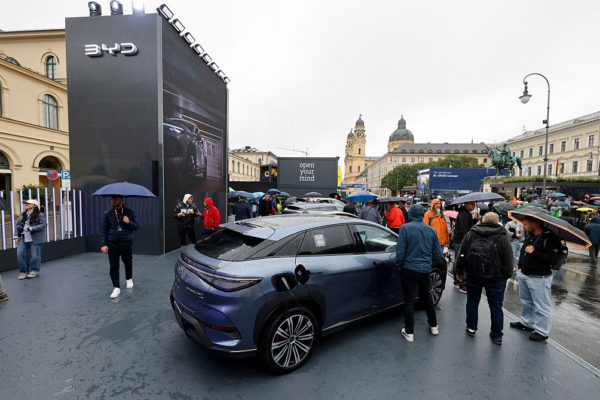
BYD and its competitors have been escalating their discount efforts out of fear of losing market share. Despite the Chinese authorities’ efforts to ease the automotive price war, the results have been minimal.
According to data compiled by Bloomberg, BYD saw an average price reduction of up to 10% in March, marking a record high decrease in prices. Competitors like Geely and Chery have also increased their discount levels.
The Beijing Auto Show opened this week, highlighting the fierce competition and overcapacity pressures facing the Chinese automotive market. Profit margins within China are under significant pressure, leading BYD, Geely, and other Chinese automakers to seek growth in overseas markets. From Brazil and the UK to Australia and Canada, these countries have become destinations for their exports.
Bloomberg reports that the Chinese authorities have repeatedly urged to curtail the deflation trend, but so far, no one seems to be buying it. Industry insiders indicate that the discount trend is unlikely to abate in the short term, with no end in sight for this year and the next.
About a year ago, the Chinese authorities summoned leaders of over a dozen major electric car manufacturers, urging them to end the price war and warning them against selling below cost or offering unreasonable discounts. Since the beginning of the year, the Chinese authorities have issued warnings three times.
BYD’s sales in the Chinese market have declined for seven consecutive months. Informed suppliers revealed to Bloomberg that due to increasingly strict scrutiny by Chinese authorities, BYD has been forced to accelerate payments to component suppliers. Even with significant discounts, stimulating sales as before has become challenging.
As a result, BYD’s balance sheet has seen increased liabilities, with net debt equity soaring to 25% after being negative for four consecutive years. The financial pressure from debt burdens, coupled with reduced incomes due to price reductions, severely undermine BYD’s profitability. Last month, BYD’s annual profits saw their first decline since the outbreak of the pandemic. BYD’s CEO Wang Chuanfu lamented that the Chinese automotive industry has entered a brutal phase of elimination.
François Roudier, Secretary-General of the International Association of Automobile Manufacturers, noted that while these developments may seem favorable to consumers, manufacturers are facing losses. The biggest concern lies in the impact on the used car market, as uncertainty about the depreciation of second-hand cars can influence buyer behavior and financing methods, ultimately damaging the entire system.
The prolonged price war is fundamentally rooted in overcapacity. The China Automotive Technology Research Center predicts that China’s annual automotive production capacity is 55 million vehicles, yet domestic sales last year were only around 23 million vehicles, resulting in an average utilization rate of around 50% for Chinese car factories, which is unsustainable in the long run.
If Wang Chuanfu’s predictions come true, through consolidation or closure to eliminate weaker enterprises, the overcapacity situation may be alleviated. However, the consequences would include a surge in unemployment rates, which the Chinese authorities and local governments are keen to avoid. They have been trying to prevent such a scenario by providing subsidies and other favorable policies.
Currently, excess electric vehicles are increasingly being exported to overseas markets. In March alone, Chinese electric car exports more than doubled, reaching a historic high. However, this has sparked reactions in some markets, with the European Union and some Latin American countries increasing tariffs to protect their domestic automotive industries.
In China, large car manufacturers are striving to maintain market share by shortening product cycles and rapidly introducing innovative products. For instance, BYD recently announced more powerful batteries and faster charging speeds. Xiaomi CEO Lei Jun revealed that the latest popular electric vehicle SU7 from Xiaomi includes new features worth nearly 20,000 Chinese yuan (approximately $2930), but the price has only increased by 4000 Chinese yuan.
Cui Dongshu, Secretary-General of the China Passenger Car Association, stated at a recent industry event that the current performance reflects immense pressure on the automotive industry.