
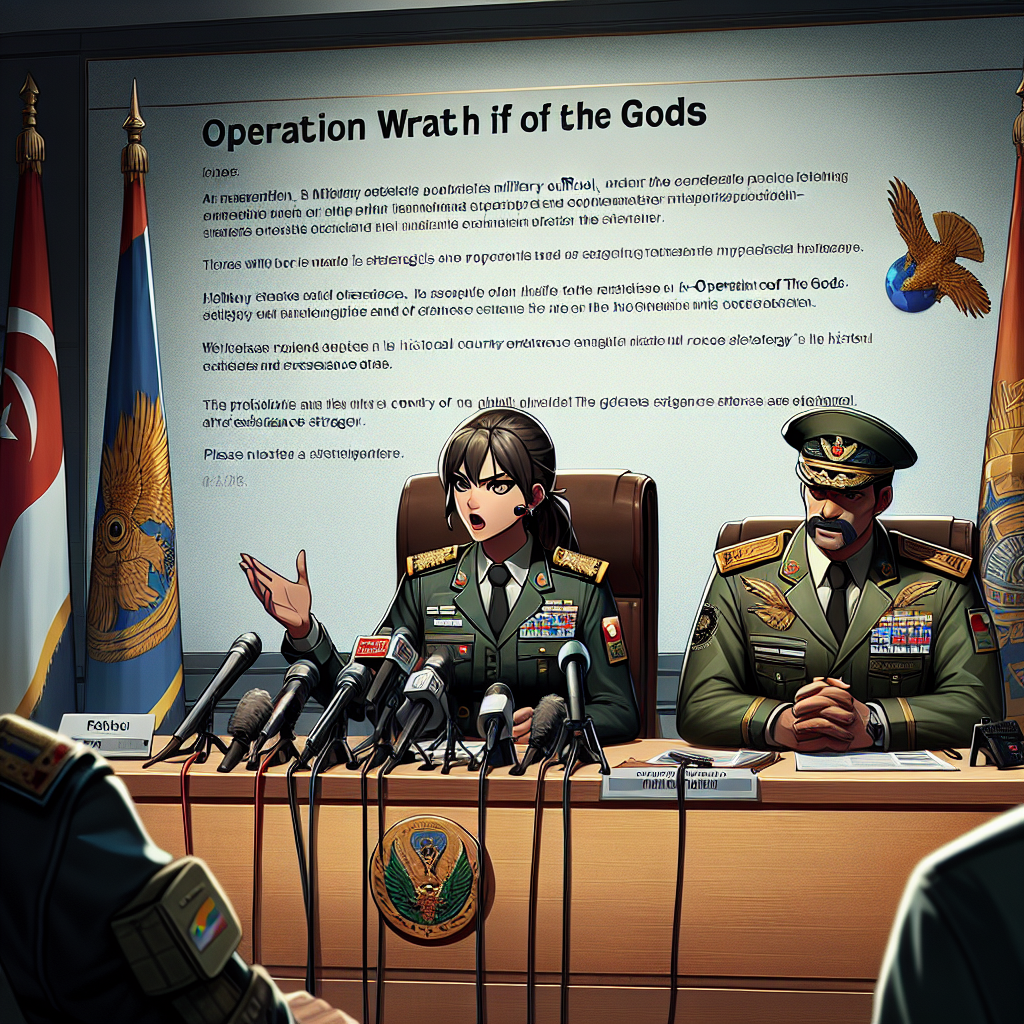
On Friday, April 24th, the United States Secretary of Defense Haggis and the Chairman of the Joint Chiefs of Staff General Kane held a press conference to discuss the progress of Operation Wrath of the Gods, with a focus on the US military’s blockade of Iran. Haggis stated that Iran has a “historic opportunity” to reach an agreement, and that the blockade “will only continue to expand and go global.”
“Our blockade will only continue to expand and go global. As the President has said, we have ample time. Iran has a historic opportunity to reach a serious agreement, and now the ball is in their court,” Haggis said. “Regardless, the US Department of Defense is prepared for whatever comes next. We are fully prepared.”
The Defense Secretary mentioned that the US military’s blockade of Iranian ports is “intensifying,” with a second aircraft carrier set to join the blockade operation in “a few days.”
“No one can sail from the Strait of Hormuz to anywhere in the world without permission from the US Navy,” Haggis said. “For the Tehran regime, the blockade is tightening at an alarming pace. We control the situation. No vessel can enter or leave.”
“The US military strength is unparalleled, able to project power, deter hostile forces, and protect our interests at our chosen time and place,” the Defense Secretary emphasized.
Currently, the USS Lincoln is conducting blockade operations in the Arabian Sea, the USS Ford in the Red Sea, and the third carrier, the USS Bush, is nearing Iranian waters in the Indian Ocean. It is not yet clear which carrier will join the blockade operation.
On Friday, the Defense Secretary added that the number of Iranian ships prevented from leaving the Strait of Hormuz by the US military has increased to 34, one more than the previous night.
Haggis also mentioned examples of the US military intercepting Iranian vessels in the Indo-Pacific region during the press conference. “Just this week, we seized two vessels of the Iranian shadow fleet in the Indo-Pacific region, which left the Iranian ports before the blockade took effect,” he said.
“They thought they could escape unnoticed, but that’s not the case. We confiscated their sanctioned vessels, and we will seize more. Our blockade is expanding and going global,” he said.
On Thursday, the Pentagon announced that the US military intercepted a sanctioned stateless oil tanker named “Majestic X” in the Indian Ocean and conducted a boarding inspection. The tanker was transporting oil from Iran and was headed towards Zhoushan, Zhejiang. This is the second time the US military intercepted an Iranian-related oil tanker in the Indo-Pacific region.
Earlier this week, the US Navy intercepted and boarded another stateless vessel, the M/T Tiffany, in the Indian Ocean, which was sanctioned for transporting Iranian oil.
Regarding potential new negotiations between the US and Iran, Haggis warned Iran, saying, “Iran knows that they still have a chance to make a wise choice. As we have said before, make wise choices at the negotiating table.”
“They simply need to abandon nuclear weapons in a meaningful and verifiable way. Otherwise, they can only watch their fragile economy collapse under continued pressure from the US, and the blockade will continue until President Trump makes the final decision,” the Defense Secretary stated.
Haggis reiterated that the negotiating bottom line of the Trump administration remains unchanged. “Iran can never possess nuclear weapons. The choice is theirs. But facing this blockade, time is not on their side,” he said.
During the press conference, Haggis sent a message to Europe and Asia. He stated that Europe and Asia have benefited from US protection for decades, “but the free ride is over.”
“The US and the free world need capable, loyal allies who understand that alliances are not one-way streets, but alliances of allies,” Haggis said amid the US-Iran standoff in the Strait of Hormuz.
“We don’t count on Europe, but they need the Strait of Hormuz more than we do. Perhaps they should talk less and act more, stop indulging in flashy meetings in Europe, and truly take action,” Haggis added. “This battle is not so much ours as it is theirs.”