
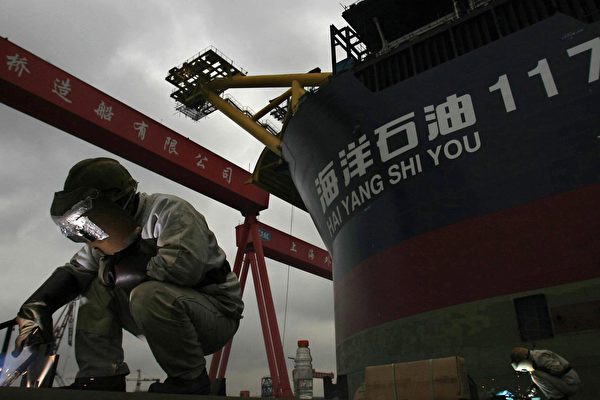
As the Iran conflict creates turmoil in the global energy market, the Chinese Communist Party (CCP) is launching a new type of cognitive warfare against Taiwan under the guise of “energy issues.” Experts believe that countering these narratives is a crucial regional priority, especially when the energy security of the entire Indo-Pacific region is being tested, potentially becoming a tool for the CCP to coerce other countries.
On Thursday, April 23, the Global Taiwan Institute (GTI), a non-profit think tank based in Washington, D.C., released its latest analysis, indicating that the CCP is employing a strategy of simultaneous pressure through both “soft and hard tactics.” On one hand, they claim that reunification with Taiwan can provide stable energy supply post-unification, purportedly solving Taiwan’s energy predicament. On the other hand, through military exercises simulating a blockade against Taiwan, they aim to exploit Taiwan’s high dependence on energy imports to sow panic in Taiwanese society.
Researchers point out that this is a United Front discourse using “energy” as its cover story and emphasize the importance of exposing the contradictory nature of such narratives.
The report emphasizes, “China is portraying itself as the guarantor of stable energy supply for Taiwan, while at the same time creating risks to destabilize this stability – that is, by blockading or isolating Taiwan.”
It was disclosed that on March 18 this year, a spokesperson for China’s Taiwan Affairs Office publicly stated that once “peaceful reunification” is achieved, China is ready to provide Taiwan with reliable energy supply to address Taiwan’s alleged energy shortage.
On social media platforms in mainland China, including Weibo, Douyin, and influencer comments, reunification with Taiwan is being touted as the “golden key to solving Taiwan’s energy dilemma,” with proposals to connect Taiwan’s power grid with China’s through undersea interconnection lines.
However, alongside offering incentives, Beijing continues to exert military pressure.
Over the past four years, the Chinese navy and coast guard have frequently conducted exercises simulating the blockade of Taiwan’s key energy infrastructure like liquefied natural gas (LNG) receiving terminals. CCP-controlled media outlets claim that these exercises demonstrate Beijing’s ability to block Taiwan’s imports and cut off its energy supply.
These military threats are accompanied by a series of fear-inducing narratives. The report reveals that CCP propaganda agencies assert that Taiwan is facing a “countdown crisis,” with only 7 to 8 days of natural gas reserves left.
In reality, the Taiwanese government not only mandates a statutory reserve of 11 days for LNG but has also ensured stable supplies for most sources, with emergency coal-fired power generation capacity as a safeguard.
Taiwan is heavily reliant on imports for energy (97%) and officially achieved “de-nuclearization” in May 2025, making energy issues highly politically sensitive domestically.
Researchers note that the CCP authorities capitalize on normal concerns in Taiwan about rising electricity prices, progress in energy transition, and energy security. They amplify fears through local pro-CCP activists, some media outlets, and political commentators, steering policy disputes towards the narrative of “energy policy failure.”
“Crucially, the Taiwan Strait is one of the world’s busiest shipping lanes. Any disruption will impact global trade, akin to the instability caused by the Strait of Hormuz. If China threatens to take any such actions, they should face swift and clear condemnation from the international community,” the report states.
The authors of the report were Elizabeth Frost and Elena Yi-Ching Ho, both longtime researchers focusing on Taiwan’s energy security and information warfare issues. Frost is an energy security researcher based in Taipei and the founder of the Taiwan Climate & Energy Briefing.
Ho is a co-founder of the non-governmental organization Research & Action Hub and is currently pursuing a Ph.D. in Communication and Media Studies at the Queensland University of Technology, with research interests including political communication, information integrity, and social media manipulation.
Both authors stress in the report, “Understanding, exposing, and countering cognitive warfare narratives require coordinated actions between Taiwan and its partners… Not only should the Taiwanese government recognize the importance of countering this emerging trend, but regional partners should also prioritize collective action to address energy-related threats.”
To counteract energy threats, Taiwan is actively diversifying its sources of supply. The Taiwanese Ministry of Economic Affairs expects the proportion of LNG imports from the United States to increase to 25% by 2029.
Furthermore, the U.S. Congress is currently promoting the Taiwan Energy Security and Anti-Embargo Act of 2026. If passed, this legislation will enhance Taiwan-U.S. cooperation in energy security, potentially leading to U.S. Navy escorts for LNG ships bound for Taiwan.