
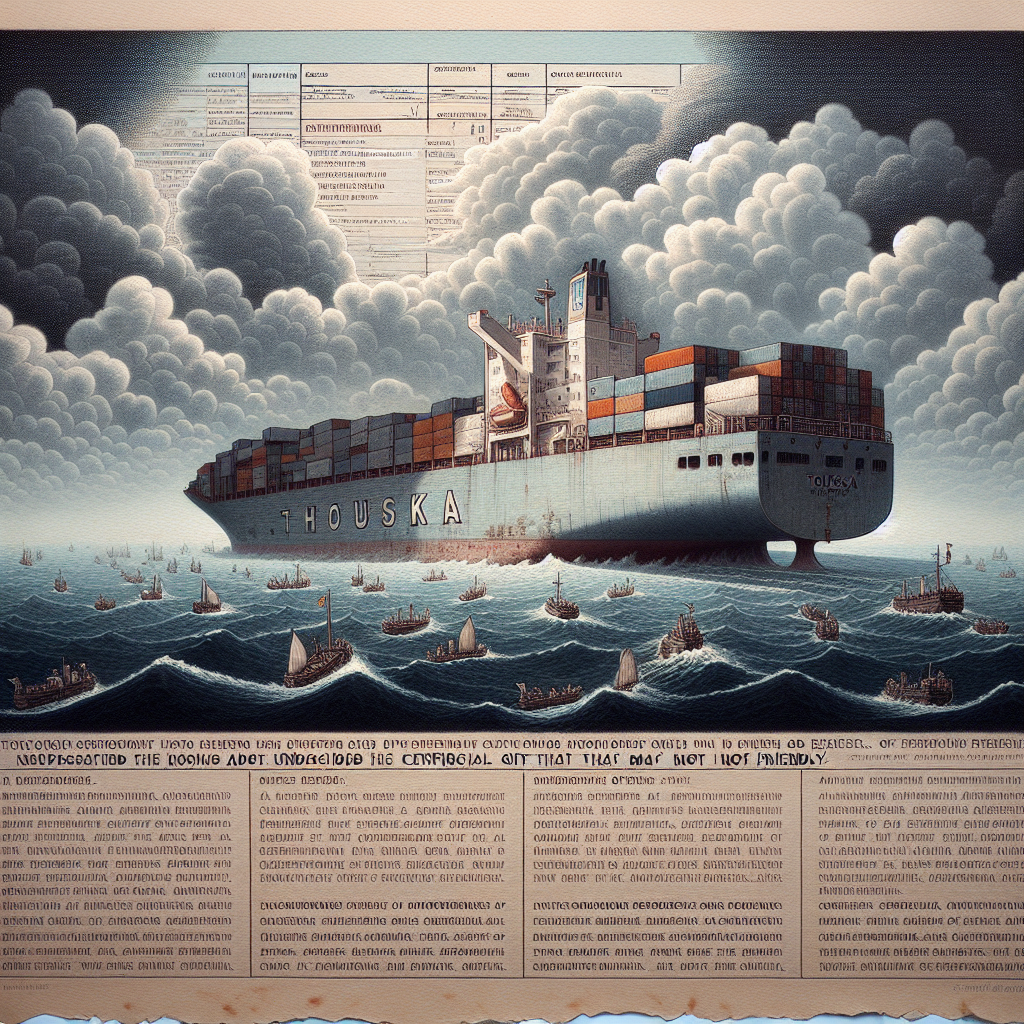
A cargo ship named Touska heading from China to Iran was detained by the US military, with President Trump stating that the ship carried “gifts from China” that were “not very friendly.” The Chinese Foreign Ministry spokesperson evaded questions about the cargo loaded on the Touska twice. Experts suggest that this incident could impact the upcoming Trump-Xi meeting next month.
On April 22, Chinese Foreign Ministry spokesperson Guo Jiakun was asked about “what goods were carried by the cargo ship flying the Iranian flag departing from China.” Guo Jiakun only reiterated that “China has repeatedly stated its position. We emphasize that as a responsible major country, China consistently fulfills its international obligations.”
During the press conference on April 21, when asked about the issue of the “US detaining an Iranian cargo ship carrying chemicals used in missile production,” Guo Jiakun referred to it as a “foreign container ship” and emphasized “opposition to any malicious associations and hype.”
In an interview with CNBC on April 21, Trump stated that Tehran attempted to replenish military supplies during the ceasefire period. He directly pointed out that the ship intercepted by the US military (Touska) carried “gifts from China,” and the cargo on board was “not very friendly.”
Trump admitted that he was “a bit surprised” as he believed there was already “consensus” between himself and Chinese President Xi Jinping on the Iran issue.
Taiwan’s National Defense Security Research Institute’s Director of Defense Strategy and Resources Studies, Su Ziyun, analyzed that when Trump mentioned that the cargo on the Iranian ship contained “gifts from China,” it likely referred to the raw materials Beijing supplied to Iran for missile production, exposing Beijing’s deception and challenging Xi Jinping.
According to The Wall Street Journal, the Touska is owned by an affiliate of the Iranian state-owned Islamic Republic of Iran Shipping Lines (IRISL), which has been shuttling frequently between China and Iran. The ship departed from Zhuhai Port in China at the end of March and was detained by the US near the Strait of Hormuz in the Gulf of Oman on April 19. IRISL itself is a sanctioned company by the US for transporting materials usable for military purposes to Iran.
Xie Peixue, Associate Researcher at Taiwan’s National Defense Research Institute’s Cybersecurity and Decision Simulation Research Institute, told Dajiyuan that the Chinese Foreign Ministry’s ambiguous language serves to deny self-incrimination while maintaining room for negotiation. As long as the US does not publicly disclose a specific list of prohibited items, Beijing claims its trade is legitimate.
Zheng Qinmo, Associate Professor of Diplomacy and International Relations at Tamkang University in Taiwan, told Dajiyuan that China has been providing Iran with materials to manufacture missiles, even when caught red-handed, Beijing continues to deny. China has a history of deception, including the Sino-British Joint Declaration and promises made upon joining the WTO, which have not been fulfilled.
Western intelligence agencies have long gathered evidence of China’s involvement in this gray-area military assistance.
The US-China Economic and Security Review Commission (USCC) released a briefing on March 16, “Facts of China-Iran Relations,” focusing on China’s past twenty years of alleged transfers of dual-use military technology, missile-related materials, or sanctions evasion, rather than direct nuclear weapon assistance.
Since the US and Israel launched attacks on Iran, China’s support for Iran has manifested across various strategic fronts, including diplomatic, financial, technological, and influence operations.
Many media reports indicate that Iran has obtained indirect or dual-use technology support from China. This includes China considering providing advanced radar systems to Iran; possibly delivering a batch of shoulder-fired missiles; Semiconductor Manufacturing International Corporation (SMIC) supplying chip-making equipment to Iran since early 2025; Iran secretly acquiring a Chinese-made spy satellite by the end of 2024, using it to target US military bases in the Middle East; Iranian cargo ships allegedly importing missile propellant raw materials from China and sailing towards Iran.
Additionally, Chinese technology companies are accused of providing satellite images of Middle East US military bases; Iran is integrating China’s Beidou satellite navigation system, enhancing missile strikes and target location precision in the region.
Zheng Qinmo suggested that Western countries are well aware of these activities, but the question is whether they are willing to confront them. Some Western nations are caught in economic downturns but still hope to improve their economies through cooperation with China. Currently, China’s economic downturn is severe, and cooperating with China is merely a temporary solution. At least the US has a clearer understanding of China.
Su Ziyun believes that it will take time for the West to fully and officially expose China, as seen in the case of Huawei’s station security risks that European countries initially doubted and even opposed Trump’s ban. Time is needed to make the West truly recognize the true face of China across party lines.
However, he pointed out that China often stumbles upon the barrel of the gun itself in these situations, “Whether it is the Iran incident this time or European countries discovering Chinese spies, it is China proving itself a threat.”
Trump is scheduled to visit China from May 14-15 for a summit with Xi Jinping. The summit, originally planned for late March, was postponed due to the US strikes on Iran. Experts believe the latest Iranian cargo ship incident might impact the Trump-Xi meeting.
Su Ziyun said Trump has gathered evidence of China’s gray-zone military assistance on the Iranian cargo ship for the summit, to see how China responds. China is likely to use economic means to buy more soybeans from the US. “Trump is essentially shrinking China’s influence, tactically allowing China to buy US soybeans but not accepting any new conditions from China.”
Xie Peixue noted that concerning the Iranian cargo ship being detained by the US military, China is now testing Trump’s bottom line, gambling that he won’t escalate for the atmosphere of the May summit, “I know you seem to have caught me red-handed, but I bet you won’t completely tear up the agreement now.”
However, Xie Peixue believes that Trump holds evidence and will use it as a bargaining chip during the summit. He will demand that China completely cut off military aid to Iran in exchange for the US not imposing additional sanctions, such as tariffs or semiconductor export controls. If both sides fail to reach an agreement, Trump is likely to directly implement the threatened 50% tariff increase or even cancel parts of the summit agenda.
“If the talks don’t meet US, especially Trump’s, demands, it’s very likely to lead to a breakdown of negotiations, or even end early,” he said.
Zheng Qinmo stated that although Trump raised the issue high, he has yet to let it go, probably waiting for the mid-May Trump-Xi meeting. From the current situation, Trump will have sufficient leverage during the summit, including the swift capture of Maduro at the beginning of the year, the efficiency and advancement of US military operations against Iran, all putting immense pressure on Xi Jinping. The recent confiscation of weapons material supply to Iran by China is likely to be one of Trump’s bargaining chips.
“The summit will be a strong Trump facing a relatively strategically shrinking Xi Jinping. It can be predicted that in terms of agricultural procurement, high-tech controls, and even red lines in the Taiwan Strait, it may be Trump setting red lines for Xi Jinping, not the other way around,” he said.
Chinese state media reported that on the afternoon of April 20, Xi Jinping telephoned Saudi Crown Prince and Prime Minister Mohammed, emphasizing an immediate and comprehensive ceasefire and maintaining normal passage through the Strait of Hormuz.
Xie Peixue stated that Xi personally calling for normal passage through the strait is to protect China’s core energy security and outwardly play the responsible regional coordinator role.
However, he reminded that for China, as long as the Iran war remains in a controllable turbulent range, it effectively diverts US military capabilities and the Trump administration’s attention from the Indo-Pacific region, especially Taiwan and the South China Sea.
“Beijing is playing a dangerous balancing trade now. It wants to use Iran to restrain the US but also avoid prolonged blockage of the Strait of Hormuz, which would deal a fatal blow to its already fragile economy,” he said.
Trump announced an indefinite extension of the US-Iran ceasefire agreement on April 21 until Iran submits a “unified proposal” and completes related discussions.
Su Ziyun believes that three political forces have emerged within Iran – the theocratic, the elected, and the military, namely the Revolutionary Guards. Trump is now waiting for Iran to make a mistake. In addition, the recent large-scale US military exercises in the Philippines have made Trump’s strategy to observe changes in Iran, further worrying Beijing.
“The one in a hurry is China, but no matter how impatient China is, it’s futile. Its oil sources have been cut off, and the peg it planted in the Middle East has been removed, so it’s losing both ways,” he said.
Su Ziyun believes that ultimately, the US aims for Iran to agree to certain conditions, chiefly transforming Iran into a less threatening regime and completely expelling China’s influence.