
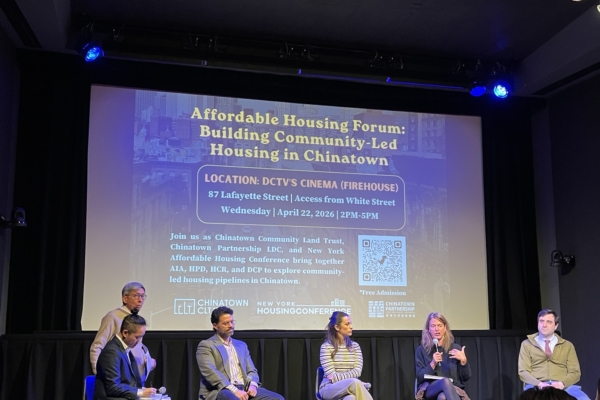
The “Chinatown Affordable Housing Forum: Building a Community-Led Housing Model” was held in lower Manhattan on April 22nd. The organizers brought together community organizations, policymakers, and professional groups to address the long-standing issue of affordable housing shortage in Chinatown. They discussed community-centric solutions and promoted interdepartmental collaboration to accelerate the implementation of relevant projects.
The forum, jointly organized by the Chinatown Community Land Trust, the Chinatown Partnership Development Corporation, and the New York Affordable Housing Conference, invited representatives from institutions such as the American Institute of Architects (AIA), the New York City Department of Housing Preservation and Development (HPD), the New York State Homes and Community Renewal agency (HCR), and the New York City Department of City Planning (DCP) to discuss how to strengthen the Chinatown affordable housing supply system.
Representative Wang Di from the Chinatown Community Land Trust pointed out that while Chinatown has successfully preserved existing buildings over the past few decades, there has been a stagnation in new housing construction. This has led to population loss and a decline in community vitality. He emphasized the need to shift from mere preservation to a focus on both preservation and production, advocating for the increase in medium to high-density residential supply and exploring practical solutions such as hotel conversions and investment mechanisms.
Chinatown Partnership Development Corporation Executive Director Chen Zuozhou highlighted the nationwide housing gap of approximately 5 million units, with New York facing particularly severe challenges. He noted that while Chinatown has a significant number of rent-controlled and rent-stabilized units, rising costs in insurance, property taxes, and maintenance are increasing operational pressures for property owners. Limited rent adjustments exacerbate structural imbalances, leading to erosion in overall affordability. He suggested government considerations for alleviating pressures through tools like tax incentives, Community Land Trusts (CLT), and reviewing building height and zoning restrictions to improve land use efficiency.
AIA representative Bria Donoghue emphasized the importance of enhancing spatial efficiency and optimizing regulations to expedite project implementation while ensuring residential quality and environmental sustainability. She noted that while zoning and approval systems have been adjusted in recent years, further streamlining processes and increasing flexibility are necessary.
John Mangin, a representative from the New York City Department of City Planning, introduced the citywide zoning reform “City of Yes” launched in 2024. The new policy relaxes restrictions on converting commercial buildings to residential units, expands applicable areas, and allows for diverse forms of supportive and shared housing.
Ross Karp, a representative from the New York State Homes and Community Renewal agency, highlighted hotel-to-residential conversions as a significant avenue for increasing housing supply. Such conversions offer advantages in prime locations, rapid construction, and potential cost-effectiveness. However, practical challenges such as high acquisition costs, complex renovations, and policy constraints hinder project advancement.
Dina Levy, the Commissioner of the New York City Department of Housing Preservation and Development (HPD), stated that the city government is collaborating with multiple departments to formulate a new five-year housing plan. The future focus will be on improving government efficiency, preserving existing housing, expanding supply, and strengthening enforcement. Levy mentioned that HPD constructed or preserved around 28,000 housing units in 2025, indicating the city’s ongoing efforts to address housing needs. She emphasized the need to streamline government operations for faster and more effective outcomes while ensuring existing housing continues to serve the community.