
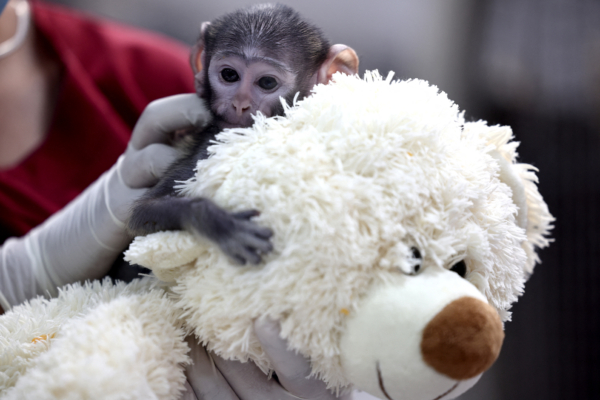
Mexico, a six-week-old red colobus monkey named Yuji wakes up every day and the first thing it does is tightly embrace its furry dog plush toy beside it. For this fragile primate, this plush toy is not just a plaything, but also a “mother” it can turn to for emotional comfort.
Yuji was born on March 3rd this year, and its mother, Kamaria, is a first-time mother monkey. Shortly after giving birth, caregivers noticed that Kamaria was behaving abnormally; she couldn’t properly hold her baby and failed to establish a mother-child bond. To save the cub’s life, the zoo made the tough decision to separate them.
Yuji’s situation brings to mind the famous Japanese macaque “Punch.” When Punch was abandoned by its mother, the sight of it snuggling in the arms of a plush orangutan touched many around the world. Now, Yuji seeks solace in a similar way by being cradled in the arms of a man-made toy.
At the “Comprehensive Animal Medicine and Welfare Center” (CIMBA) in the Guadalajara Zoo in western Mexico, a team of 12 professional veterinarians and biologists take turns caring for Yuji around the clock. From its birth weight of a mere 443 grams, Yuji has steadily grown to 673 grams.
To maintain hygiene and provide a sense of security, aside from the furry dog, the zoo has also prepared plush bears and monkeys to rotate for Yuji, ensuring it always has a “clean companion” to cling to.
According to reports from Agence France-Presse, Yuji is currently placed in a controlled environment at 35 degrees Celsius, receiving professional care and nutritional support. Caregivers have installed a hammock and ropes in the incubator to train its grip strength and stimulate development.
Iván Reynoso Ruiz, head of the primate department at the zoo and a veterinarian, mentioned that when Yuji reaches around six months old, successfully weans off and starts eating solid fruits and vegetables, they plan to reintegrate it into the group habitat consisting of 12 adult red colobus monkeys and 3 young ones.
Although Yuji’s story has garnered warmth and resonance on social media, the practice of “artificial rearing” has also raised questions from animal welfare advocates. They believe that no artificial substitute can replace the natural habitat and argue that animals have the right to live and die in their natural environment, rather than grow up in human-created environments.
Regarding these concerns, Ruiz pointed out that in the wild, cubs abandoned by their mothers like Yuji would have little chance of survival. Modern zoo interventions aim to give endangered species a “second chance at life,” which is crucial in combating global threats to species survival.