
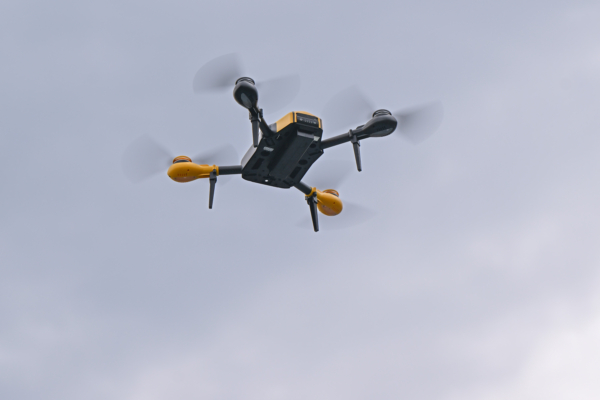
Taiwan’s unmanned aerial vehicle exports to Europe in the first quarter of this year have exceeded the total for the entire previous year. A national think tank in Taiwan released a report on April 22, delving into Taiwan’s key role in the global drone industry supply chain, particularly focusing on its strategic contribution to the European market amid the context of “de-risking.”
The “Center for Technology, Democracy, and Society” (DSET) in Taipei published a policy report titled “The Invisible Drone Wall: Taiwan’s Silent Support for Non-Red Unmanned Aerial Vehicle Supply Chains in Europe” on April 22. The report highlighted that from 2024 to 2025, Taiwan’s total export of complete drones to Europe increased from 2,574 units to 107,433 units, a growth of about 41.7 times. In the first quarter of 2026, Taiwan’s export of complete drones to Europe reached 136,010 units, approximately 1.3 times the total export volume of the previous year.
According to the report, Europe is the largest export market for Taiwan’s complete drones, mainly concentrated in Poland and the Czech Republic, with drones possibly being further transported to Ukraine. Unlike the United States, the European Union does not frame its drone strategy around a “non-red supply chain” but emphasizes reducing reliance on “non-associated third countries” outside Europe. Lithuania is the only country in Europe to explicitly institutionalize a non-red policy.
The backdrop for Taiwan proposing the “non-red drone” supply chain was the Russia-Ukraine war.
Since the outbreak of the Russia-Ukraine war in 2022, Ukraine has extensively used drones, especially low-cost commercial modified drones, showcasing their ability to deplete combat effectiveness. The global community has recognized the high dependency on China in the drone supply chain, creating security risks under pressure from the Chinese Communist Party.
Starting in 2023, Taiwan began the “civilian drone militarization” and simultaneously established a domestic supply chain.
Meanwhile, the U.S. Department of Defense (now called the Department of War) launched “The Blue UAS Program.” This project within the U.S. Department of Defense entails reviewing, approving, and ongoing management of a series of secure drone systems and components for federal government and military use, with the core principle of avoiding Chinese components to enhance material and supply chain security.
In 2024, Taiwan’s policy and industry sectors began directly employing the “non-red supply chain” (emphasizing a supply chain not under the control of the Chinese Communist Party and not relying on politically risky Chinese companies) and “de-Sinicization supply chain” (referring to reducing dependence on Chinese manufacturing, materials, and components regardless of whether companies are “red” or “non-red,” as long as they produce within China).
On September 10, 2024, Taiwan’s Ministry of Economic Affairs announced the establishment of the “Taiwan Excellent Unmanned Aerial Vehicle Overseas Business Opportunities Alliance” (TEDIBOA), with a clear goal: integrating Taiwan’s drone industry (from whole drones to components), expanding international markets (especially Europe and America), strengthening technological cooperation and the industrial chain, and creating a “non-red supply chain.” TEDIBOA set an initial goal of helping Taiwanese manufacturers obtain U.S. certification (Blue UAS).
After becoming president, Tsai Ing-wen proposed three major drone policy goals for Taiwan: promoting industry development, enhancing defense self-sufficiency, and deepening democratic supply chain integration.
DSET stated that the new policy goal of the Tsai administration is to establish Taiwan as a “manufacturing powerhouse of Indo-Pacific drones,” emphasizing Taiwan as a key node in the democratic allied drone “non-red supply chain” while strengthening cooperation alliances among democratic nations.
The ongoing conflict between Russia and Ukraine has not only spurred high demand for drones but also sustained demand for them.
In the context of China weaponizing supply chains, such as restricting rare earth exports, Europe has recognized the risks of over-reliance on China and begun de-Sinicizing its supply chains.
Taiwan possesses a strong supply chain foundation in areas like semiconductors, electronic manufacturing, batteries, motors supply chains, enabling it to quickly respond to market demands—Taiwan’s drone exports to Europe last year were 41.7 times higher than the year before.
Since last year, Taiwan’s drone exports to Europe have surged. However, Taiwan remains a non-dominant import source in Europe. According to Taiwan’s customs and Eurostat data, in terms of value in the first three quarters of 2025, Taiwan ranked fourth in Poland’s import market and second in the Czech Republic’s import market. China remains the largest import source for both countries.
The report pointed out that while Taiwan has not monopolized the market in complete drone brands, it can provide high-quality critical component supply, mature IC design and manufacturing capabilities, ensuring buyers receive stable and cybersecurity-compliant chips, which are crucial support areas.
In January 2026, the European Parliament overwhelmingly passed the report “On Drones and New Warfare Systems: The EU’s Need to Adapt to Current Security Challenges,” urging the EU to strengthen security and defense partnership relations with Indo-Pacific partners, including Taiwan, in drone technology and industry, emphasizing the importance of constructing secure and non-red supply chains based on democratic values. According to DSET’s report, this reflects Taiwan’s strategic value in the European supply chain.
In conclusion, the report presented several observations and recommendations for the Taiwan government and industry. It highlighted that the institutionalization level of cooperation between Europe and Taiwan is lower than that of the United States and Taiwan, suggesting that Taiwan should accelerate alignment with NATO or EU drone technology standards to deeply embed into Europe’s defense supply chain. Faced with Europe’s rapidly growing demand for dual-use drones, Taiwan needs to expand production capacity to cope with the influx of orders brought about by geopolitical changes.
DSET, established by the Taiwanese government in 2023, is a national think tank focusing on policy research in geopolitics and technology, providing strategic advice to the government and allied nations. Its research scope covers semiconductor, artificial intelligence, energy security, climate resilience, and defense technology.