
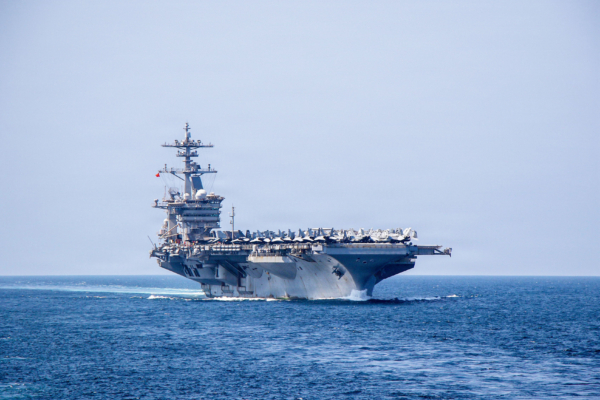
The U.S. military’s “Lincoln” aircraft carrier fleet, originally deployed in the Western Pacific, is currently carrying out a mission to strike Iran in the Middle East. Now, the U.S. military’s amphibious assault ship fleet “Delhi” has also been sent to the Middle East. With the consecutive withdrawal of the main naval forces from the Western Pacific, is there a possibility that the Chinese Communist Party (CCP) may take advantage of the situation to cause trouble, increasing the risk in the Taiwan Strait?
Under normal circumstances, the U.S. military maintains one aircraft carrier fleet and one amphibious assault ship fleet in the Western Pacific. Currently stationed in Japan are the “Washington” aircraft carrier (CVN 73) and the “Delhi” amphibious assault ship (LHA 7). The deployment cruising time of the “Washington” aircraft carrier usually starts from April or May in the spring and ends in October or November in the fall. During the winter season, the U.S. military rotates to deploy another aircraft carrier fleet for cruising in the Western Pacific.
The U.S. amphibious assault ship stationed in Japan can coordinate with aircraft carrier operations or operate independently, especially when the aircraft carrier is redeployed, often taking on the role of a light aircraft carrier. After the “Lincoln” aircraft carrier was redeployed to the Middle East, at the end of February and beginning of March, the “Delhi” amphibious assault ship conducted a joint exercise near the Bashi Strait with Japan and the Philippines, simulating the blockade of the Bashi Strait.
Sometimes, the U.S. military also dispatches another amphibious assault ship for cruising in the Western Pacific, testing the carriage of up to 20 F-35B fighters, fully playing the role of a light aircraft carrier or a lightning carrier.
Currently, the U.S. Navy’s “Washington” aircraft carrier stationed in Japan has not been deployed yet, while the “Lincoln” aircraft carrier and the “Delhi” amphibious assault ship have both been redeployed. The U.S. military’s strength in the Western Pacific, especially its naval aviation power, has significantly decreased, and the frontline amphibious mobile forces have also decreased. If the CCP chooses to take risks at this time, the timeliness of the U.S. military’s response seems to have diminished.
However, through the recent U.S. military strikes against Iran, it is clear that air power is the key to victory. The “Lincoln” aircraft carrier remaining outside Iran’s retaliatory range is crucial in the airstrikes against Iran. Many of the U.S. military bases in the Middle East are at risk of Iranian missile and drone attacks, and some countries are reluctant to allow the U.S. military to use their bases to attack Iran.
After the destruction of Iran’s air force and air defense systems, U.S. carrier-based aircraft F/A-18s can be fully loaded with ground attack weapons and patrol inside Iran, ready to attack potential targets such as missile launch vehicles, makeshift drone airstrips, etc.
In the Western Pacific, U.S. aircraft carriers will try to stay beyond the first island chain and will also stay on the edge or outside the combat radius of CCP fighter jets in the South China Sea. In the event of war, the primary mission of U.S. aircraft carriers should be to engage in naval combat, swiftly eliminating CCP warships deployed beyond the first island chain, including aircraft carriers, destroyers, frigates, amphibious assault ships or drone carriers, submarines, etc.
In the early stages of a conflict with the CCP, the initial U.S. counterattack should involve the launch of Tomahawk cruise missiles by destroyers and submarines, followed by AGM-158 long-range missiles launched by bombers. Within the carrier air wing, airborne early warning aircraft, electronic warfare aircraft, F-35C fighter jets may participate in the initial operations, with more F/A-18 fighter jets joining in ground attacks only when the CCP’s air defense systems are paralyzed and coastal airfields are severely damaged.
The redeployment of the “Lincoln” aircraft carrier will not significantly reduce the U.S. military’s responsiveness. If any suspicious movements by the CCP are detected, U.S. bombers and fifth-generation fighters can quickly be deployed to various bases in the Western Pacific. The U.S. likely deployed less than 10% of its active-duty bombers and fifth-generation fighters in the Iran conflict.
During the CCP’s Two Sessions, many senior military leaders concentrated in Beijing, halting their actions of harassing the Taiwan Strait with military aircraft. After the Two Sessions, a large number of military aircraft reappeared in the Taiwan Strait. This abrupt change confirms the ongoing turmoil within the CCP military. During the Two Sessions, the CCP’s primary concerns are mutinies and insurrections, leading to a significant reduction in military mobilizations and exercises, including prohibiting military aircraft from flying over the Taiwan Strait.
During the Two Sessions, even unmanned drones were prohibited from flying, let alone jet fighters. Whether someone might defect by flying a plane or launch an attack toward Beijing, the risks were deemed too great, resulting in a blanket ban on all flights.
The power struggle within the CCP military remains a mystery, and resolving issues such as filling numerous senior leadership positions and rebuilding an effective chain of command will pose significant challenges. The decreasing ability of the CCP’s senior or military leadership to control frontline forces not only exacerbates the risk of mutinies but also increases the risk of accidental incidents with foreign countries, causing extreme concerns within the CCP.
Following the Two Sessions, a significant number of researchers from military industrial enterprises encountered troubles, indicating ongoing purges within the military. The corruption and false propaganda behind many weapons development projects in the military are likely to be exposed further.
The recent Iran conflict once again demonstrated the ineffectiveness of CCP air defense systems. The performance of equipment such as the J-20, Dongfeng missiles, etc., likely contains many flaws. Recent U.S. revelations regarding CCP’s nuclear warhead management have exposed numerous weaknesses in CCP’s military technology and management.
The U.S. engaging in war in the Middle East may seem like an opportunity for the CCP to take risks in the Taiwan Strait. However, with internal turmoil within the CCP military, their previously hyped-up combat capabilities have now deteriorated even further. At this moment, the leadership in Beijing is more fearful of the capabilities demonstrated by the U.S. in the Middle East, making it unlikely for them to consider starting a war in the Taiwan Strait.
The weakness of the CCP military is a key factor in the U.S. decision to strike Iran and boldly withdraw aircraft carriers and amphibious assault ships from the Western Pacific to the Middle East. Seeing the U.S. targeting the Iranian regime, not only deters the CCP from taking reckless actions but also instills further dread within them.
The U.S. showcasing its aerial strike capabilities against Iran should cause the CCP to be astounded once again. The higher-ups in the CCP fear being targeted for assassination, the CCP navy fears their main warships will be sunk quickly, and the CCP air force fears their aircraft will be destroyed before taking off from the runway or their bases will be bombed, preventing them from responding effectively. The CCP rocket force’s bases and missile launch vehicles will undoubtedly become primary targets for U.S. attacks.
If the CCP ventures into war, the billions spent over the past two decades on weapon acquisitions could quickly go up in smoke. Destroying the “Hongchuan” central vault of nuclear warheads near Shaanxi Baoji, destroying missile production bases, aircraft manufacturing factories, shipyards in Dalian and Shanghai could leave the CCP military unable to recover for a long time.
The joint U.S.-Israeli strike against Iran is another typical preemptive move. This indicates that if the U.S. detects CCP readiness for aggression, they are likely not to wait for CCP missiles to fall before retaliating. To prevent possible losses, the U.S. may strike first. This scenario is more concerning for the CCP than the false notion of potential U.S. support for Taiwan.
With the consolidation of U.S. forces in the Middle East to strike Iran, not only has it cut off Iran’s supply of cheap oil to the CCP, but the U.S. has also gained control over oil routes in the Middle East. If the CCP decides to take a risk and go to war now, the U.S. would immediately cut off oil supplies from the Middle East, making the CCP’s military operations unsustainable, putting the CCP regime in jeopardy.
From the Arabian Sea to the South China Sea, U.S. aircraft carriers, amphibious assault ships, destroyers, submarines, etc., can intercept all CCP merchant ships within a few days along the way.
The delay in the U.S. President’s visit to China places political constraints on the CCP. Currently, the attention in Zhongnanhai should focus not on escalating tensions with the U.S. but on how to improve relations and save face.
On March 18, the U.S. Office of the Director of National Intelligence released the “2026 Annual Threat Assessment of the U.S. Intelligence Community,” suggesting that in 2026, the CCP may “be more inclined to achieve reunification with Taiwan by non-military means.”
The report describes that “the CCP military may be steadily, but unevenly, developing military capabilities and employing any means possible to seize Taiwan and deter—when necessary defeat—U.S. military intervention.” However, the report also notes, “Chinese officials recognize that an amphibious invasion of Taiwan will be extremely difficult and carries a high risk of failure, especially in the face of U.S. intervention.”
The report assesses that “CCP leaders ‘currently have no plan to invade Taiwan in 2027, nor have they set a fixed timetable for achieving reunification.'”
Whether in space or on the ground, internally or externally, the U.S. possesses full intelligence capabilities to understand the state and movements of the CCP military. This to some extent shatters CCP propaganda; although the CCP military often makes bold claims, most military leaders should be aware of the gaps between their forces and the U.S. The capabilities displayed by the U.S in the Iran conflict are sorely lacking in the CCP, further shaking the CCP’s confidence in launching an attack on Taiwan.
In recent years, the CCP military has promoted various weapons systems, including the J-20, J-16, the latest J-35 fighters, aircraft carriers, destroyers, amphibious assault ships, Dongfeng-26 missiles, and various new missiles displayed during the 2025 military parade.
The primary emphasis in promoting these weapons is on how to deter U.S. aircraft carriers, including using various types of long-range anti-ship missiles and deploying fleets beyond the first island chain. The second focus is on how to seize control of airspace over Taiwan and its vicinity.
The U.S. operation of “Epic Fury” against Iran has demonstrated a powerful air-to-ground strike capability, one that the CCP military sorely lacks.
All three types of U.S. bombers have been deployed to the battlefield, utilizing their immense payload, a role that cannot be replaced by fighter jets. The B-2 bomber is the world’s only stealth bomber, capable of penetrating enemy air defenses for deep strikes.
In contrast, the CCP’s only bomber, the H-6, is relatively outdated, being a variant of early Soviet bombers with slower speed and shorter range. The H-6 originally had limited payload capacity, but to increase range, the internal bomb bay was converted into a fuel tank, leaving only six external hardpoints on the wings. The CCP knows that the H-6 cannot conduct large-scale bombings and mainly trains it to carry two anti-ship missiles, intending to threaten U.S. aircraft carriers.
This implies that the CCP lacks the capability to conduct large-scale bombardment of Taiwan. Although the CCP military can still attempt a forced landing, without strong aerial support, the landing fleet will likely face intense air attacks from the enemy, leading to a high risk of failure.
The internal bomb bay of the CCP’s J-20 fighter may potentially accommodate a small bomb, primarily used to confront U.S. fifth-generation fighters rather than for limited bombing missions. Most J-16 fighters would likely need to confront U.S. fourth-generation fighters. If they carried 1,000-pound or 2,000-pound bombs forcibly, their maneuverability and range would be severely compromised; the J-10 is even less capable. If the CCP military cannot neutralize Taiwan’s air defense systems, their aircraft will not dare approach Taiwan’s airspace within 100 kilometers. Glide bombs can only glide for tens of kilometers, making it impossible to reach Taiwan.
The CCP’s J-35 fighter, with a smaller size, has not shown the ability to carry large ammunition in its internal bay. Additionally, lacking advanced ground attack munitions and yet to be tested in actual combat, their maneuvers in exercises usually only involve dive-bombing and rocket launches.
The CCP’s ground strike capabilities are entirely incomparable to the U.S., even inferior to Israel. With such capabilities, attacking Taiwan, the confidence of the CCP leaders is questionable.
Over 90% of missiles fired by Iran were intercepted by various countries; estimating the effectiveness of CCP missiles hitting targets is not difficult. In the event of war, it is uncertain if the CCP would cripple Taiwan’s air defense and command systems, or if U.S. systems would be the intended target, logically leaving the CCP at a disadvantage.
The gap in the CCP military extends across all fronts, including intelligence capabilities, coordination among multiple branches of the military, logistical capabilities, etc.
The concentration of U.S. forces in the Middle East, drawing naval power from the Western Pacific, presents a rare opportunity due to internal chaos within the CCP military, reducing risks in the Taiwan Strait. While the U.S. is engaged in the Middle East, the CCP is unlikely to take rash actions as its oil supply is cut off and the possibility of U.S. preemptive strikes looms. The displayed aerial strike capabilities of the U.S. further underline the gap in CCP military capabilities, leading CCP commanders to lose confidence in starting a war.