
Hello, audience friends! Welcome to “Century Truth”.
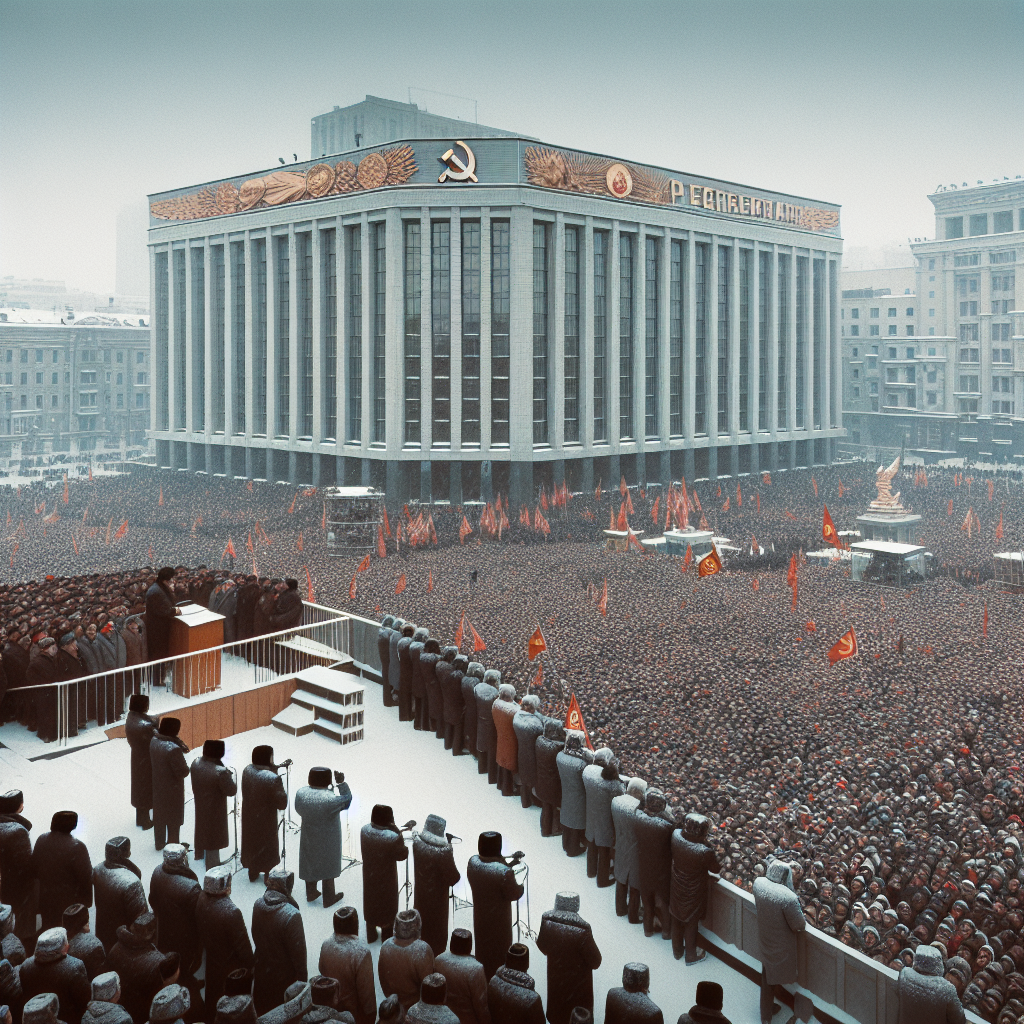
On December 21, 1989, in the Romanian capital of Bucharest, a hundred thousand people gathered in front of the Communist Party Central Committee headquarters. Romanian Communist Party General Secretary Nicolae Ceaușescu made a passionate speech condemning the recent protests and demonstrations.
However, the next day, Romania saw an even larger protest, leading to Ceaușescu and his wife hastily fleeing from the Central Party building. A few hours later, they were captured.
On December 25, Ceaușescu and his wife were sentenced to death by a special military court and executed immediately. This event marked the downfall of the Romanian Communist Party.
From Ceaușescu’s speech on the square to his execution, only five days had passed.
Political changes often come unexpectedly. Many Communist leaders like grand spectacles, but often the shining facade cannot hide the underlying truth.
Today, we will uncover the drastic changes happening in the Zhongnanhai through three major events that occurred in China in September 2025.
The September 3rd military parade of 2025 seemed like a grand display of power. Xi Jinping stood on the Tiananmen Gate Tower, accompanied by Russian President Putin and North Korean leader Kim Jong-un, delivering an “important speech,” reviewing the troops in a grand display.
However, the question remains – did Xi, Putin, and Kim standing together on the Tiananmen Gate Tower add or subtract points for Xi?
Commentators outside have called Xi, Putin, and Kim axis of dictatorship or anti-America axis. But the truth is, these three individuals have their own hidden agendas, using each other, and having conflicting goals.
Russian President Putin has been involved in the war in Ukraine for over three years. He is seen as an aggressor in the conflict, while Kim Jong-un supports Russia’s invasion of Ukraine, providing weapons and ammunition and even sending troops to assist Russia, making him an accomplice in this aggression.
During the commemoration of the 80th anniversary of the Chinese people’s victory in the Anti-Japanese War, the presence of both an aggressor and an accomplice of an aggressor beside Xi is indeed a great irony.
This 360 billion yuan military parade was supposed to showcase the influence of the Chinese Communist Party, but the results were disappointing. Most world leaders who oppose the Russia-Ukraine war refused to attend, leaving Xi Jinping with only a few non-mainstream country leaders remaining in his “friend circle.”
Furthermore, Russia’s power has significantly declined. The war in Ukraine has not only exposed Russia’s military weaknesses but has also severely hampered its economy. The Russian Minister of Economic Development admitted that the country’s economy is on the brink of recession.
Though Russia appears as a global power on the surface, in reality, it has become an economically weaker and smaller nation.
North Korea under Kim Jong-un has been sustained for decades by Chinese support. While Kim Jong-un is seen as a junior partner to China, his regime has become a burden on the Chinese people.
To commemorate the 80th anniversary of the victory in the Anti-Japanese War, amidst Xi Jinping’s splurging of 360 billion yuan, numerous key international leaders declined to attend. This event turned out to be a major diplomatic failure for Xi.
Surprisingly, the intended purpose of the September 3rd military parade was to showcase China’s military might, but the infighting among the top brass of the Chinese military was evident during the parade.
In the 2015 parade, General Song Puxuan, Commander of the Beijing Military Region, led the parade with six Major Generals and 51 Brigadier Generals.
However, in the 2025 parade, the expected Commander from the Central Theater Command, General Wang Qiang, was absent. The parade was instead led by Air Force Commander of the Central Theater Command, Lieutenant General Han Shengyan, with no Major Generals or Brigadier Generals as leaders.
This absence raised questions about General Wang Qiang’s whereabouts and the lack of senior military officials in key roles during the parade.
Since the 20th Congress of the Chinese Communist Party, the military has undergone several rounds of purges, including the removal of prominent figures like Wei Fenghe and Li Shangfu, who were close associates of Xi Jinping. Speculations suggest that Wang Qiang might be another casualty of these purges.
The crackdown on the political faction led by Wei and Li is essentially aimed at weakening Xi Jinping’s military authority.
From September 17-19, 2025, the 12th Beijing Xiangshan Forum was held at the Beijing International Convention Center.
The Beijing Xiangshan Forum, established by the Chinese Communist Party as a platform to showcase its defense diplomacy achievements, serves as a significant window to observe the direction of Chinese politics.
What stood out in this year’s forum?
Firstly, the absence of a congratulatory message from Xi Jinping, the Chairman of the Central Military Commission.
According to reports from Chinese state media, over 1,800 guests including official representatives and experts from over 100 countries, regions, international organizations, and observers attended the forum.
The reduced level of participation from the US delegation at this year’s forum – only sending military attachés rather than higher-ranking officials like in previous years – indicates the bleak prospects for US-China military cooperation, a result of the significant regression in US-China relations during Xi’s 13-year presidency.
On September 19, 2025, a phone call between US President Trump and Chinese Communist Party leader Xi Jinping took place. Trump mentioned progress on important matters like trade and fentanyl during the call and divulged that China had approved the TikTok deal.
Since taking office in January 2025, Trump initiated a trade war. Initially met with strong resistance from China, particularly on the TikTok issue, China has now made significant concessions, facilitating the approval of the TikTok deal with the US.
Trump also revealed plans to meet Xi at the AP EC Summit in South Korea and make a state visit to China in early 2026.
While these developments may seem like diplomatic breakthroughs, they suggest Xi Jinping’s growing predicament. After reaching the pinnacle of power post-20th Congress, Xi has faced challenges like officials he promoted being implicated in corruption, failed economic policies, escalating international isolation, dwindling credibility, and mounting domestic and international dissent.
Xi Jinping is unlikely to voluntarily relinquish power, indicating a possible loss of control over the highest authority within the Chinese Communist Party ranks due to internal power struggles.
From the military parade to the Xiangshan Forum and the Trump-Xi phone call, we glimpse beneath the surface of seemingly calm waters to the tumultuous currents within the Zhongnanhai. Xi Jinping’s diminishing military power, the downfall of key officials close to him, and the economic and diplomatic challenges signal a larger storm brewing on the horizon!
That’s it for today’s program. Thank you for watching. If you enjoyed our show, don’t forget to like, share, and subscribe. See you next time.