
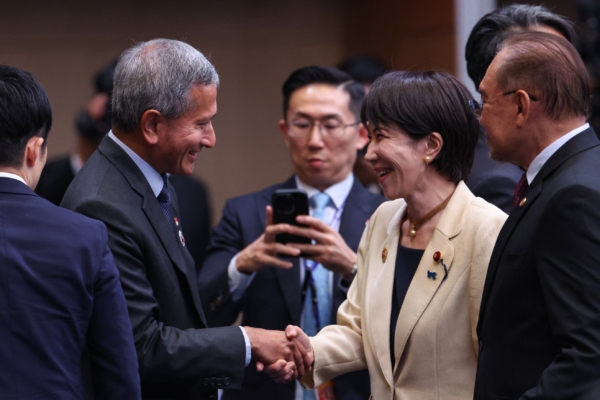
Japan’s Prime Minister Sanae Takachi sparked tensions with the Chinese Communist Party (CCP) in November last year with her remarks on “Taiwan’s security”. In response, the CCP implemented a series of measures to counter Japan. Reports suggest that the CCP, in an unusual move, convened Southeast Asian diplomats in Beijing at the end of last year, urging countries to unite in “resisting Japan”. However, only Myanmar openly condemned Takachi’s statements. Additionally, Singapore’s Prime Minister previously publicly pointed out that Japan is the most trusted major power in Southeast Asia.
According to a report by the Hong Kong-based South China Morning Post on February 6, the CCP convened most ambassadors or their deputies from Southeast Asian countries for a meeting in Beijing towards the end of last year. The meeting was framed as a platform for regional countries to express their views on Sanae Takachi’s statements. The meeting was chaired by a vice-ministerial level official from the CCP.
Sources indicated that at the meeting, CCP officials urged countries to stand with Beijing and support its stance against Sanae Takachi’s remarks. Southeast Asian ambassadors were informed that they should back Beijing’s position due to the historical aggression they had faced from Japan during World War II.
The report highlighted that this rare meeting with senior Southeast Asian diplomats underscored the CCP’s active pursuit of support to counter Japan, but also revealed the limitations of Chinese diplomatic efforts.
The effectiveness of the meeting was minimal. So far, Myanmar is the only Southeast Asian country to publicly denounce Sanae Takachi’s statements, while China remains Myanmar’s biggest supporter in the region.
Myanmar’s military government spokesperson Zaw Min Tun had criticized Takachi’s remarks on November 22 last year.
Jeremy Chan, a senior analyst at Eurasia Group, stated that Beijing, as the largest trading partner in Southeast Asia, aims to leverage its significant influence in the region to sway other countries.
However, Jeremy Chan noted that Beijing is attempting to rally support by invoking shared experiences of persecution under Japanese militarism, but countries are aware that the world has changed, and revisiting history serves little purpose.
Jeremy Chan mentioned that ASEAN leaders prefer to stay as neutral as possible. Nonetheless, sources cited in the report indicated that Beijing seemed to adjust its strategy after the meeting, now urging countries to maintain a neutral position on the Japan issue; however, there are still claims that Beijing is “cleverly” seeking support.
Public reports reveal that Southeast Asian countries not only failed to comply with the CCP’s “anti-Japan” stance but also expressed opposing views.
Singapore’s Prime Minister Heng Swee Keat, speaking at a Bloomberg New Economy Forum on November 19, 2025, when asked about the tension between China and Japan, publicly urged the CCP to let go of hatred towards Japan. He emphasized that Japan is the most trusted major power in Southeast Asia and hoped that both countries could find ways to resolve complex issues and move forward.
Following Sanae Takachi’s official assumption as Japan’s first female Prime Minister, she visited Malaysia and attended the ASEAN summit. Malaysian Prime Minister Anwar called for enhanced ASEAN-Japan cooperation.
In April 18 last year, during Xi Jinping’s visit to three Southeast Asian countries, Ho Ching, the wife of former Singaporean Prime Minister Lee Hsien Loong, reshared an article on Facebook suggesting Xi Jinping behaved like a mafia boss by pleading for cooperation with neighboring countries he had shamelessly exploited for over a decade. While the article was not written by Ho Ching herself, her reshare was seen as an endorsement of the criticism against Xi Jinping.