
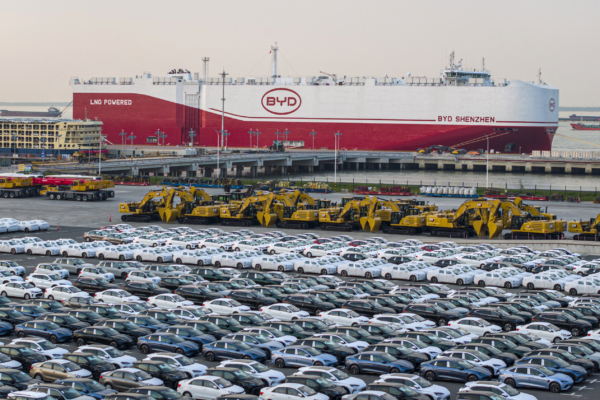
On Monday, February 2nd, BYD’s Hong Kong stocks plunged following the company’s announcement of a 30% year-on-year decline in car sales for January 2026. This decline also affected the entire automotive sector in the Hong Kong stock market, with numerous car manufacturers experiencing a significant drop in sales compared to the previous month.
BYD’s stock in Hong Kong fell by 6.9% to 91 Hong Kong dollars at the close of trading on Monday, marking the largest single-day drop since May 26th, 2025, with an intraday decline nearly touching 8% and reaching its lowest point in nearly a year.
In the A-share market, BYD saw a 4.2% drop, hitting its lowest point since September 2024.
The sharp decline in BYD’s stock price has sparked discussions among netizens, with many admiring Warren Buffett’s foresight. Buffett’s Berkshire Hathaway had held BYD stock since 2008 but completely divested its holdings in September last year. Since May 2025, BYD’s stock price has plummeted by nearly 40%.
Earlier, BYD announced that its sales of new energy vehicles in January 2026 reached about 210,000 units, a 30% drop from the same period the previous year. This marked the largest decrease in nearly two years, with BYD’s car sales declining for the fifth consecutive month.
Among the figures, passenger car sales were around 205,500 units, down by 30.67% year-on-year; pure electric vehicle sales were approximately 83,200 units, a decrease of 33.60%; and plug-in hybrid electric vehicle sales stood at about 122,300 units, down by 28.53%.
BYD has relied on growth in the international market to offset the weakness in the domestic new energy vehicle market. Despite a 51.5% year-on-year increase in BYD’s new energy vehicle exports in January 2026, reaching 100,482 units, there was a 24.6% month-on-month decline, highlighting a rapid decline in export momentum.
According to analysis by the US stock market service provider TipRanks, BYD is facing multiple pressures including fierce competition in the Chinese electric vehicle market, impact of price wars on profit margins, reduced policy support, and macroeconomic uncertainties.
Additionally, revised subsidy policies in 2026 and a 5% purchase tax faced by energy vehicle buyers will impact economic car brands. The subsidy amounts under the new policies will be based on new car prices rather than fixed subsidies, affecting about 90% of BYD’s sales, which are dominated by the mid-to-low-end vehicle series Dynasty and Ocean.
On February 2nd, Hong Kong’s automotive sector saw widespread declines in stock prices, notably with new energy vehicle companies leading the fall while traditional car manufacturers also experienced setbacks.
By the close of trading, traditional car companies like Great Wall Motors and Geely had varying degrees of decrease, while new forces in car manufacturing such as XPeng Motors fell by over 6%, NIO and Leapmotor dropped by over 4%, and Li Auto declined by 2%.
On Monday, more than 4600 individual stocks in the A-share market closed in the red, with the automotive sector as one of the heavyweight components, suffering from significant capital outflows. The China Securities Intelligent Electric Vehicle Index fell by 2.4%, and the Intelligent Vehicle ETF slumped by 3.76%, with many individual stocks following the market’s overall weakness.
The extensive downturn in the stock market’s automotive sector is the result of multiple negative factors. Market analysis points to lower-than-expected delivery data from car manufacturers as a direct trigger for the downturn.
Several car companies reported declining sales month-on-month. Among new forces, XPeng Motors delivered 27,700 new cars in January, a 7.55% year-on-year drop and a 37.46% decrease month-on-month; XPeng Motors delivered two thousand units, a 34.07% year-on-year decline and a 46.65% month-on-month drop; Leapmotor delivered 32,100 units, a 27% year-on-year increase but a 46.94% month-on-month decrease; NIO delivered 27,200 new cars with a 43.53% month-on-month decline; Huawei-backed Seres delivered 43,000 units, a 29.4% month-on-month decline.
Furthermore, traditional car manufacturers also experienced significant month-on-month sales declines in January, with SAIC Group down by 18%, GAC Group down by 37.8%, and Chery Auto down by 18.3%.
Many institutions believe that despite the continuation of the 2026 policies for trading in old cars for new ones, the core design has changed, linking subsidy intensity to car prices. This will result in a reduction in subsidies for low-priced electric vehicles. The previous fixed subsidies effectively boosted the sales of low-priced models in 2025, but with policy adjustments, market concerns are now on the overall auto sales for 2026, fearing that the subsidy reduction might further suppress consumer demand.
Bloomberg reported that by the end of 2025, Chinese consumers rushed to purchase mid-to-low-end car models before the subsidy reduction by the end of December, which led to the expected decline in sales mentioned earlier.