
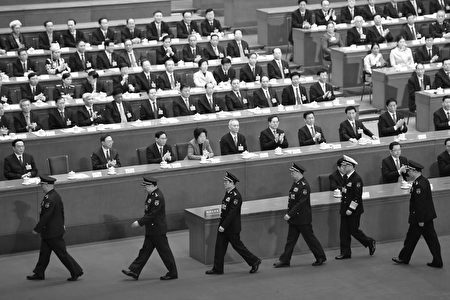
Former China analyst at the CIA, Dennis Wilder, said that the downfall of Zhang Youxia, the second-ranking figure in the Chinese military, has raised doubts within the party about Xi Jinping’s leadership abilities.
According to an article by Wilder published on Friday, January 30th, in the Financial Times titled “The Significance of Xi Jinping’s Cleansing of the Military,” he believes that the relationship between the Chinese Communist Party (CCP) leaders and the military has always been tense. Wilder currently serves as a senior research fellow at Georgetown University’s China Global Dialogue program.
Wilder stated that many foreign analysts believed Xi Jinping possessed supreme power and authority that was unmatched. However, recent events have shown this assessment to be severely flawed.
Firstly, this assessment overlooked Xi’s longstanding suspicions. From the 1989 Tiananmen Square incident to the democratic protests in Hong Kong and the unrest among the Uighurs, Xi has repeatedly claimed that the CIA was behind these events. Therefore, when party leaders questioned his decision to remove Zhang Youxia, it could naturally be seen as an excuse for Xi’s “paranoia.”
Moreover, this assessment disregarded the inherent tension between the two most crucial institutions within the CCP system – the party and the military.
In fact, since the establishment of the People’s Republic of China in 1949, every civilian leader has maintained a delicate relationship with military generals, with Mao Zedong being no exception. For example, during the Korean War in 1958, General Peng Dehuai questioned the validity of Mao Zedong’s Great Leap Forward policy, citing letters from soldiers about their families starving.
It is evident that after Peng Dehuai’s questioning angered Mao Zedong, Peng was eventually purged.
At times, the Chinese military expresses dissatisfaction with the way in which the CCP leader handles U.S.-China relations in a less dramatic but equally attention-grabbing manner.
Wilder recounted an incident in January 2011 when U.S. Secretary of Defense Robert Gates visited Beijing and met with CCP leader Hu Jintao. Prior to their meeting, the Chinese military publicly showcased their new J-20 fighter jet, which was interpreted as a deliberate “show of force.”
One of Gates’ aides told him, “This is just blatant provocation.”
Hu Jintao felt embarrassed by this sudden event, and the only official present who was aware of it beforehand was the military representative.
There is no apparent evidence indicating that Zhang Youxia, who was dismissed, had ever disobeyed Xi Jinping’s orders. However, everything seemed to have a root cause.
In an article in 2025 in “Foreign Policy” magazine, Wilder stated that a series of high-level purges within the Chinese military indicated a life-or-death struggle between the old and new factions, including intense infighting between the Crown Prince Party and Xi’s faction.
Wilder suggested that the conflict between Zhang Youxia and He Weidong might have started in July 2023 during the collective purge of senior rocket force officers. The Rocket Force oversees China’s nuclear arsenal and has long been led by the Crown Prince Party.
In January 2024, Bloomberg reported that, according to U.S. intelligence, many new types of Chinese nuclear missiles were unable to be deployed due to corruption issues in the manufacturing process.
Wilder speculated that He Weidong might have exploited this scandal to purge the Rocket Force, and Zhang Youxia could have been angered by He Weidong’s efforts to suppress the Crown Prince Party.
In October 2023, He Weidong accused former Defense Minister and Central Military Commission member Li Shangfu of corruption and had him removed from office. This was a further blow to Zhang Youxia, as Li Shangfu was his protégé and part of the Crown Prince Party. Li Shangfu had succeeded Zhang Youxia as the military commander for procurements. The procurement domain offered numerous opportunities for corruption, as many companies competed for contracts.
Wilder argued that Zhang Youxia then turned his attention to Miao Hua and launched a counterattack against He Weidong.
In November 2024, the Chinese Ministry of Defense announced that Central Military Commission member Miao Hua was suspended pending an investigation for serious disciplinary violations. Miao Hua joined the military at sixteen and is also affiliated with the 31st Group Army. His promotion and career path closely mirrored that of He Weidong.
Wilder questioned why, if this was simply an anti-corruption campaign within the military, it only targeted the generals of the 31st Group Army so far and not other Central Military Commission officials.
Since Zhang Youxia had removed two generals close to Xi Jinping personally appointed in the top ranks of the Central Military Commission, it likely shocked Xi.
According to an editorial in the PLA Daily, Zhang Youxia was accused of “seriously failing the trust and mission of the Central Party Committee and the Military Commission, severely trampling and destroying the responsibilities of the Military Commission Chairman.” This clearly pointed to Xi’s role as the supreme commander of the PLA.
Wilder mentioned in his Friday article that “Xi may be wondering if he will be Zhang’s next target or if Zhang will try to stop his reelection for a fourth five-year chairman term. As a member of the Politburo and the top military officer, Zhang is likely to work with other Politburo members and retired party elders over the next year to carry out the aforementioned actions.”
Moreover, Zhang Youxia may have been engaged in verbal disputes with Xi Jinping’s directive to be prepared for conflict in the Taiwan Strait by 2027.
Wilder wrote, “Regardless of the truth, Zhang’s downfall could lead to questioning among the party elite about Xi’s judgment and leadership capabilities. For example, they could urge Xi to designate a successor – something he has been reluctant to do so far – or seek a power-sharing mechanism to give younger leaders the opportunity to shine.”
This China expert concluded that it was certain that “Zhang Youxia’s true sin is by no means corruption or incompetence but rather his power was so great that Xi Jinping could not tolerate it.”