
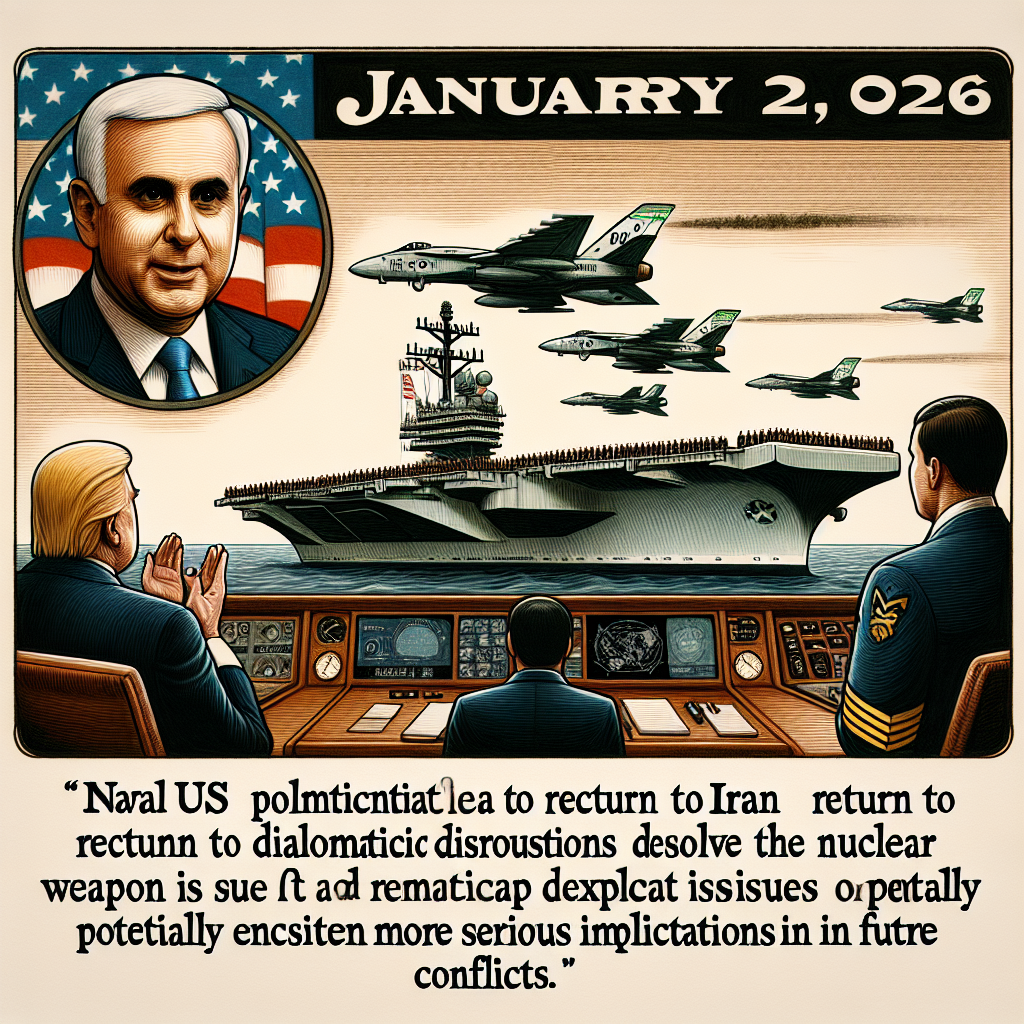
On January 28, 2026, US President Trump urged Iran to return to the negotiating table to reach an agreement on the nuclear weapon issue or face even more severe consequences in the next strike.
As President Trump issued the warning to Iran, the US Navy’s Lincoln Carrier Strike Group has already arrived in the Middle East region and is on standby, while the US Central Command’s Air Force is conducting readiness exercises.
On Wednesday morning, Trump posted on “Truth Social” stating that a massive fleet was sailing towards Iran. It was moving swiftly, displaying grandeur, and had a clear objective. This fleet was even larger in scale, led by the powerful aircraft carrier “Abraham Lincoln,” surpassing the fleet sent to Venezuela.
“Just like dealing with Venezuela, this fleet is poised and ready, with the capability to swiftly complete its mission, even resorting to military action if necessary,” the President sternly warned Iran.
Trump urged Iran to reach a nuclear agreement, stating, “We hope that Iran can quickly ‘return to the negotiating table’ and reach a fair and reasonable agreement – one that does not involve nuclear weapons – an agreement beneficial to all parties. Time is of the essence and the stakes are high!”
“As I have previously said to Iran, reach an agreement! If they do not, the result will be the ‘Midnight Hammer Operation,’ and Iran will suffer greatly. The next strike will be even more devastating! Do not let history repeat itself,” the President warned emphatically.
On June 21, 2025, the US Air Force’s B-2 stealth bombers successfully carried out airstrikes on Iran’s nuclear facilities. The Pentagon stated that seven B-2 bombers participated in the “Midnight Hammer” operation, shocking the world.
According to reports from Iranian state media on Wednesday, Iranian Foreign Minister Abbas Araqchi stated that he had not recently contacted US special envoy Steve Witkoff, nor had he requested negotiations.
“Our position is clear: negotiations cannot take place in the presence of threats and excessive demands. Negotiations can only occur when there are no longer threats and unreasonable requests,” Araqchi said.
This tough response contradicted the remarks of Turkish Foreign Minister Hakan Fidan. Fidan stated in an interview with Al Jazeera on Wednesday, “Iran is ready to negotiate on the nuclear issue once again.”
The Iranian Permanent Mission to the United Nations stated that Iran is prepared for dialogue but will defend its own security interests.
During his first term, President Trump withdrew from the 2015 agreement that restricted Iran’s nuclear capabilities and instead adopted a policy of “maximum pressure,” aiming to severely weaken Iran’s economy through harsh sanctions.
President Trump also previously mentioned that if Iranian authorities reinstate their nuclear program after Israeli and US military airstrikes in June, the US would take action.
Since late December last year, Iran has experienced widespread anti-government protests. Trump has stated multiple times that he is considering ordering military actions in response to the Iranian authorities’ crackdown on the protests earlier this month.
The “Human Rights Activists News Agency” based in the US released the latest death toll figures on Tuesday. The organization confirmed that the deceased included at least 5,777 protesters, 214 government-related individuals, 86 children, and 49 civilians who did not participate in the protests. The organization also added that the crackdown has resulted in over 41,800 arrests.
The economic pressures facing Iran may lead to new unrest as daily essentials are becoming increasingly unaffordable for the population. Iran provides most citizens with a monthly subsidy equivalent to around $7 to cope with rising living costs.
On Tuesday, the exchange rate of the rial to the US dollar offered by currency exchange shops in Tehran hit a historic low. Traders declined to comment publicly on the matter, and some expressed anger at the situation.
Iranian citizens watch helplessly as the rial has drastically devalued against the dollar in just ten years, from 1 dollar to 32,000 rials to 1 dollar to 1.5 million rials, significantly eroding their savings.