
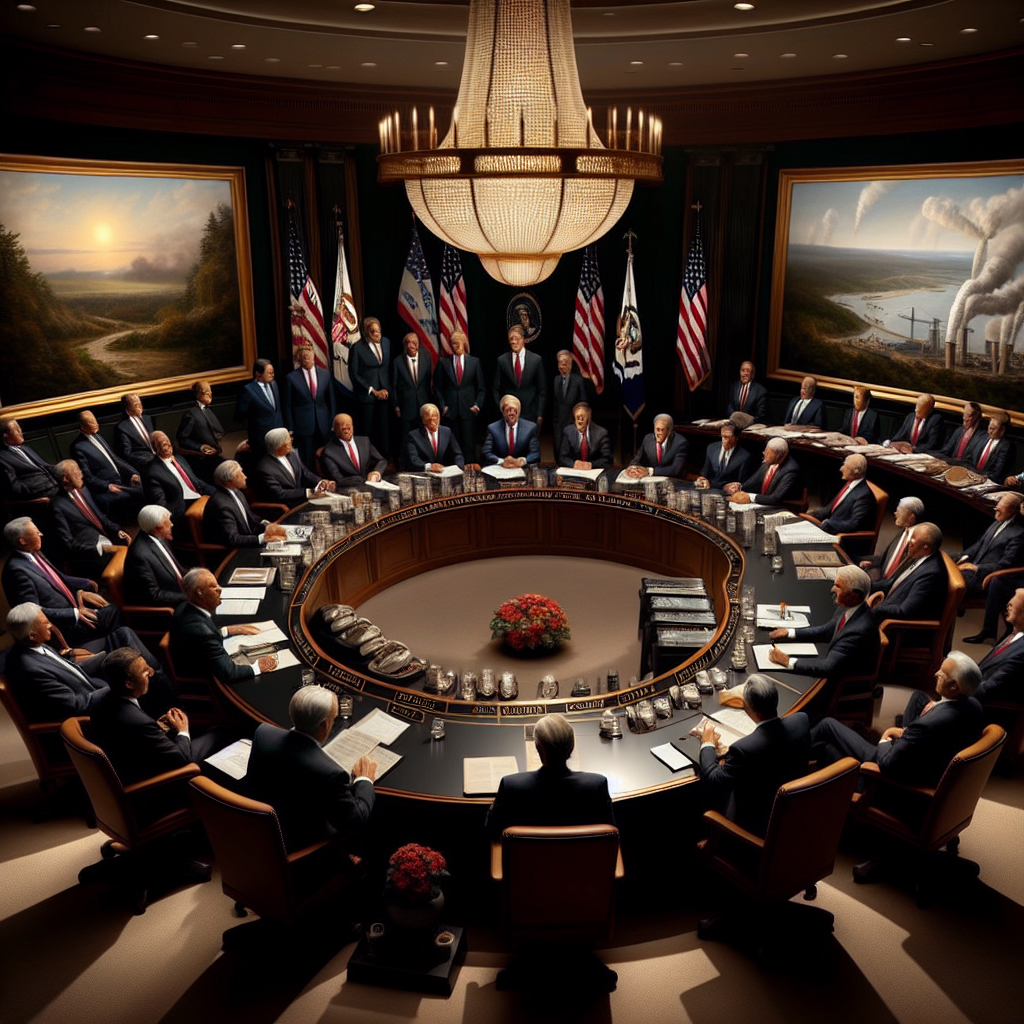
In the first year of President Trump’s second term, his administration’s energy policies largely aligned with his campaign promises: strong support for oil, natural gas, and coal production; increased investment in nuclear energy development; rollbacks of environmental regulations; and a push for the revival of the American mining and mineral processing industries.
However, a new strategic direction has quietly emerged, such as allocating billions of federal dollars for mining companies and reactor projects. The government not only used taxpayer funds to support the development of mines, smelters, and refineries but also aimed to maintain stability in the global minerals and metal markets, currently dominated by the Chinese Communist Party (CCP).
In December of last year, the U.S. Department of Energy announced $134 million in funding opportunities to strengthen and commercialize the domestic rare earth element supply chain. Rare earth elements are essential members of the 54 items listed in the U.S. Geological Survey’s “Critical Minerals List.”
Processing companies in China currently produce over 50% of the global output for more than 30 of the 54 mineral items, smelt over 70% of refined metals globally, and supply 90% of the rare earths needed by the U.S. manufacturing sector, including defense contractors, holding a dominant position in the global market.
While federal subsidies for critical minerals and rare earth mining and processing have been ongoing since the Obama administration, the Trump government has taken further steps by investing taxpayer money directly into American companies and projects.
The Department of Energy (DOE) acquired a 5% stake in Lithium Americas and obtained a 10% share in Canadian firm Trilogy Metals Alaskan mining development project. The U.S. Defense Department also holds a 15% stake in MP Materials’ rare earth mine at Mountain Pass in California.
Additionally, the U.S. Export-Import Bank has expressed interest in providing a $120 million loan to Critical Metals for the development of a rare earth mine in Tabriz, Greenland.
At the same time, ten companies are developing eleven “first mover” nuclear innovation technologies with the goal of achieving criticality by July 4, 2026, to qualify for federal funding.
These funds come from the recently authorized Energy Reactor Pilot Program, which includes a long-term commitment of $332 billion for advancing technology research and development.
The Energy Department’s Great Reactor Race, announced in August of last year, aims to approve permits for ten new reactors by 2030 and quadruple the nation’s nuclear capacity by 2050. These goals were detailed in four nuclear energy executive orders issued by the President in May 2025.
These initiatives in Trump’s first year’s energy policy are distinctive and are likely to influence future developments significantly. However, perhaps the most notable aspect lies in Trump’s swift and comprehensive actions, which have fundamentally altered the energy development landscape and have become a critical aspect of his foreign policy.
Trump signed 220 executive orders during his first term, and in less than eleven months in his second term, the number of executive orders signed has surpassed the total for the previous four years.
The White House reported that as of the first anniversary of his inauguration on January 20, the President had signed 228 executive orders. In the summary of “365 Wins In 365 Days,” the White House listed this remarkable number of executive orders as the 220th victory, proving Trump’s rapid implementation of core campaign promises without delay or deviation — the most in a single term in decades.
Many of these orders directly relate to energy policy, and dozens of executive orders with “whole of government” impacts also play a role in energy development or provide auxiliary support. This wave of action began with five executive actions on the President’s first day in office:
1. Issuing the National Energy Emergency Declaration.
2. Urging increased oil and gas production through the Unleashing American Energy order.
3. Announcing the U.S. withdrawal from the Paris Climate Agreement.
4. Opening up areas in Alaska with “extraordinary resource potential” for development.
5. Immediately suspending federal permits for wind energy projects.
As part of the early foundational steps highlighting the government’s prioritization of energy development, the National Energy Dominance Council, led by Interior Secretary Doug Burgum and Energy Secretary Chris Wright, was established. Wright, a founder of a pioneering fracking company, is overseeing a policy aimed at significantly increasing investment in fossil fuels.
The White House contends that the emphasis on oil, natural gas, and coal development is reflected in the “lowest in five years” gasoline prices. As of January 20, gasoline prices in 43 states in the U.S. were below $3 per gallon, with 19 states even below $2 per gallon.
According to data from the Energy Information Administration (EIA), liquefied natural gas (LNG) exports are currently at record highs; previously under the Biden administration, LNG exports were halted in 2023 and 2024. The current government has reached agreements worth billions of dollars in oil and LNG trade with the EU, South Korea, and Japan, and plans to open up 1 billion acres of federal land and waters for oil and gas drilling.
After decades of decline, coal consumption has seen a slight resurgence but still struggles to compete with natural gas, favored by power generators. The Department of Energy has instructed some older coal-fired power plants to continue operations and opened up vast tracts of public land for mining. To support metallurgic coal production, the government reintroduced a 25% tariff on imported steel and raised the aluminum import tariff to 25%.
The government asserts that the baseload power provided by these reliable fossil fuels “has enabled approximately $10 trillion in new domestic investment, promoted the return of job opportunities, and revitalized American manufacturing.”
Under Trump’s Trump Corollary to the 1823 Monroe Doctrine, the unique sphere of influence for the U.S. in the Western Hemisphere covers Venezuela’s oil and potentially Greenland’s rare earths. The corollary emphasizes the restoration of America’s energy dominance (including oil, gas, coal, and nuclear) and reshoring critical energy component industries domestically, seen as not only crucial for foreign policy and the national economy but also as the “highest strategic priority.”
In addition to supporting fossil fuel and nuclear energy development, directly investing in critical mining projects, and providing alternative supply chain financing to counter CCP dominance in minerals and metals markets, Trump’s first-year energy policy also focused on possibly overturning Biden’s “green energy agenda” as much as possible and conducting a comprehensive review of federal regulations to reduce permit costs and shorten approval timelines.
In July 2025, Trump issued an executive order directing the Treasury Department to terminate implementation guidance for a series of clean energy tax credit exemptions and to undergo revisions. These subsidies, authorized by the 2022 Inflation Reduction Act (IRA), were originally intended to extend until 2032.
The IRA was landmark legislation of the Biden administration, a massive bill that added over 80 sets of regulatory measures when promoting what was packaged as “The New Green Deal” in a “whole of government” approach.
In his first day in office, Trump issued an executive order announcing the “indefinite pause” of offshore wind energy development, essentially preemptively blocking any room for new projects. The government later issued another order on December 22, 2025, to suspend construction on five approved offshore wind projects citing the need to review their “national security risks.”
Under pressure from the Trump administration, over $32 billion in wind and solar “green energy” projects driven by the IRA were canceled in 2025, as analyzed by the Environmental Entrepreneurs (E2) organization in December of last year.
The Solar Energy Industries Association (SEIA) also stated that developers had canceled hundreds of solar projects, and other projects in the pipeline faced significant delays in federal approvals.
The association emphasized that these projects were distributed across 44 states, providing enough electricity to power 16 million households, and underscored that Trump’s goal of halving electricity prices within 18 months of taking office could not be achieved without support for renewable energy. In fact, electricity prices rose by 5% in 2025.
According to SEIA data, solar energy accounts for “over half of all new electricity capacity planned in the U.S. by 2030.”
Trump’s energy development policy has driven extensive regulatory rollbacks and revisions. The White House claims that this is the “largest deregulatory action in American history,” projected to save $5 trillion.
In June 2025, the Environmental Protection Agency (EPA) revoked regulations requiring coal-fired power plants to reduce emissions in the Biden era. Subsequently, in July, the EPA announced intentions to rescind the “endangerment finding” used as a scientific basis in permit reviews, thereby removing emissions restrictions on cars and power plants.
In addition to repealing broad environmental regulations, Trump’s government’s first-year energy policy included cutbacks such as canceling 16 categorical grants totaling $1 billion, reducing Superfund management funds by $254 million, abolishing the EPA’s Office of Research and Development and cutting its budget by $235 million, canceling $100 million in environmental justice grants, and cutting $100 million from the air protection program.
The government’s proposal for the EPA’s 2026 fiscal year budget is $4.2 billion, less than half of the $9 billion allotted in 2025. This move will result in a 55% reduction in spending and cut the workforce by at least one-third, affecting around 15,000 employees.