
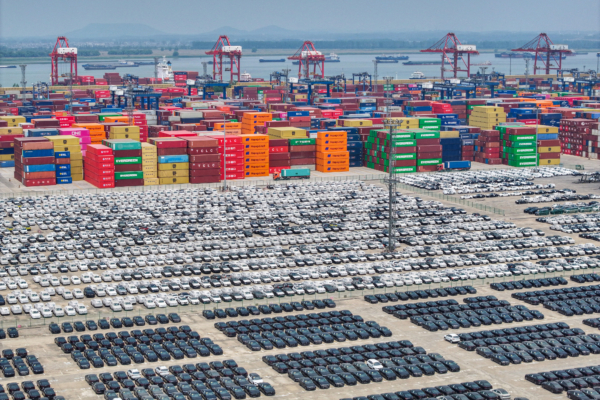
In 2026, China’s sales of passenger cars have been accelerating their decline since the beginning of the year. From the 1st to the 11th of the month, retail sales of passenger cars dropped by 32% year-on-year, far exceeding the declines of 8.1% in November and 14% in December. It is worth noting that this decline occurred against the backdrop of continued car purchase subsidy policies at the central and local levels, as well as aggressive promotions by car manufacturers, highlighting that the Chinese Communist Party’s consumer subsidies and stimulus policies have lost their effectiveness. Several institutions predict that passenger car sales in China will experience negative growth in 2026, indicating a difficult situation to reverse.
On Wednesday (January 14), data released by the China Passenger Car Association (CPCA) revealed that from January 1 to 11, a total of 328,000 passenger cars were retailed nationwide, a 32% year-on-year decrease and a 42% decrease compared to the previous month. Among them, sales of new energy vehicles amounted to 117,000 units, representing a 38% year-on-year decline and a 67% decrease from the previous month.
Zhu Huarong, a director at Changan Automobile, believes that the policy adjustments in 2025 and 2026 have led to the early exhaustion of a large amount of consumer demand, resulting in a “cliff-like” decline in demand in the first quarter of 2026.
According to a report by the venture capital and business technology platform “Titanium Media” on Wednesday, sales personnel from 7 dealerships representing 3 different car brands admitted in interviews that there was a significant decline in sales, order volume, and foot traffic in stores in early January compared to both the New Year holiday and the same period last year. Some dealerships even reported zero transactions, with others selling fewer than 5 cars, illustrating a significant decrease compared to January last year and even more so than December last year.
The China Association of Automobile Manufacturers (CAAM) stated on Wednesday that it expects a 1% increase in car sales this year, lower than the 9.4% growth in 2025. However, a report released by S&P Global last week indicated that passenger car sales in China are likely to decline by 1% to 3% in 2026. It is estimated that the Chinese auto industry will need at least three years to digest excess capacity and complete integration.
What is concerning is that this decline in sales is occurring despite the continuation of the 2026 China auto sales subsidy program and the aggressive promotions by car manufacturers.
As we enter 2026, over 20 Chinese auto companies have announced price reductions and other promotional policies for up to 75 models, including joint ventures such as BMW, Tesla, Toyota, as well as domestic brands like BYD. Despite the significant scale and magnitude of these promotions, consumer response seems lukewarm after years of discount sales.
Numerous local Chinese auto brands like Xingtu, Shangjie, Zhijie, Shenlan, and GAC Aion have also introduced promotional plans for over 40 models. Joint venture brands have also lowered their prices. For example, BMW China announced a comprehensive price reduction for 31 of its main models on January 1. The flagship pure electric model i7 M70L saw a price decrease of 301,000 yuan.
Additionally, more than 5 joint venture brands including FAW-Volkswagen, FAW-Toyota, Chang’an Mazda, Dongfeng Nissan, Dongfeng Honda, and GAC Toyota have launched price reduction promotions ranging from 10,000 to 50,000 yuan.
On January 6, Tesla China introduced a “7-year ultra low-interest rate” installment payment plan for Model3, Model Y, and the new Model YL models. Consumers can also opt for a 5-year 0-interest rate installment payment plan.
The automotive information platform “Top Automotive” recently quoted CAAM Vice Secretary General Chen Shihua as saying that consumers are adopting a wait-and-see attitude towards policy adjustments, reflecting weak intrinsic demand. He pointed out that excessive promotion will only deepen this dependence, creating a vicious cycle: sales soar when discounts are available, but plummet once the discounts stop.
However, relying on promotional warfare—a dangerous path akin to poison—will bring about threefold costs: continued pressure on profit margins, damage to brand value, and worsening operational conditions for dealers. A significant number of dealers were already facing cash flow pressure in 2025, which may escalate in 2026.
At the central level, the car scrappage and trade-in subsidy plan will be extended to 2026, while local governments are rolling out new rounds of car purchase subsidy policies.
On December 30, 2025, the National Development and Reform Commission and the Ministry of Finance of the CPC issued a notice regarding the “Implementation of Large-scale Equipment Renewal and Consumer Trade-In Policy in 2026 for New Energy and Fuel Vehicles.” The new policy continues subsidy measures for new energy and fuel vehicles but with adjustments, shifting from fixed subsidies to subsidy percentages based on vehicle prices.
For new energy passenger cars, the subsidy is set at 12% of the car price (up to a maximum of 20,000 yuan) and 8% (up to 15,000 yuan). For purchases of fuel passenger cars with a displacement of 2.0 liters and below, the subsidies are 10% (up to 15,000 yuan) and 6% (up to 13,000 yuan), respectively.
According to a report by “First Financial” on Wednesday, subsidy policies have been initiated in regions like Jinan in Shandong, Luoyang in Henan, Jing’an District in Shanghai, and Gongshu and Yuhang Districts in Hangzhou. For instance, Jinan recently allocated 50 million yuan in special funds for the “Wanma Benteng Quancheng Purchase” auto consumer subsidy program, providing direct subsidies to car buyers in the form of insurance subsidies and consumption vouchers. Hangzhou’s Gongshu and Yuhang Districts have successively introduced new auto consumer subsidy policies for 2026, with a total amount of 30 million and 25 million yuan, respectively. Individual car buyers can receive a subsidy of up to 6,000 yuan per vehicle.
Jing’an District in Shanghai will launch an auto consumer subsidy activity themed “Immediate Car Delivery, Gifts in Jing’an” on January 15. Individual consumers participating in the activity at car sales enterprises in Jing’an District can receive a consumption subsidy of up to 4,000 yuan per vehicle. When combined with national and municipal subsidy policies, the maximum subsidy could reach 24,000 yuan.
The growth in auto sales from the “Two New” policies in the first 11 months of 2025 was significant. According to data from the Ministry of Commerce of the CPC, over 11.2 million vehicles were traded in the replacement of old cars for new ones during the first 11 months of 2025, greatly boosting auto consumption. However, as subsidy funds are exhausted and the stimulus effects diminish rapidly, the domestic market has started to adjust, with a year-on-year decline of 8.1% in November and a 14% decline in passenger car sales in December.
S&P Global mentioned in a previous report that despite extending auto subsidy policies to 2026, China may still struggle to prevent a decline in sales. Automakers will face another challenging year, impacted by multiple factors including declining demand, increases in electric vehicle purchase taxes, and government measures against industry redundancies.
Data released by CAAM on Wednesday indicates that the sales growth rate of electric and plug-in hybrid vehicles in China is expected to slow from 28.2% to 15.2% in 2026, while the growth rate in car exports, which exceeded expectations with a 21.1% increase in 2025, is projected to drop to 4.3%.
The head of Chinese auto research at UBS predicted in a report at the end of 2025 that signs of structurally weak demand in the Chinese domestic passenger car market have already emerged. It is forecasted that the growth rate of domestic passenger car sales in 2026 will plummet from 8% in 2025 to -2%, showing negative growth year-on-year.
In a report released in December last year, Morgan Stanley predicted that car sales in the Chinese domestic market could drop significantly by 30% to 35% in the first quarter of this year, with a potential full-year decrease of 5%. Excluding export sales replenishment, the decline could reach as high as 7%.