
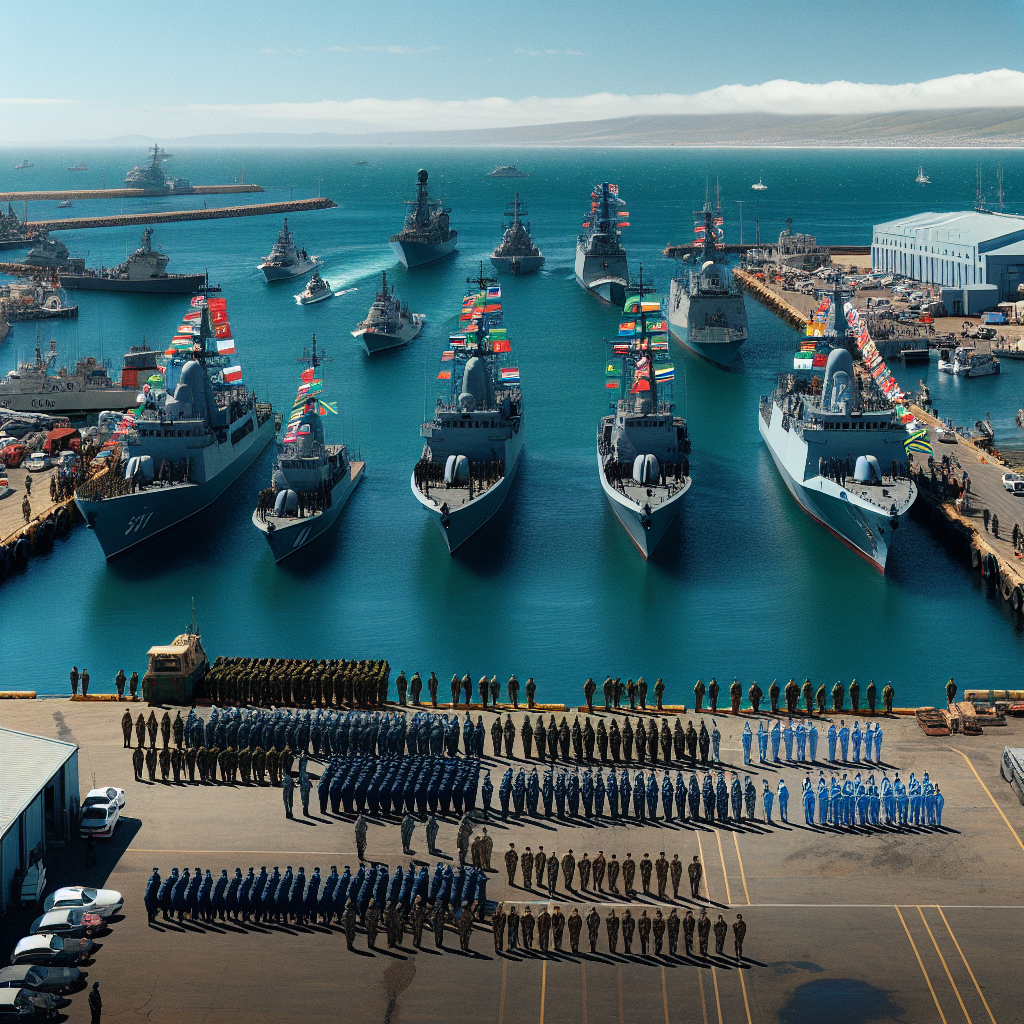
Recently, in its own territorial waters, South Africa hosted a multi-country naval exercise led by the Chinese Communist Party known as “BRICS Plus”. Chinese, Russian, and Iranian warships successively arrived at the Simon’s Town Naval Base in Cape Peninsula.
The South African military stated that the exercise, codenamed “Exercise WILL FOR PEACE 2026”, falls under the framework of “BRICS Plus” for the purpose of promoting maritime security cooperation and joint operational capabilities among BRICS expansion countries’ navies.
Lieutenant Colonel Mpho Mathebula, the spokesperson for South African Joint Operations, mentioned that all BRICS expansion countries were invited to participate in the exercise and reiterated that this was purely a military training and not a political arrangement.
The statement clarified that this exercise, led by the People’s Republic of China, had South Africa acting as the host country, providing facilities like the Simon’s Town Naval Base and related logistical support. The statement did not specify the list of countries participating. However, it was revealed during the opening ceremony by Chinese military officials that Brazil, Egypt, and Ethiopia attended as observers.
According to South African media outlet News24, South Africa initially hoped to convince Iran to participate only as an observer, not actively engaging in the training, demonstrating the sensitive diplomatic nature of the military exercise. Nonetheless, warships carrying the flags of China, Russia, and Iran eventually docked, and the one-week exercise officially commenced last Friday, January 9th.
This exercise has stirred controversy within South Africa. The ruling African National Congress (ANC) traditionally viewed China and Russia as ideological and historical allies. However, following the loss of majority in parliament in 2024, they were compelled to form a coalition government with pro-Western and free-market advocate parties like the Democratic Alliance (DA).
The DA openly criticized this joint military exercise, stating that it goes against South Africa’s proclaimed non-aligned and neutral diplomatic stance. They warned that the BRICS mechanism is gradually turning South Africa into a “pawn in the power game of rogue nations on the international stage”.
This military exercise comes at a tense period in the relations between the United States and several BRICS expansion countries. President Donald Trump has repeatedly accused BRICS countries of pursuing “anti-American policies” and warned in January last year of imposing a 10% tariff on all member countries on top of existing tariffs.
Professor William Gumede from the University of the Witwatersrand in South Africa, in an interview with the BBC, expressed concerns that amidst the current international political climate, such military exercises could further strain relations between South Africa and the United States. He mentioned that even during the Democratic administration before Trump, the U.S. generally viewed South Africa as leaning towards being “anti-American”.
Gumede pointed out that Trump not only criticized the South African government for failing to protect the white minority but also proposed offering refugee status to Afrikaners, imposing tariffs on South African goods, cutting aid, and deteriorating bilateral relations.
Economically, the risks are particularly prominent. Gumede emphasized that the importance of the U.S. to South Africa’s economy surpasses that of China in practical terms. American businesses directly create over 500,000 employment opportunities in South Africa, whereas the estimated job contribution from Chinese companies is only tens of thousands. The South African Reserve Bank warned that a new 30% tariff from the U.S. could lead to the loss of around 100,000 jobs, especially impacting agriculture and automotive industries.
Originally composed of Brazil, Russia, India, China, and South Africa, the BRICS mechanism expanded in 2024 to include Egypt, Ethiopia, Iran, the United Arab Emirates, and Indonesia, evolving into “BRICS Plus”. Member countries generally perceive this mechanism as a crucial platform to counterbalance the economic dominance of the U.S. and the West.
Fundamentally an economic cooperation platform rather than a military alliance, this joint naval exercise held under the “BRICS Plus” banner for the first time emphasizes being non-directed against third parties and focusing on maritime economic security. However, due to its military cooperation aspect, it contrasts with its economic focus, attracting significant external attention.