
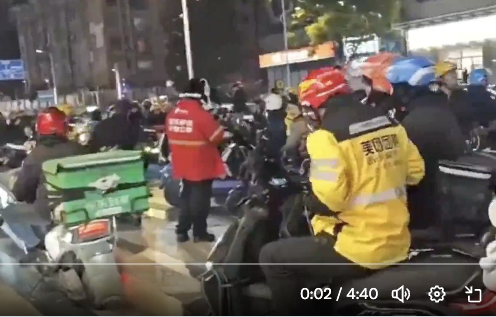
On December 29th, a protest by food delivery drivers gathered in Zigong City, Sichuan Province. Hundreds of delivery drivers gathered near the city center shopping district to voice their dissatisfaction with the closure of roads by property management, restricting their deliveries. This protest was sparked by issues related to access and passage, similar to a recent incident in Changsha, Hunan Province.
Videos circulating online and accounts from witnesses indicate that the incident took place at Hua Shang International City in the Ziliujing District of Zigong City. On that day, the property management of the shopping mall installed barriers on surrounding sidewalks and lanes citing “ease of management,” restricting the passage of electric motorcycles and vehicles, causing delivery drivers to be unable to access the mall to pick up orders.
Under the pressure of long-term delivery demands and limited passage on that day, some drivers had disputes with on-site management personnel, which led to more drivers arriving at the scene to express their grievances. According to estimates, there were over a hundred drivers gathered at the scene, causing traffic congestion in front of the mall, attracting the attention of passersby and shoppers.
Footage shows some delivery drivers standing on their electric vehicles protesting loudly, while others pushed over or dismantled the barriers set up by the property. Several police officers were present at the scene to maintain order, and no further physical conflicts were reported.
An analysis by a Ph.D. candidate from Peking University pointed out that in recent years, food delivery platforms have been continuously reducing delivery times, causing drivers to lack organized channels for safeguarding their rights, leading to immense pressure under high-intensity algorithmic management. In this context, any additional restrictive measures from outside the platform, such as road closures and limitations on riding, could quickly escalate tensions.
The Zigong incident follows a similar collective action for rights protection by food delivery drivers in Changsha the previous week, demonstrating a recurring pattern of protests stemming from access restrictions.
Previously, multiple media outlets reported a large-scale protest by food delivery drivers in Changsha, Hunan on December 22nd, triggered by restrictions on using electric scooters in a residential compound for deliveries, prompting drivers from various delivery platforms to gather in solidarity.
Videos from the scene showed drivers from platforms like Meituan and Alibaba’s “Taobao Flash Purchase” rallying at the entrance of the compound, chanting slogans demanding a response from the property management. As word spread, more drivers arrived, leading to an expanding protest that lasted into the night.
Police, special forces, and traffic officers were deployed to maintain order and evacuate the gathering crowd. In the early hours of the 23rd, the lighting at the scene was cut off, and the crowd dispersed. Subsequently, relevant videos and information were restricted on some social media platforms.
Analysts believe that the incidents in Changsha and Zigong were both sparked by issues related to riding and passage restrictions, reflecting the real challenges faced by food delivery drivers under the amalgamated pressures of urban management, property regulations, and platform delivery mechanisms.