
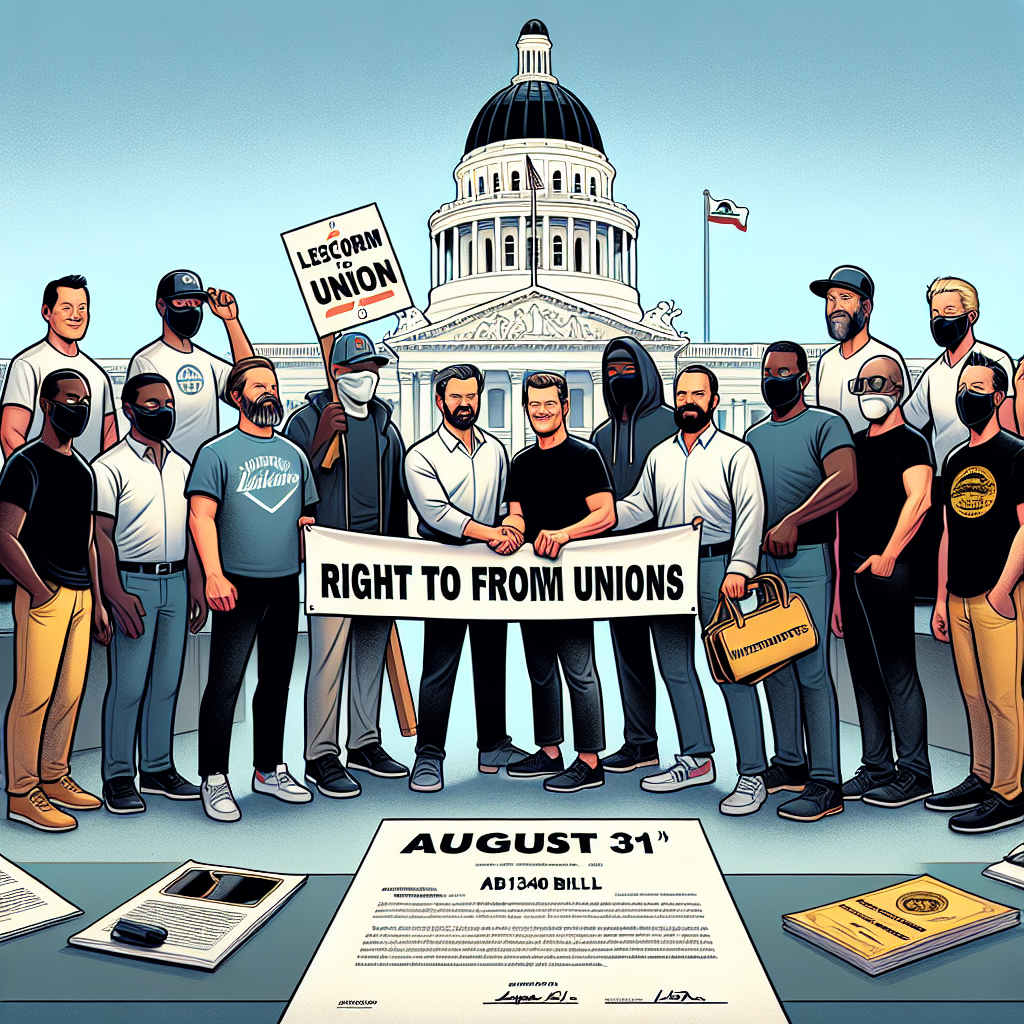
California Governor Gavin Newsom and state lawmakers have reached an agreement with Uber and Lyft to grant drivers the right to form unions while maintaining their status as independent contractors.
The agreement, finalized on August 31, combines the labor-backed AB1340 bill (allowing over 800,000 drivers to form unions and negotiate wages) with the company-supported, reduced mandatory insurance coverage SB371 bill (lowering mandatory insurance coverage from $1 million to $600,000, and total payout per accident from $1 million to $300,000).
The union supporting AB1340, Service Employees International Union (SEIU California), expressed its support for this agreement.
SEIU California executive director Tia Orr stated in a declaration on August 29, “Gig workers have been organizing and advocating for years because industry giants have long provided unfair treatment to workers: you do all the work, bear all the risks, while the company makes all the decisions and reaps most of the benefits. The AB1340 bill will end this situation.”
This is not the first time that independent gig economy workers in California have clashed with ride-sharing platforms over employee status.
In 2019, the California legislature passed the AB5 bill in an attempt to reclassify Uber, Lyft, and other gig drivers as employees, granting them rights to minimum wage, overtime pay, and other benefits.
In 2020, companies including Uber, Lyft, and DoorDash joined forces to push Proposition 22, spending over $200 million to secure its passage. At the time, these companies argued that AB5 would significantly increase their operating costs, potentially forcing them to exit the largest state market in the U.S.
Many independent contractors interviewed by the media have expressed that what attracts them most to working for Uber is the freedom and flexibility it provides in terms of working hours. While the AB5 bill aimed to secure benefits for workers, it did not apply to every industry and may have inadvertently restricted job opportunities for many freelancers.
A Chinese Uber driver mentioned that many people drive for ride-sharing platforms to make extra money while balancing family responsibilities, and it is fair and reasonable to have more work and income opportunities. If they were to become employees, this job would lose its biggest advantage.
Proposition 22 ultimately passed, allowing app-based ride-hailing and delivery companies to classify drivers as independent contractors rather than employees covered by labor compensation laws.
In 2024, the California Supreme Court upheld the legality of Proposition 22, seemingly closing the door on hopes for labor unions. However, AB1340 has now opened a new path, allowing drivers to collectively bargain through the certification of the Public Employment Relations Board without crossing the “employment relationship” boundary.
Uber’s Director of Public Policy Ramona Prieto described it as a balance, giving drivers a stronger voice while bringing cost savings to passengers.
Lyft’s Director of Public Policy Nick Johnson stated that reducing mandatory insurance coverage could address costs that make up nearly a third of fares, helping to maintain affordability in ride-sharing services in California.
Governor Newsom highlighted in a statement that this agreement represents a compromise between unions and sharing economy companies.
He said, “Labor and businesses coming together to resolve differences, find common ground, empower hundreds of thousands of drivers, while also enabling millions of Californians to use ride-hailing services at a more affordable price. This demonstrates that California can achieve great things, solve difficult problems, and improve people’s lives.”