
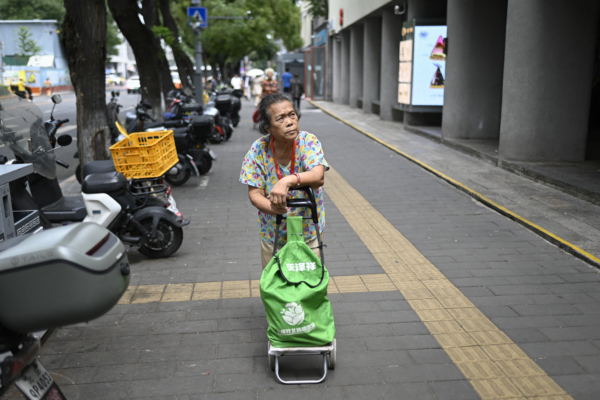
78-year-old Beijing retiree Wang Shuyun receives a pension of 10,000 yuan per month, without the burden of children, allowing her to spend thousands on nutrition classes, imported milk, and Adidas shoes. She told Reuters, “What I value most is living a good life.” However, experts point out that such rare cases cannot represent the actual situation of the majority of elderly people, as the spending power of the silver-haired population is not enough to offset the deflationary pressures facing the Chinese economy.
Wang Shuyun is an ideal target for the Communist Party’s promotion of the “silver economy.” Since 2021, the CCP has proposed to “vigorously cultivate” the silver-haired industry, issuing at least 20 policy documents this year alone, requiring businesses to develop food, medical, financial, and elderly care products suitable for the elderly in order to turn this group into a new consumption engine.
However, Wang Shuyun’s situation is just a minority exception. The average pension in urban China is only around 3,000 yuan, dropping even lower to 200 yuan in rural areas. Most elderly people have limited daily expenses and can only afford basic living costs. Qiao Li, a 66-year-old retiree in Beijing, says he mostly spends his money on buying vegetables for his family.
“At our age, our main focus is still on getting by day to day,” he said.
Economists point out that while some elderly people may have some savings, overall, their spending power is not enough to support the continued sluggish Chinese economy. Alicia Garcia Herrero, Chief Economist for Natixis in Asia Pacific, bluntly stated, “The spending of the elderly group is not strong enough to counterbalance deflationary pressures, let alone drive widespread economic growth.”
In July of this year, China’s Consumer Price Index (CPI) remained flat compared to the previous year, reflecting low price pressures. Although Euromonitor data shows that from 2015 to 2025, elderly household consumption expenditure increased by 129%, surpassing the overall population’s 79%, overall domestic demand remains weak.
Official figures show that in the first half of this year, Beijing’s hotel profits plummeted by 92.9% year-on-year, with restaurant income increasing by only 0.9% in June, far below the 5.9% in May. These numbers serve as a warning: insufficient consumption, and the risks of economic downturn are still expanding.
Many Chinese companies are trying to seize this emerging market by introducing AI reading glasses, voice navigation, and “emotional conversation” tools for the elderly. However, analysts emphasize that even if these strategies are feasible, they cannot fundamentally change the situation of low consumption.
Professor He-Ling Shi of Montash University said, “China’s long-term economic growth has been heavily reliant on manufacturing and exports rather than consumption, making it more difficult to resolve deflation risks.”