
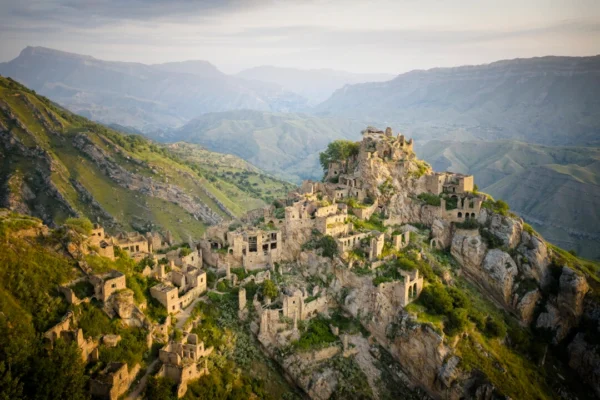
In the medieval times, the best home security system was to build houses on steep mountain peaks. The Khans who once ruled the Dagestan region in Russia undoubtedly understood this well. With the Ottoman Empire’s massive invasion in the 16th century, the Khans probably realized the importance of constructing defensive fortifications for themselves and their families on the dry Caucasus Mountains’ peaks.
Imitating the ruins of Machu Picchu on the mountaintops of the Peruvian Andes, there is an ancient mountain fortress called Gamsutl located between the Caspian and Black Seas in Dagestan. Its history can be traced back at least 1600 years ago, possibly even having a history of 5000 years. While Machu Picchu was abandoned in the 16th century, Gamsutl thrived until the 20th century.
Situated on Mount Gamsutlmeer at an altitude of about 4,650 feet, people utilized cliffs as stone walls and constructed stone houses on protruding mountain peaks. The steep cliffs made Gamsutl easy to defend. The village resembles a swallow’s nest, nestled in the rocky pinnacle, with its name telling an ancient tale. Translated from the traditional language of the Avar residents, Gamsutl means “at the foot of the Khan’s fortress,” indicating that the Khan once resided here for protection. Another ancient village situated at its foot still exists today, where the Khan’s armies were stationed. It is said that this fortress was never conquered.
Gamsutl village has almost faded into the annals of history. The buildings on the mountaintop, although constructed of stone and clay with roof beams covered in mud and straw, were actually renovated structures from the 19th century. The old residential dwellings are no longer in existence. There were approximately 300 buildings here, housing up to 3000 people.
As early as the 20th century, Gamsutl had started thriving. It had its own school, grocery stores, hospital, maternity clinic, and even a mobile cinema showing movies in town. However, by the 1960s, increased social mobility and opportunities caused changes in the local area. Nearby towns became more appealing to the people of Gamsutl. Particularly for the youth, the allure of remote village life quickly lost its luster.
From around that time, the population residing in Gamsutl began to decline. Being only a three-hour drive from the largest city in Dagestan, Makhachkala, they started moving away to pursue better and more practical lifestyles. However, despite the sharp decrease in the village’s population, some elderly people who grew up in Gamsutl chose to stay. By 2002, only 17 residents remained in the village. By 2010, this figure had dropped to 10 people. Soon, Gamsutl was left with only one local resident, Abdulzhalil Abdulzhalilov, who was born there. He had been engaged in gardening and beekeeping until his last breath.
Before Abdulzhalil Abdulzhalilov passed away in 2015, he warmly welcomed visitors to his remote mountainous homeland. Television stations reported on him and bestowed upon him the title of “Mayor of Gamsutl.” Once a prosperous and indestructible Gamsutl, one of Dagestan’s largest tourist attractions, has now become an abandoned ancient village, frequented only by tourists.