
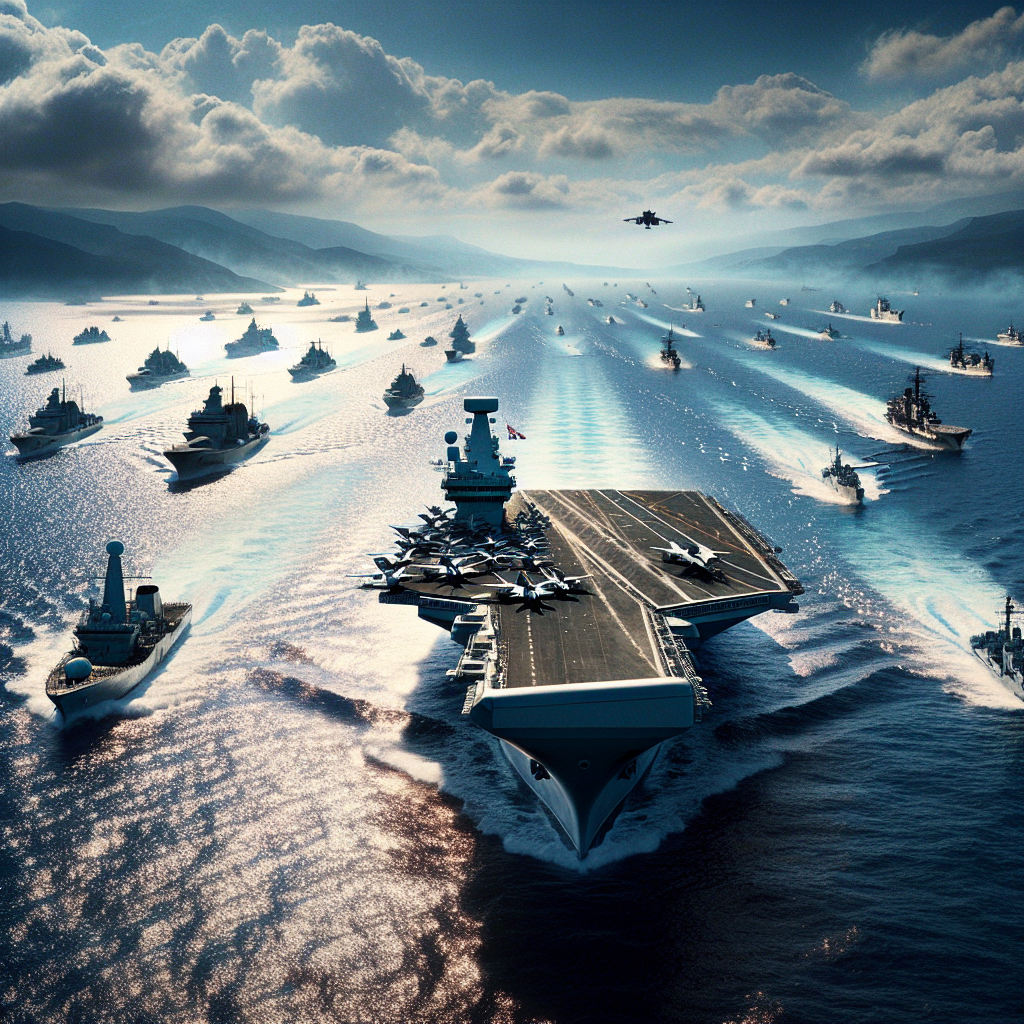
Britain’s largest aircraft carrier, the HMS Prince of Wales, is leading a large fleet through the Mediterranean Sea towards the Asia-Pacific region. This marks the second Indo-Pacific deployment of a British carrier strike group since the HMS Queen Elizabeth in 2021.
The carrier strike group will conduct joint exercises with different countries along the way, including the NATO exercise “Neptune Strike” in the Mediterranean, as well as the “Talisman Sabre” exercise hosted by Australia with about 20 countries participating. The group also plans to make port visits to countries such as India, Singapore, Malaysia, Japan, and the United States.
The redeployment of a British carrier strike group to the Indo-Pacific not only demonstrates the UK’s strong support for the United States’ Indo-Pacific Strategy but also underscores NATO’s determination to maintain peace and stability in the region. It shows international concern over China’s military expansion and its impact on freedom of navigation in the Indo-Pacific.
The HMS Prince of Wales, an aircraft carrier, departed from Portsmouth, England, on April 22 with ships from the UK and other NATO naval forces, including destroyers, frigates, nuclear submarines, and supply ships. The deployment, dubbed “Operation Highmast,” is expected to last about 8 months, covering exercises and visits to the Mediterranean, Middle East, Southeast Asia, Japan, and Australia.
Over 4,000 personnel from various countries are involved in the British carrier strike group, with 12 countries expected to deploy ships in different capacities. Spain and Canada, among others, will join the group at different times. Norway is sending a warship to participate in the entire deployment, demonstrating that while the British Navy leads the group, it is, in fact, a composite formation of NATO navies, highlighting NATO’s deep interest in the Indo-Pacific dynamics.
UK Defence Secretary John Hill said, “As one of the few countries capable of leading such a large-scale deployment, the Royal Navy once again demonstrates the UK’s strong and modern defense capabilities, ready to respond to current and future threats.”
The HMS Prince of Wales is the second ship of the Queen Elizabeth-class aircraft carriers, commissioned in December 2019. With a full load displacement of nearly 70,000 tons, it can carry 24 F-35B fighter jets, making it more potent than the HMS Queen Elizabeth.
However, the HMS Prince of Wales has experienced multiple malfunctions, resulting in several mission cancellations due to issues such as leaks. On October 12, 2022, the carrier had to return to the shipyard for repairs due to damaged propeller shafts, only resuming operations on July 21, 2023.
On April 28, 2025, the British attack nuclear-powered submarine HMS Astute appeared together with the aircraft carrier strike group in the waters off Portugal — © the UK Ministry of Defence.
Before entering the Mediterranean, the UK Navy’s HMS Astute attack nuclear submarine surfaced and posed for photographs alongside the carrier strike group. The Astute class submarine had participated in a similar Indo-Pacific deployment with the HMS Queen Elizabeth carrier strike group four years ago, showcasing the flexibility and range of these nuclear-powered submarines.
The HMS Astute, the lead ship of the Astute-class attack submarines, entered service in 2010. With a length of 97 meters and a standard displacement of 7400 tons, it is powered by Rolls-Royce’s PWR-2 pressurized water reactor, capable of a top submerged speed of 29 knots. Equipped with 6 torpedo tubes at the bow, it can carry a variety of torpedoes and missiles, making it versatile in mission capabilities from special forces delivery to anti-submarine and anti-ship warfare.
The Astute class submarines employ various technologies to reduce noise, featuring a teardrop-shaped hull design for minimal resistance and a pump-jet propulsion system instead of propellers. The Astute class is known as the “quietest” submarines in the British navy.
During this cruise to the Asia-Pacific region, Japan will dispatch warships and fighter jets to provide protection for the British carrier strike group under a military cooperation agreement reached in January. This marks Japan’s first provision of military protection for a European military force. Currently, Japan, the UK, and Italy are collaborating on the development of the next-generation fighter jet, the largest military cooperation between the two countries.
Before the HMS Prince of Wales carrier strike group’s Indo-Pacific deployment, the HMS Queen Elizabeth aircraft carrier had a similar mission in May 2021. The fleet includes two escort ships, two destroyers, two supply ships, one nuclear submarine from the UK Navy, and the US Navy destroyer USS The Sullivans, as well as one frigate from the Dutch Navy. The fleet’s deployment spanned 28 weeks, covering approximately 48,000 kilometers, engaging with over 70 contacts and exercises with 40 countries in the Mediterranean, Indian Ocean, and the Indo-Pacific region.
This marks the first long-term deployment of a British carrier formation to the Indo-Pacific region and the largest fleet deployed overseas by the Royal Navy since the Falklands War in 1982, drawing significant attention and criticism from China. When the British carrier fleet sailed through the South China Sea, the Chinese Navy deployed its aircraft carrier, the Shandong, to the area, leading to a standoff within just 580 nautical miles between the two fleets. Additionally, a Chinese-made Kilo-class conventional submarine covertly followed the carrier group but was eventually detected and driven off by the carrier battle group preemptively.