
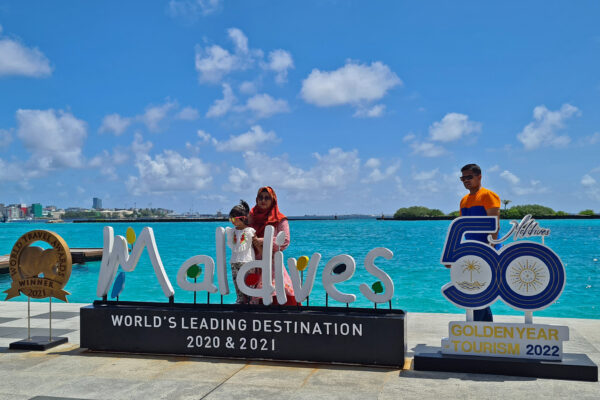
Located at the southern tip of India, the archipelago nation of Maldives scattered in the northern Indian Ocean has not only been known as a “paradise island” tourist destination but has also become a strategic location fiercely contested by India and communist China in the past decade. This is because Maldives sits on a crucial maritime route connecting the Middle East and Asia. This article will reveal some lesser-known aspects of the power play between India and Chinese influence in the Maldives.
Maldives, an Asian country comprised of nearly 1,200 islands with a land area of about 300 square kilometers and a population of over 500,000, the majority of whom are Muslims. Many of the islands in this nation are as small as a few football fields, surrounded by palm-fringed beaches and turquoise lagoons, making it a tranquil haven and honeymoon destination far from the hustle and bustle of city life.
The capital of Malé, located on the island of Malé, covers only about 2.5 square kilometers and has a population of 60,000. The island serves as a crucial military and transportation hub in the Indian Ocean. Indian officials have warned that communist China could potentially build facilities in Maldives to track maritime traffic or provide supplies to Chinese warships and submarines.
Over the past few decades, India has played a significant role in various aspects of Maldives. For example, India provides food and medical services for Maldivian civilians. Maldivian military and police officers receive training in Indian academies. In 1988, the Indian military helped Maldivian leaders thwart a coup attempt by Sri Lankan armed militants, and India has had a presence in Maldives for decades.
India supported activist Mohamed Nasheed, who graduated from Oxford University, in challenging the powerful Gayoom family that had ruled Maldives for a long time. When Nasheed and his Maldivian Democratic Party (MDP) won the country’s first competitive election in 2008, the Gayoom family and their supporters often criticized Nasheed as a nouveau riche backed by India and the West.
A descendant of the Gayoom family, Abdulla Yameen, became the leader of the political forces in Maldives opposed to Nasheed and the MDP. When Yameen was elected President of Maldives in 2013, Chinese influence surged in the island nation. According to The Washington Post, a cabinet minister of Yameen recalled in an interview that Yameen instructed his aides that China could help Maldives reduce its dependence on India.
In 2014, Yameen, as President, warmly welcomed Chinese leader Xi Jinping and his wife Peng Liyuan for a state visit to the paradise destination. The natural beauty of Maldives dazzled the Xi Jinping couple, and soon Chinese investments began pouring into the country.
China gifted Maldives a $200 million bridge connecting the capital Malé with the airport. Yameen’s close allies also benefited from the arrival of Chinese influence, as a probe by the Maldives Monetary Authority found that Chinese state-owned companies deposited $214,000 into the personal bank account of Yameen’s Housing Minister Mohamed Muizzu. Muizzu claimed the payments were from tenants renting his personal properties.
At that time, Xi Jinping’s Belt and Road infrastructure initiative was booming worldwide, sparking concerns in India about China’s growing influence in South Asia.
In 2017, Sri Lanka – a neighbor to both India and Maldives – leased one of its strategic ports to communist China for 99 years. Subsequently, Maldives appeared to be the next country entering into China’s orbit.
Former Indian Foreign Minister Harsh Vardhan Shringla told The Washington Post that leaders in South Asian countries “essentially play one off against the other and profit based on their relationship with Beijing or New Delhi.” Shringla said India often had no choice but to “try to match resources.”
During Yameen’s tenure, India significantly bolstered support for the MDP.
When Yameen imprisoned Nasheed, MDP leaders appealed to India to pressure Yameen. When Yameen refused Indian PM Modi’s plan to visit Nasheed in prison during an official visit to Maldives, Modi canceled his trip entirely.
In 2018, Yameen accused India of trying to overthrow him. He abruptly arrested his own police chief Ahmed Areef, who had received training in New Delhi. Areef was later released.
Three MDP insiders informed The Washington Post that in the summer of 2018, Indian officials helped MDP leaders arrange a private meeting in Sri Lanka. At Nasheed’s insistence, the MDP leaders decided to choose Nasheed’s mild-mannered cousin Ibrahim Solih as a competitor challenging Yameen for the presidency.
Solih won, and he declared “India First” as his foreign policy. India promptly provided Solih’s government with a $800 million credit line and a $400 million grant, overshadowing the aid provided to Yameen’s government by China.
Solih also allowed India to establish a helicopter base in Maldives and finalized an agreement with New Delhi to build and jointly manage Maldives’ first dedicated military port.
After his election defeat, Yameen launched the “India Out” protest movement, despite having signed some agreements with India during his presidential tenure. He also aligned with Islamic organizations supporting anti-Indian views.
In 2022, when the Indian Embassy in Maldives held a “Yoga Day” celebration, protesters waving flags stormed the event, claiming it was against Islamic teachings.
Abdulla Shahid, former Maldivian Foreign Minister and MDP Chairman advocating closer ties with India, told The Washington Post: “Whenever there’s an emergency, whenever Maldives dials ‘international 911,’ the first responder is always, always India. Maldivians should not forget this, but Maldives has always had strong waves of extreme nationalism alongside religious fundamentalism.”
In 2023, Solih faced a tough reelection campaign, with his opponent being the candidate carefully chosen by Yameen, Muizzu, while Solih didn’t have the support of former MDP leader Nasheed, who sought to regain power after his release from prison.
India intervened again. MDP leaders recalled to The Washington Post that the Indian Ambassador privately urged Nasheed to support Solih. According to Maldivian police officials and event photos, while tensions between Nasheed and Solih persisted, Indian officials flew in on an Indian military aircraft and engaged in persuading Nasheed at a secret meeting held at Kurumba Island Resort with the transponder turned off.
A current Maldivian Defense official told The Washington Post that by June 2023, Maldivian police and military intelligence increasingly monitored Indian activities. They learned that over a dozen Indians had flown in and booked a floor at the Mookai Hotel in Malé, supporting Solih’s election campaign through opinion polling analysis.
Nevertheless, Solih ultimately failed to win reelection. Nasheed ultimately did not support Solih as desired by Indian officials. Due to divisions within the MDP base, Muizzu was elected as the new President of Maldives on September 30, 2023.
In his victory speech, Muizzu declared, “God willing, we will withdraw all foreign military forces from Maldives.” He referred to expelling the Indian troops.
Upon ascending to power, official relations between Maldives and India plummeted. Muizzu continued Yameen’s strategy, expressing friendliness toward India’s regional rival – communist China.
To ease the strained relationship, Indian PM Modi embarked on a belated state visit to India in October 2024. In New Delhi, Muizzu praised India as a “crucial partner” for Maldives and expressed gratitude for the $700 million currency swap agreement to help avoid a default.
In a joint statement, the two governments reiterated India’s role in Maldives: India would help build and manage a naval port for Maldives, unveil a new Ministry of Defence headquarters, and continue training Maldives military and police.
A member of the ruling party of Muizzu told The Washington Post that there was never any need for India to pressure Muizzu using covert tactics, as Muizzu’s change of stance was “not out of fear” but “out of financial reality.”
Regardless, in the political power play over Maldives, India once again gained the upper hand. Meanwhile, Chinese financial prowess has waned compared to a decade ago. China is not only ensnared in domestic economic troubles but is also becoming increasingly isolated internationally, forcing China to scale back some of its expansionist ambitions.